LUBLIN, Poland–They may lead organizations significantly different in asset size, but the last 500 days for two credit union CEOs in Poland have been remarkably similar when it comes to learning how to pivot in the face of a war, how their employees and members are responding, what refugees really need, and why CU membership for those refugees is not the first priority.
In separate interviews with CUToday.info, the two leaders of credit unions that are approximately 275 kilometers apart spoke passionately about how they and their CUs have responded to the war on Ukraine by Russia and the more than 13 million refugees who hurriedly escaped the country, with some moving through Poland to other places and some since returning.
The interviews were part of a week-long tour of Poland and Ukraine’s CU communities arranged by the Via Stella Foundation, the joint effort by Polish and U.S. credit unions to raise funds for Ukrainian refugees in Poland and to assist Ukrainians themselves, such as by purchasing ambulances. CUToday.info documented a trip into Ukraine to deliver two ambulances here and documented how the Via Stella Foundation is supporting Ukrainian orphans here and women’s clinics here.
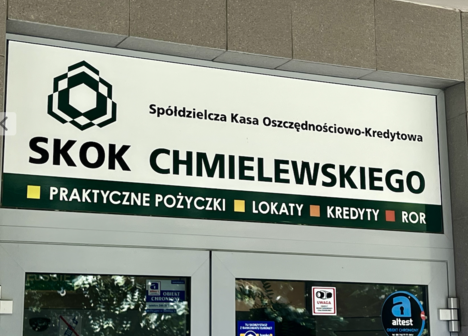
The main office of Skok Chmielewskiego.
‘It Was Very Unpredictable’
In Lublin, Poland, less than a half-day’s drive from the Ukrainian border, Bogumil Krzyszczak, president of Skok Chmielewskiego, said his CU and its foundation have been active in responding since the very first day of the war. The efforts have focused on two areas: helping the refugees in Poland who arrived and stayed—many of whom he believes will remain—and helping those affected in Ukraine.
“In the beginning it was very unpredictable,” said Krzyszczak recalling the early days when it was believed the Russians would soon overrun Ukraine and the conflict would then come to Poland’s borders. “No one knew how long this war would take and what would be the result. Millions of Ukrainian refugees came to Poland because our people opened their homes and our hearts. The children and women who came to Poland were under great stress. We started to organize help for Ukrainians from the very beginning. We started organizing aid. We took care of Ukrainian families. We provided meals. Our employees joined in the effort. They have collected (supplies and personal items) and dropped them off at reception points and bus stations.”
Surviving the Death of the Beatle
Skok Chmielewskiego was chartered in 1994 in the heady and enthusiastic early days of the resurrection of credit unions in Poland—indeed, it was organized and operating with three months of inception—and it has grown into the country’s second-largest CU. It began its life in a truck factory that produced vehicles called Beatles that were not related to the more famous model by Volkswagen. As western auto and truck brands arrived in Poland, the Beatle factor was squashed and closed.
Krzyszczak said the credit union knew it needed to diversify and it began opening branches in other factories and schools and in other regions. It now has more than 200,000 members and 100 branches. It has assets of 900 million Polish zlotys, which was $226 million in U.S. dollars on the day the interview was conducted by CUToday.info. It has 300 employees.
Ways it has Helped
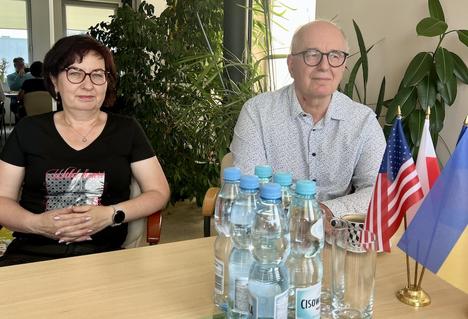
From left, Katarzyna Krzyszczyk, VP, and President Bogumil Krzyszczak.
The credit union has also:
- Worked with Caritas, a large Catholic relief agency in the country
- Purchased 43 power generators to date for Ukrainians who are often without power
- Purchased meals for Ukrainian children in Polish schools and committed to purchasing meals again in the new school term
- Considered hiring two Ukrainian refugees as employees.
“We believe they are well educated and when they go back to Ukraine they will take their skills and knowledge with them,” Krzyszczak said through an interpreter, adding that when the war is over Skok Chmielewskiego intends to play a role in helping Ukraine’s CUs to rebuild, perhaps by providing staff training and technical support.
He noted most Ukrainian credit union members are poor and will also need help.
Additional Assistance
During the credit union’s meeting with CUToday.info it shared a presentation in which it outlined some of the other ways it has worked to provide help, including:
- Allowing members to transfer funds free of charge, including to aid organizations
- Collecting donations from members that were donated to the Lublin branch of the Red Cross
- Participating in blood drives
- Offering first aid lessons
- Employees have led efforts to collect numerous items
- Its foundation has helped some people find employment, including one teacher in a private school that has Ukrainian refugee children where they attend free of charge and where they receive six lessons per week in the Polish language
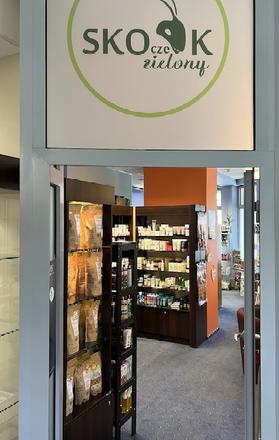
One of the stores owned by a subsidiary of Skok Chmielewskiego.
- Assisting Ukrainians with paying taxes
- Providing 32 school backpacks filled with “starter kits” of supplies
An Unusual Arrangement (By U.S. Standards)
And in one of the more unusual arrangements for a credit union, at least by U.S. standards, Skok Chmielewskiego has a wholly owned subsidiary (it would be a CUSO in the U.S.) that in turn operates a chain of convenience stores called Skok Zielony many of which are adjacent to its branches. It is donating a portion of the income from the stores to its charitable work. The stores do encourage people to become members of the credit union.
‘Nothing Good’
Krzyszczak added the hope is that with help from the United States and European Union, Ukraine will be able to defend itself, and that Russia “can forget” about ever having any influence over Ukraine.
“There is nothing good in a war at all, but maybe this can teach us something,” Krzyszczak stated. “In the history of humankind there have been a lot of wars and it seems we do not learn. Ukraine and Poland are very close and have a long and difficult history. It seems our futures will be similar.”
The president said he expects the U.S. and EU to eventually provide significant rebuilding assistance, and further anticipates that after the war the connections between Ukraine and Poland will only strengthen.
“We should be prepared for unpredictability. We should look for areas where we can help. The needs are enormous, and without our help Ukraine will fall.”
‘Part of our DNA’
For now, Krzyszczak downplays any strains all of the assistance to refugees and Ukrainians may cause the credit union.
“Our help is part of our normal activities,” he said. “It is not special for us. It has had no impact on our financial situation. We participate with many charities in giving aid to people. It is very special, but it is not unusual for us. Credit unions must provide hope. Helping is part of our DNA.”
When asked why there is little effort to turn those refugees who are receiving assistance into members of the credit union, Krzyszczak said it is not a priority.
“At first it was not a good time to become a member; it was not a first need,” he said. “There are also other formalities. The law requires that when making a loan we assess creditworthiness of the borrower, and that’s quite hard with the refugees. They often don’t have stable employment. (We will work with them) when they do become more stable. Then we can make them loans. We think in a year we will have a lot more members from Ukraine.”
The Government & The Banks
Rafal Matusiak, the president of the president & CEO of Poland’s trade association, the National Association of Credit and Savings Unions (NACSCU), who was at Skok Chmielewskiego at the time of the interview with CUToday.info, also noted that when the Ukrainian refugees began arriving by the millions the government provided special support through accounts at the nation’s largest banks, which in turn made those refugees customers of those institutions.
For now, Krzyszczak said his credit union will continue to do whatever it can, even as the violent world in which it operates has turned into something of a state of normalcy.
“I’m sorry to say we and Ukraine have become much more familiar with this and gotten used to this nightmare situation,” said Krzyszczak. “But we are trying to live like normal people.”
‘Arriving Around the Clock’
Four hours away in Bytom, Poland, a credit union that is considerably smaller has an equally large heart when it comes to the issue of refugees.
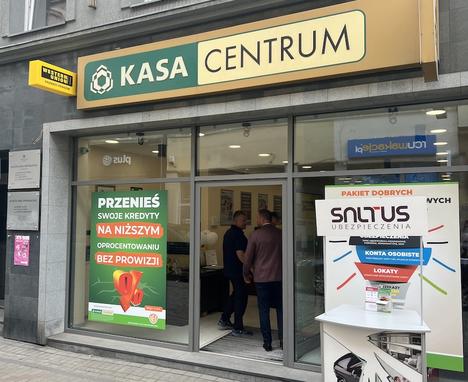
One of the offices of Kasa Centrum.
“Our members took action even before the war started,” said Lukasz Mowak, CEO of Kasa Centrum, which is in the Upper Silesia region in Southern Poland. “They got in their cars and drove to the border (to get refugees). They left leaflets and put up posters at the railway station. It was a very tense situation and it was very sad.”
According to Mowak, Ukrainians were “arriving around the clock” and the credit union helped to buy tickets, arrange apartments and work with members who helped to house the refugees.
“Sometimes it was one room, sometimes it was a whole flat,” he said. “We did everything we could to make them feel at home. I think it is the Polish nature to give a warm welcome. I think it’s in our hearts.”
‘Putin’s Troll Farms’
The CEO said when there have been problems it has been the result of “Putin’s troll farms,” which have created fake donation collection sites and fake news stories. Mowak said the credit union has offered information on how to distinguish between what is true and what is not, and has also supported the collection of supplies and money for refugees, along with other credit unions.
The group has coordinated to find beds and desks for kindergarteners, and worked with Scouting organizations—which have a strong presence in Poland and which Mowak described as deserving of “winning the wings; they are the angels of support.”
In addition, he said Kasa Centrum teamed with Visa to promote the talents of Ukrainian refugees via social media in an effort to find jobs, and also worked to get the Ukrainians their Polish identity numbers so they could access government services, schools and health care.
No Jealousy
Concerns over Ukrainians taking jobs away from Poles has not been an issue,
“I have never heard of any jealousy of people taking jobs. Poland needs the workers,” he said, noting many Poles themselves work in other countries in Europe.
Mowak said the credit union has worked with NACSCU and with the Via Stella Foundation and he is most proud of the project to purchase ambulances, which have been driven from Bytom to Lviv, Ukraine, which is 420 kilometers away.
According to Mowak, Kasa Centrum, which means “Central,” lacks the scale to add many of the Ukrainians as members, and it has referred some people to Kasa Stefczyka, the largest credit union in the country by far. He added the credit union’s core system also has some issues with entering data into certain fields related to the Ukrainians.
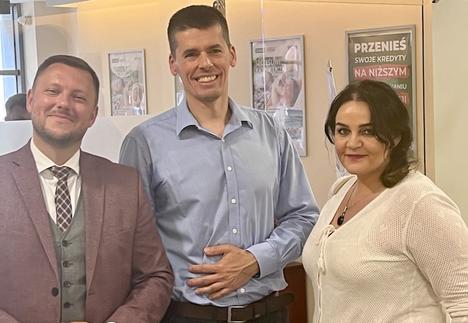
At left is Lukasz Mowak and at right is Ewa Wasylyk of Kasa Centrum. CUToday.info is working to confirm the spelling of the individual in the middle.
When asked why not more of an effort to bring the Ukrainian refugees into the credit union, Mowak noted that only 20% or so have any savings, and the bottom 30% have nothing at all. “They came directly from the fields that were destroyed by war.”
Mowak described the current situation as “stable,” with one exec at the credit union even saying 10 Ukrainians have already joined his mountaineering club.
Fears Shared by Many
Like everyone else with whom CUToday.info spoke in Poland, the staff at Kasa Centrum repeatedly thanked U.S. credit unions and the U.S. government for its assistance in responding to the war. And Mowak also repeated a thought expressed by just about everyone else CUToday.info spoke to in Poland, as well.
“Overall, our big enemy is that people have gotten used to the situation and the headlines are not shocking.”
Like others, he fears the war is going to continue.
“Everyone in eastern Europe is afraid of Russia. My heart would like it to stop quickly, but in my mind…I think it’s going to last.”
Talk turned of rebuilding, as far away as that may seem. And Mowak expressed insights into what under normal circumstances would never be part of the knowledge set of a credit union CEO, explaining that as soldiers in Ukraine are searching for the larger anti-tank mines, they are discovering that the smaller anti-personnel mines have been placed on top or in the area, and dying as a result.
That has contributed to the slow progress this summer in pushing Russia back.
One View of Banks
Mowak has been with the CEO of the credit union for nearly seven years—he began as a messenger--and indicated driving new asset growth is not his first priority. The 28-year-old CU has approximately $25 million in assets, and in a number that will catch the eye of any CU CEO in the U.S., it has 23 branches (it used to have considerably more).
He said Kasa Centrum offers all the services its members need, although it lacks a digital presence, but a 2018 overhaul of its operations did improve its decision-time on loans. The message to members, he said, is, “Take from the banks what the banks do well, and take from the credit union what we do well.”
The latter includes the appeal of being able to meet with the CEO, he added.
On the Wish List
Asked what’s on his wish list beyond the end of the war, Mowak said it would be business intelligence analytics. “We must do things better than bigger organizations. We think about this all the time.”
In addition, he said he is interested in additional cooperation with other credit unions, stating, “They are not our rivals. We must be together, we must grow together. To banks, we don’t exist. We must fight for our clients. “
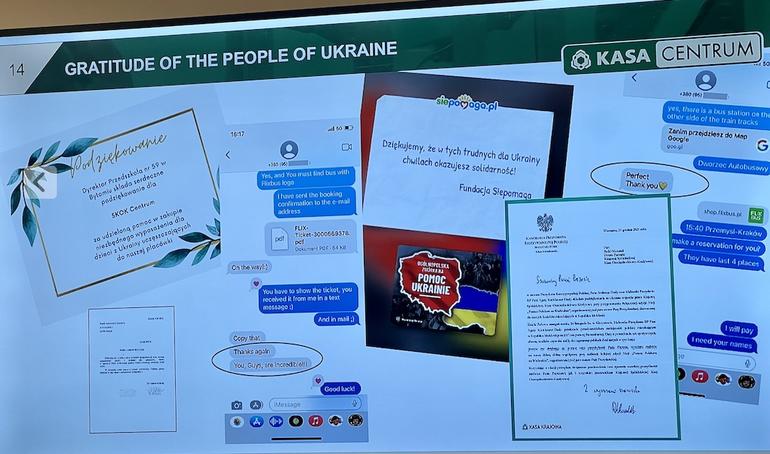
Below, thank you notes from Ukrainians to the credit union for its assistance.