

By Ray Birch
LAKE FOREST, Ill.—While auto lending is expected to hit the accelerator again in 2021, one economist warns it still could be a rough ride for the product.
Why the “check engine” light? Two reasons: An ongoing reduction in already low auto loan rates, which will further affect margins, and an expected crackdown by the CFPB on auto lending practices, which could lead to additional compliance burden.
“On the surface auto lending appears stable for 2021,” said Michael Moebs, economist and CEO at Moebs $ervices. “Yet there are two elephants in the room no one wants to recognize. Will rates continue to fall? Will regulation inflict costs and compliance woes?”
Moebs believes both factors will influence auto lending beyond 2021.
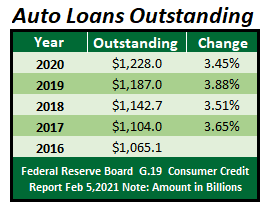
“The Great Pandemic threw financial services into turmoil, including the auto market,” said Moebs. “Yet, outstanding auto loans ended 2020 at $1.228 trillion. This is up $41 billion over 2019 and right in line with 2019 to 2016 in growth. However, total consumer credit is at zero growth for 2020.”
Moebs pointed out the Federal Reserve Board’s recently released Consumer Credit report shows auto rates declined for all financial institutions in 2020, while at the same time U.S. Treasury rates have been slowly on the rise.
Pressure on Margins
“Overall vehicle loan rates have been falling. This is starting to cut into net interest margins which are already thin from declines in home equity and credit card revolving lines of credit in 2020,” explained Moebs. “This Fed monthly analysis concentrates on the previous year and can set the tone for the current year. While many FIs do auto loans, credit unions—as we know—have a huge stake in the auto credit market.”
As CUToday.info reported, NCUA Chief Economist Andrew Leventis expects deposit growth to remain “elevated” but is not yet sure of the forecast, but is confident net interest margins will continue to be an issue and “significant threat.”
Following a “miserable” first half of 2020, the second half of the year was strong enough enough to drive positive gains in auto loans, said Moebs.
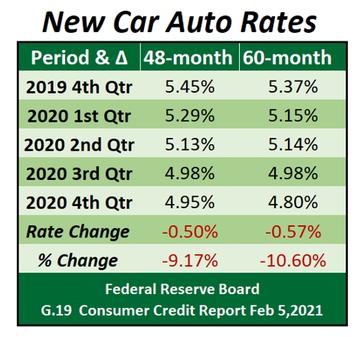
“The volatility in auto rates shows a difficult trend,” according to Moebs. “Forty-eight month loans are down 50 basis points for the year. This is a decline of over 9% for the year. Sixty-month terms show a 57 basis point decline, or over a 10% rate drop.”
Strategies to Consider
In light of this rate movement, Moebs suggested several pricing moves for auto lenders to consider:
- Go with the rate trend and use fees to buy down rates. “Loan fees can keep auto loan revenue up, especially with borrowers who are rate conscience and not fee averse,” said Moebs.
- “Use FICO scores as a process, not a loan tool, to attract more borrowers yet control default and payment risk,” said Moebs.
But Moebs believes the biggest uphill climb facing auto lending in 2021 is increased compliance demands, which will lead to more costs and even raise the potential for fines, as the CFPB under a new administration pays close attention to auto lenders for discriminatory practices—especially auto dealers.
Examples Offering Guidance
As an example, Moebs cited an action brought by the Federal Trade Commission (FTC) in 2020.
“In the matter of Liberty Chevrolet and Bronx Honda, FTC Commissioner Rohit Chopra, concluded his statement last year writing, ‘I hope that today’s action marks the beginning of more data-driven detection of discrimination and a systemic approach to protecting Americans from auto market abuses,’” Moebs said.
The reason the statement is of interest to credit unions is Chopra has been nominated to lead the CFPB.
In the FTC action, Bronx Honda and its general manager, Carlo Fittanto, paid $1.5 million to the Federal Trade Commission to settle charges of discrimination against African-American and Hispanic car buyers and for engaging in other illegal, deceptive practices.

Michael Moebs
“This was an appropriate action by the FTC. It signals a new direction at the CFPB under Rohit Chopra…The FTC action was initiated during President Trump’s administration and in all likelihood will continue under President Biden at both the FTC and CFPB,” Moebs said.
As CUToday.info also reported, acting CFPB Director Dave Uejio recently stated, the Bureau is looking to hire attorneys as it plans “vigorous oversight of all applicable federal laws and the fullest utilization of our legal authorities.”
Potential for Random Audits?
Moebs said lenders should be aware either the CFPB or the FTC could conduct random audits of auto dealerships and their finance and insurance personnel at unexpected times, as well as expect full adherence to all Truth-In-Lending and other related regulations.
Moebs advised credit unions to get close to their indirect auto dealerships to understand their loan decisioning processes and to make sure they are not discriminating against individuals.
“This is why everything with a dealer now should be done with emails,” Moebs said.
A Changed Lending Market
Moebs said the pandemic, at least for the foreseeable future, has changed auto lending.
“Unexpected audits of dealers and full observance of borrowers’ rights will become ways of life—like the mandatory wearing of seat belts on all vehicles,” said Moebs. “Margins will be narrower as borrowing rates fall and regulatory fines increase. Yet, auto lending and consumer borrowing will not go away, and if the steps suggested are followed auto lending can be more profitable for financial institutions and less costly to the buyer.”