

By Ray Birch
LAKE FOREST, Ill.—Given the turmoil in the banking industry and the complexity of what actually comprises capital, one economist is advising that a new metric needs to be used to better assess risk—“survival equity.”
Michael Moebs, economist and CEO at Moebs $ervices, told CUToday.info that new measures need to be taken to manage risk within the financial services industry. And Moebs believes it isn’t just new metrics, but higher insurance coverage limits that are also required, as are heftier penalties for organizations’ leaders who are guilty of mismanagement or fraud.

Survival equity, Moebs is positing, is more important than net worth in determining an FI’s ability to withstand a run on deposits.
Moebs asserted that financial institution capital has become so intertwined when it comes to measuring “tiers” of equity, from risk-weighted capital to regulatory capital, that it’s difficult to get a true picture.
“The calculation of what is capital has gotten so complex that the average depositor and stakeholder do not know how much is in reserve there is if something happens to the FI,” said Moebs. “Survival equity, in simple terms, is the amount of the reserve the FI has to pay depositors off. Taking survival equity and dividing by a common denominator—i.e. assets—is a good measure for people to understand. With the banking crisis revolving around deposit risk, grandma wants to know if her money is safe in a bank. Tell her to ask what the bank’s survival equity to assets ratio is, and 8% or more is what she wants to hear.”
Moebs asserted that current capital measurements “misrepresent” a depository’s balance sheet strength by excluding government guaranteed securities and boost ratios with intangibles.
“The entanglements complicate capital measurements and confuse stakeholders,” he said. “Survival equity is the only measurement for depositors and stakeholders to measure risk and for regulators to restore confidence in banking.”
Changes Needed
Moebs contended that changes need to be made today to reduce systemic risk in the system, given the new banking environment
“The risk is deposit runs and a lack of trust in the banking system,” he said. “Depositories never have enough actual physical cash. I have been involved with two bank runs when I was a banker and people panic. Trust is key.”
Another change that needs to be implemented, stated Moebs, is higher limits for insured deposits.
“Limits need to parallel inflation. It is now time for the federal government to sort out deposit insurance to stabilize deposits,” said Moebs, who shared an anecdote drawn from another country.
An Overseas Example
In 1988, the U.S. State Department sent Moebs $ervices to Kenya to teach pricing to C-level executives of building societies—equivalent to savings & loans in U.S. While the team was in the country, a bank run started. Of the 100 banks and building societies in the nation of 22 million, 17 went under, Moebs explained.
Moebs said the executives attending the Moebs $ervices Pricing Institute class were asked for their views on why the run happened.
“One CEO stood up and said not one representative from any of the 17 financial institutions that failed was in the room, and the 30 executives clapped,” recalled Moebs. “They all agreed fraudulent management was the primary reason. Within weeks, depositories and consumers in Kenya were back to normal. The United States can learn a lot from the rest of the world that does not have deposit insurance, and institute rules now to better regulate financial institutions,” stated Moebs.
A Look at What’s in Reserve
Currently the FDIC has $128.2 billion in reserve, while the National Credit Union Share Insurance Fund has $12.8 billion. As CUToday.info has reported, former NCUA Chairman Dennis Dollar recently noted that it would only take the failure of a few of the very largest CUs to put a strain on the CU insurance fund.
“The yearly price for this deposit insurances depends on the assessment of a depository base on capital, assets, management, earnings, liabilities and safety and soundness (CAMELS rating),” noted Moebs. “Generally, the insurance price is 0.03% to 0.40% of deposits. If a consumer keeps about $500 in their checking or savings, the yearly insurance cost born by the FI is between 15 cents to $2,” said Moebs. “Considering all costs, such as interest and non-interest compensation, the annual all-in insurance cost for a $500 checking or savings account is $16, or 1% to 12.5% of the yearly $500 deposit cost.”
Who Exceeds Coverage?
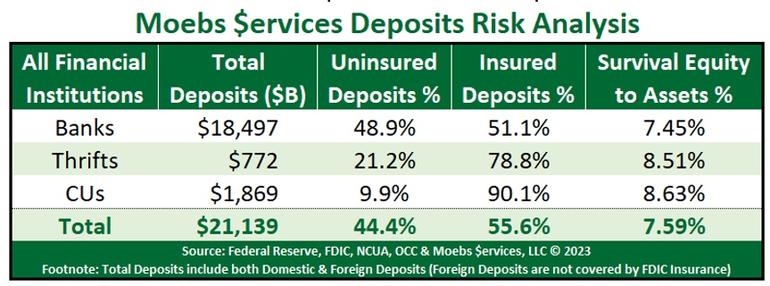
Moebs pointed out U.S. depositories had $21.1 trillion in deposits for 2022 (see table), including both domestic and foreign deposits. Banks had 87.5% of all deposits while credit unions 8.8% and thrifts 3.7%.
Credit unions also have the option of purchasing excess deposit insurance.
Approximately 55.6% of total deposits were insured, or $11.7 trillion. Uninsured deposits totaled $9.4 trillion, or 44.4%. Credit unions—as the industry was quick to note following the failure of several banks recently--lead the way with 90.1% of all deposits insured. Thrifts had 78.8% of their deposits insured, while 51.1% of bank deposits were insured.

Michael Moebs
“How much or how little of insured or uninsured deposits reflects a depository’s risk status,” suggested Moebs. “The Silicon Valley Bank, Signature Bank and Silvergate Bank were risky banks. The key is to communicate the risk to the depositor, investors, and owners. In Kenya in 1988 the vast majority knew the risky depositories.”
4 Measures of Risk
Moebs said there are four things, in addition to survival equity, than can assess an FI’s risk:
- “Excessive concentration of 30% or more of assets is another risk indicator. Examiners use the balance sheet rule of no more than 30% concentration of a specific loan, investment, or deposit category to flag risk,” said Moebs. “This rule is possibly used to affect the examiners’ CAMELS ratings, too. A firm, unchanging concentration percentage rule needs to be established and strictly adhered to by regulators. Strictly means a CAMELS 3 or higher, as well as enforcement action such as civil and criminal penalties. This follows the guidelines used to operate a motor vehicle for excessive speeding and drinking, why not banking?”
- “Deposit Insurance has gone from $2,500 when it started in 1933, with seven changes to $250,000 in 2008 during the Great Recession,” noted Moebs. “One solution is to increase deposit insurance with inflation adjustments which according to the Minneapolis Federal Reserve Bank Inflation calculator would move the amount to $340,000.
- “Is inflation a measure of deposit insurance risk? Doubtful, yet pragmatic for the small depositor,: he continued. “Should uninsured deposits exceeding the $250,000 limit and foreign deposits be covered by deposit insurance? Yes, as it eliminates risk of bank runs yet opens the door to fraud and mismanagement. Yet, strict CAMELS measurement, large civil penalties, and prison terms would close this door.”
- “Systematic risk of a single financial institution needs detail clarification. An easy way to measure this risk is to define any FI above the economy of scale (EOS) as a systematic risk,” offered Moebs. “Why EOS? As a FI grows beyond the EOS, they enter a diseconomy of scale. Growth is not as important as efficiency of performance, measured by employees per million of assets to net income, which is the source of survival equity. EOS was diagnosed over 25 years ago, and its accuracy is over 96%. It is the key factor in stress testing a FI.”
Like Requiring Seatbelts
Like mandatory seat belts, the consumer wants deposit insurance, concluded Moebs.
“Deposits have risk. Measuring the risk can be done analytically with proper equity, asset/liability concentration, amount of deposit insurance, and the economy of scale,” offered Moebs, who believes the risk, or lack of it, and institution represents should be easily communicated with depositors and stakeholders. Transparency of risk without revealing CAMELS is absolutely essential,” said Moebs. “Stopping behavior actions of fraud and mismanagement is just about impossible, but large fines and prison terms will curtail the conduct.”