

KYIV, Ukraine–The CEO of a credit union in Ukraine—who has employees fighting on the front lines of that country’s war with Russia–shared with credit unions around the world an update on events in Ukraine and at his credit union during a webinar hosted by the World Council of Credit Unions on International Credit Union Day.
How tenuous is the situation his credit union faces? It was noted in the introduction to the webinar that participation by Viacheslav Vitiuk, CEO of Credit Union PVKS, could be interrupted at any time should a Russian missile or drone strike knock out electricity.
Vitiuk participated in a Q&A with Greg Neumann, director of communications with WOCCU. Vitiuk spoke in Ukrainian and his comments were translated into English for participants in the WOCCU “EMPOWER” webinar, which featured presentations from multiple continents.
Here is what was discussed:
Neumann: How safe is it there?
Vitiuk: It is hard to tell where the safest spot is. Today, we are safe.
Neumann: In the early days of the invasion, when your members were nervous, you created a special reserve fund. Why?
Vitiuk: We call it a reserve fund, which was diversified and we placed that in different banks to ensure the stability of the credit union in case we needed to pay off deposits, because many people panicked. Actually, it worked in the opposite way. People felt safer and felt stability, and we managed to avoid the panic. We use this fund as a back-up fund.
Neumann: You made a decision to resume agricultural lending through (World Council’s) CAP program. Is it true that was due in part to needing to get more food into local grocery stores?
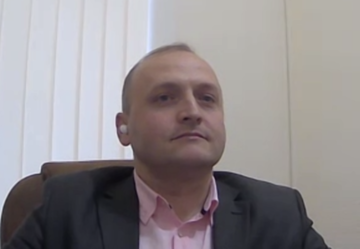
Viacheslav Vitiuk addressing WOCCU webinar.
Vitiuk: Despite the terrorist acts committed by the Russian Federation, the local people and farmers had to continue sewing and working the land and, obviously, logistics was disrupted, there was a lack of food stuffs, and we lost some territories in the east and the south. That affected the whole country.
It also affected the number of refuges and therefore, demand grew. So, farmers had to increase the size of their herds and the land they sew and plow, and that required additional financial funds. Therefore, our assistance offer was very timely and people really appreciated that.
Neumann: How did the CAP Project assist you and what does it mean to local farmers to have this kind of support?
Vitiuk: For farmers, this assistance meant quicker decisions, access to funds, loans, additional assistance to local people for covering expenses for fuel. All of that helped them as a package, plus it encouraged them to work and it gave them peace of mind. It gave them more confidence at a time when that confidence was lacking.
It is due to many years of cooperation with the CAP project that we were able to approach our cooperation with farmers in a different way. Due to training we went through and the support, we were able to understand the needs of the farmers a lot better, and therefore our assistance was more targeted and of a higher quality. We now understand and know a lot more about the farmers and can be of greater assistance to them.
Neumann: You didn’t just empower people through the functions of the credit union, but also through humanitarian assistance. Can you describe that?
Vitiuk: The essence of the credit union is closely linked to the social side. From the very first day of the aggression, we quickly changed our activities to support the refugees. We created what we call a humanitarian hub, where people could find assistance, shelter and food. It also entails support, especially for children who are living under very, very difficult conditions.
Neumann: Your employees have not stopped working. Carrying on during a war must be difficult. Have you provided assistance to them?
Vitiuk: The war in Ukraine has touched pretty much everyone regardless of where the front line is. Some of our staff are actually fighting the Russians at the front, and some have relatives fighting.
Emotionally, it’s hard. We are trying to create a tightly knit team that is highly resilient. The CAP Project also helped us to involve a professional psychologist. That was very important. He helped many of our staff members. He taught them how they can help their colleagues here in the office. We are really grateful for this opportunity.
Neumann: Prior to 2022, International Credit Union Day in Ukraine was always a joyous celebration. What is it like this year?
Vitiuk: Unfortunately, today is really not a festive mood. The war changed all of that. We did congratulate our members, those who stopped by today. But we are confident that after our victory we will be able to catch up, so to speak, and move on.
For information on the Worldwide Foundation’s Ukrainian Credit Union Displacement Fund, go here.