


RANCHO-CUCAMONGA, Calif.—This week marks the beginning of a new chapter for CO-OP Financial Services, as Stan Hollen retires as president/CEO and Todd Clark steps in.
Clark takes over a CUSO that has grown into a significant presence in the credit union community. During Hollen’s 11 years at the controls, CO-OP grew from serving 1,800 CUs to more than 3,500 even as the industry consolidated, tripled the number of annual payment transactions (3.2 billion today), and evolved from being largely an ATM and shared branch network to a company that now also provides financial, marketing and technology services.
Hollen spoke with CUToday.info about his career at CO-OP and in credit unions—which spanned 45 years, starting with Hollen being a member of a credit union board at the age of 19.
CUToday.info: Would you agree credit unions have been your life?
Stan Hollen: Yes. I’d say that is right. I was on the board of a very small credit union that served employees of the Joan of Arc food company, about 100 miles south of Chicago. I was in junior college for computer programming. The CFO of the credit union knew my dad, who ran the local railroad station. They asked me to do part-time programing for them. Then, they asked me to be on the board. It was 1969 and the credit union had maybe $800,000 in assets. I attended three or four meetings before I moved on to attend Eastern Illinois University.
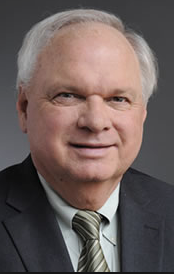
Stan Hollen
CUToday.info: What did that time on the board do for your interest in credit unions—did that plant a seed for your future?
Hollen: It might have. But what I am sure it really did was plant a seed for my interest in going into banking. My undergraduate degree at Eastern was finance. My MBA concentration was accounting. When I graduated from Eastern I was the lead programmer for the university, and I interviewed with many companies. I interviewed at Caterpillar Tractor in Peoria, Ill., and across from Caterpillar was First Federal Savings and Loan.
This was before the S&L crisis and First Federal was respected. I had to finish an MBA paper by interviewing a financial institution executive. So I walked over to the S&L and asked if I could interview the CFO. When I was there, I filled out a job application for the heck of it. And when I interviewed the CFO two weeks later they liked me and hired me.
I worked on systems programming, and First Federal had a processing platform that served more than 30 financial institutions, one of them being Caterpillar Employees CU. I worked for a year on the project, to write a new system for the credit union. The credit union, which eventually became CEFCU, asked me to come work for them, which I did for about 10 years, from 1973 to 1984, leaving as a vice president.
CUToday.info: You left CEFCU for a job at Deloitte Haskins and Sells (now Deloitte) in Chicago, where you became a CPA focusing on financial institution practices.
Hollen: Yes. I helped write the first AICPA Credit Union Accounting and Audit Guide. It was really interesting, because I researched and wrote the language that defined shares as a liability. Up until then, most credit unions considered shares equity. That was a controversial change. But it was simple to me: Who owns the shares? It’s the members, not the credit union, so shares are a liability. We also created a monitoring methodology for credit unions in Illinois, which, interestingly, later became NCUA’s CAMEL rating system.
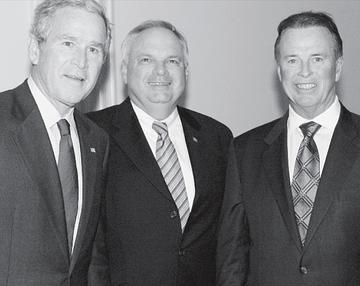
President George W. Bush greets Hollen (center)
CUToday.info: You moved on to take the job in 1984 as president/CEO of The Golden 1 Credit Union in Sacramento, Calif., and then left for Liberty check printers in 2002. You took your final job at CO-OP in 2005, were you remained for 11 years. In all your time working in and with credit unions, how do you feel they have managed their industry?
Hollen: Extraordinarily well. The central strength of credit unions is cooperation—forming entities like CO-OP or PSCU. Credit unions, even the biggest, realized they were small compared to large banks, and CUSOs gave them the ability to band together, connect their ATMs, share branches, those sorts of things.
I think credit unions have managed well, and managed their business much better than community banks have. Community banks just don’t share among each other.
Credit unions, too, have simply elevated themselves over the years. The levels of professionalism, expertise and knowledge inside credit unions today are light years from where they were in the ’80s. There are a lot of really capable people in credit unions, and a lot of very capable people are coming to CUs from outside the movement today.
CUToday.info: You say CUs have managed well, but can you point out where they have excelled and where they may have fallen short over the years?
Hollen: When it comes to payments, credit unions have excelled in the traditional areas, like ATMs, credit and debit. We are probably on par with community banks with home banking and bill pay. As an industry we are behind the curve on mobile and integration of mobile with home banking.
We are still more active on Apple Pay than community banks. But when you compare the movement with the large banks—they have such deep pockets, are acquiring companies and building systems.
That why it so important, even for CO-OP that represents so many credit unions, to find the right strategic partner to align with and use our bargaining power to get the best deal we can.

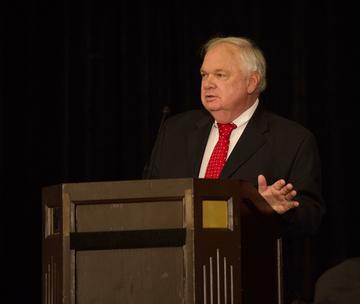
Hollen is proud of his involvement
with Children’s Miracle Network Hospitals
CUToday.info: With more daily transactions shifting from the branch to mobile, some analysts fear credit unions will lose their key advantage over banks—personal service—in the move to digital banking.
Hollen: I am not worried about that. It’s lending, opening new accounts, investment and advisory services that consumers will still turn to branches for. Study after study shows that, and even Millennials still want a branch. They may not go to one very often, but they want to know one is there.
CUToday.info: What is ahead for credit unions?
Hollen: We will see continued consolidation, which is a prediction that will surprise no one. But in addition to the small credit unions merging out, we will begin to see more mergers of large credit unions, due to the desire to gain economies of scale, pool talent and address CEO retirements
I think we will see considerably more consolidation of state trade associations as they too seek economies of scale and to reduce administrative costs.
CUToday.info: Will CU consolidation hurt membership growth, which has been setting records in recent years?
Hollen: I don’t see that happening. Most credit unions are now either community chartered or have pretty open fields of membership. That will ensure continued strong membership growth. There may be a smaller number of credit unions, but access to credit unions won’t suffer. Plus, when a credit union merges out, their members come with them, and generally enjoy more services and even better service.
But the challenge with all this growth is to be the PFI. It’s one thing to belong to the credit union, but what are all those new members really doing for the credit union?
CUToday.info: Other challenges ahead for CUs?

Hollen (second from left) is an avid golfer
Hollen: It is critical that credit unions communicate what credit unions are and the advantages that come with them. But that is not easy. Credit unions communicate with the community all the time, but are they effectively reaching people with their messages? I can’t say how many times I run into friends and neighbors who tell me they never considered joining a credit union or did not realize they could join. Most people have always been with a bank and are pretty apathetic when it comes to financial institutions. You have to really mess up someone’s account and make them mad to get them to switch. In many cases, when someone changes over to a credit union it is because a friend or relative said they belong to a credit union and told them about the advantages.
CUToday.info: You believe strongly that every consumer should be doing business with a credit union?
Hollen: Absolutely. From what I have seen and lived, credit unions in almost all cases act with the members’ best interests in mind. There is no selfishness and a ‘what’s in it for me’ thinking. I don’t see this in the community banking sector at all. Credit unions are a different calling. It gets into peoples’ blood.
CUToday.info: Will consolidation of many small CUs hurt credit unions in the long run?
Hollen: No. There was so much fear a decade ago, and I still hear it, about the small credit union going away and with them goes our tax exemption. This is not really about small credit unions holding the line for the movement, so to speak. It’s about the fact we are all cooperatives. I think if we continue to tell the story that we are cooperatives, our tax exemption won’t go away. That is why Congress created credit unions, to offer consumers an alternative to big banks—an alternative that is tax exempt. Even the very largest credit union is still a cooperative. I think there is a great, rosy future for credit unions.
CUToday.info: Even for the $100-million CUs? Can they survive?
Hollen: The $100-million credit union can certainly survive. The $25- to $30-million CU can survive as well. However, it has become so burdensome for them from a regulatory standpoint. Their regulatory expectations are virtually the same as a billion-dollar credit union. CEOs of $30-million credit unions wear so many hats. They are really well-rounded leaders who do a lot of things well and are extremely talented. These CEOs, and their credit unions, are not all going away.
CUToday.info: You have emphasized performance excellence at CO-OP and the CUSO has grown and supported CUs well under your leadership. How do you describe the organization as you head out?
Hollen: We have done extraordinarily well. It has been nice to see the financial success and growth of CO-OP. We have an outstanding management group and staff. We have not had the kinds of turnover you’ve seen in other CUSOs. It’s a solid group of people who network very well and are known in the industry. That bodes well for the change in leadership we are going through now.
I have expected a lot out of the team, and I gave them a lot of freedom and opportunity to achieve their objectives. I think they enjoy what they are doing and genuinely like working together. I think it is nice to see that level of loyalty and commitment.
CUToday.info: What stands out to you about credit unions as you look back?
Hollen: A lot of great people, many I have been privileged to get to know. Maybe this is true in many industries, but in the credit union movement there are a lot of very nice people. And you get to know them over the years and they have become my friends. Like any industry, it’s about the people, not the operations or bricks and mortar.
That is one interesting thing you realize when you retire. I am not disappearing and the people I know within credit unions are not disappearing. But the fact is I won’t be going to annual meetings and conferences, so I won’t see them nearly as often. That is what I think I will have to adapt to most in retirement.
CUToday.info: What’s ahead for you in retirement?
Hollen: I will be on two to three boards. I have been asked to do some consulting, but I don’t think I want to do that, certainly not in the foreseeable future. When you retire you’re supposed to let go of things.
I will have a lot to do. My wife and I are building a new home in Minnesota on a lake not far from my current home. We have a house in Florida we need to get ramped up for this winter, and we are selling our home in California.