

LAKE FOREST, Ill.—Just as the Federal Reserve announced another rate 25 BP rate hike Wednesday, one economist says the Fed needs to lower the rates it pays on excess reserves to encourage financial institutions to make more auto, mortgage and commercial loans.
“If the Fed would lower what is paid on excess reserves, banks and credit unions would move that money to auto loans, mortgages, and commerical loans,” said Michael Moebs, economist and CEO of Moebs $ervices. “Loans have a multiplier effect, and a dollar loaned gets spent many times. This means the economy would get fueled by moving these excess reserves to encourage consumer and business spending.”
The Fed Wednesday moved up the key borrowing rate to a range of 2.25% to 2.50% — the highest level in a decade.
Two Reserve Types
Moebs noted there are two types of reserves.
“Required reserves is money a depository must keep in their vault as cash or at the Fed,” said Moebs. “Required reserves range from 3% to 10% of the total checking account balances at a depository. Then there is money left in excess of what is required—this money is called excess reserves.”
Moebs said excess reserves are just like extra money a family keeps in a savings account in case of an emergency.
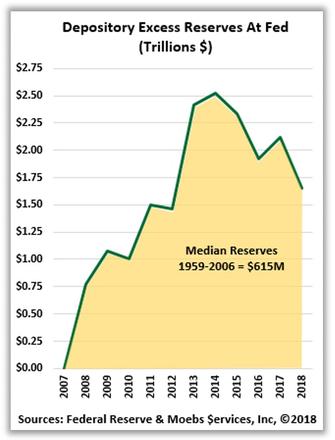
“Normally excess reserves are $615 million, the median amount kept at Fed by depositories from 1959 to 2006, before the Great Recession in the Fall of 2008,” noted Moebs. “Yet, depositories are keeping at least $1 trillion more than necessary. A big motivation is the Fed is paying 2.25% on the excess reserves.”
Powell Under Pressure
Moebs said new Federal Reserve Chair Jay Powell is under a lot of pressure.
“Those stoking the pressure cooker are the White House, auto industry, mortgage industry, pension funds, and the stock and bond markets. Each of these groups want no more rate increases—viewing rate increases as hindering economic expansion,” said Moebs. “Yet, the solution is simple. Banks, thrifts and credit unions are holding $1.6 trillion in excess reserves at the Fed. The Fed can move a trillion dollars of this money into the economy, and keep increasing rates to keep inflation down and employment high—the mandates the Fed devotedly follows.”
Mobes said Powell and all the governors of the Federal Reserve have said they need to get interest rates back to normal, so they can use their price tool—interest rates—properly.
“If this is what the Fed wants, then let them keep increasing interest rates, as they just did,” said Moebs, “but not on excess reserves. Lower rates paid for excess reserves to let more money flow from banks and credit unions in the form of loans.”