

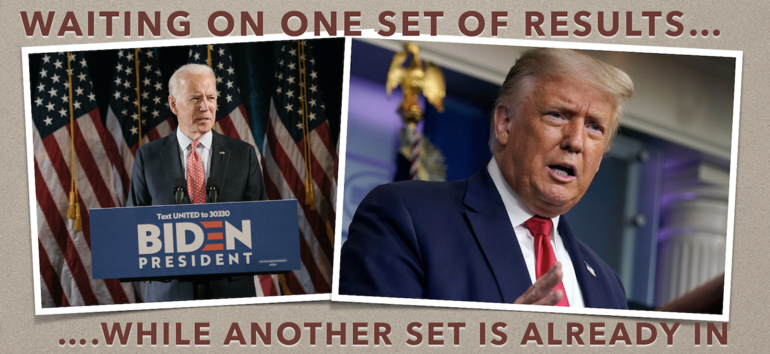
WASHINGTON–Credit unions have joined with the rest of the country and the world today in watching what every media outlet seems to be calling a “nail-biter” of a presidential race between President Donald Trump and Democratic challenger Joe Biden.
The outcome of the race hinges in large part on yet-to-be-released results in several states, including Georgia, Pennsylvania, Michigan and Wisconsin. Overnight, Trump said he planned several different legal challenges to certain votes. Note to readers: CUToday.info will be regularly refreshing this reporting.
But the presidential race isn’t the only one that has credit unions’ attention. CUNA, its PAC and the state leagues also invested more than $7 million in congressional races across the country to back “pro-credit union” candidates. Its Congress that is most likely to have a more direct effect on credit unions over the next two years than will whomever is elected president.
The election results will affect everything from the legislative priorities of all the various committees and which legislation eventually makes it to the president’s desk—where it could die or be signed into law depending on who is sitting in the Oval Office—to who serves on the NCUA board, including as chairman, to what takes place during the lame duck congressional session following the elections.
As of this reporting, it appears the House will remain under Democratic control, while the Senate had 47 Republicans and 46 Democrats, with a handful of races to still be decided.
Close Races
Heading into the elections, both CU trade groups were watching a number of Senate races particularly closely. Among them:
- In Alabama, Republican challenger Tommy Tuberville defeated incumbent Democrat Sen. Doug Jones
- In Arizona, Democrat Mark Kelly defeated incumbent Republican Sen Martha McSally
- In Minnesota, Democrat Sen. Tina Smith defeated her Republican challenger, Jason Lewis
- In Michigan, Sen. Gary Peters (D) was trailing Republican challenger John James, although that race has not yet been called
- In Montana, Sen. Steve Daines (R) has defeated challenger Steve Bullock.
- In Maine, Republican Sen. Susan Collins holds a lead over challenger Sara Gideon.
The $7 million spent by CUNA and its political action committee, the Credit Union Legislative Action Council, along with the state leagues backs some 411 candidates in the effort to support a “pro-credit union majority” in Congress, according to Trey Hawkins, CUNA’s deputy chief advocacy officer.
Those funds have been roughly equally divided between Republican and Democratic candidates, Hawkins said.
Of that $7 million, $3 million has gone to 11 especially tight House and Senate races involving “credit union champions,” CUNA reported.
Among those champions:
- In Maine, Rep. Jared Golden (D) is leading Republican challenger Dale Crafts
- In Nevada, Rep. Susie Lee (D) is leading republican challenger Dan Rodmer
- In Ohio, Rep. Steve Chabot (R) defeated Democratic challenger Kate Schroder
- In Indiana, Rep. Ron Bacon (R) has won reelection
- In New Jersey, Andy Kim (D) defeated Republican challenger David Richter.
- In New Mexico, Democrat Rep. Xochitl Torres Small, who had the backing of credit unions, lost her race to Republican Yvette Herrell.
The Lame Duck
As CUToday.info reported earlier, among the key issues in the short term for credit unions is what might occur during the upcoming lame duck session of Congress. Credit unions are hopeful that some bipartisan legislation, such as long-sought relief and improvements in BSA/AML, might make it through the final session of the current Congress.
The NCUA Board
As CUToday.info also reported, also hanging in the balance is the future of the composition of the NCUA board. J. Mark McWatters has been serving on the board since 2014 and his term has expired. In July, McWatters even offered some parting remarks, as CUToday.info reported here.
But four months later McWatters remains on the board, as no vote has been scheduled on his replacement, Kyle Hauptman, who has already been through a confirmation hearing. It’s possible Hauptman might not join the board should a vote not take place in the Senate.
Stalemates?
If Hauptman’s nomination is approved, it could create an NCUA board scenario in which the chairman is the minority member. If Biden is elected president, he could elevate board member Todd Harper to chairman, replacing current Chairman Rodney Hood, who is a Republican appointee.
While Harper might find himself at a 2-1 disadvantage on the board, the NCUA chairman does control the board agenda.
In that case, said Hunt, it could be similar to the two-person NCUA board the agency operated with for some time when McWatters was joined by former Board Member Rick Metsger, a Democrat. The McWatters/Metsger board earned a name for actually accomplishing quite a bit, as nothing could move forward unless there was agreement first.
The other option, observed Hunt: “A lot of stalemates.”
Another Complication
There is also another complication. Harper’s term is set to expire in the Summer of 2021. That status could affect negotiations around future NCUA board members, said Hunt.