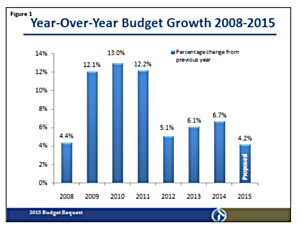
ALEXANDRIA, Va.—In a 2-1 vote last week, the NCUA board approved its 2015 budget, a 4.2% increase over 2014.
But it’s the 50% increase over where the agency’s budget stood just five years ago that has sparked debate among not just credit unions and their trade group, but the NCUA board itself, with the Board Member Mark McWatters not just casting the dissenting vote but saying he was “dismayed” at the budget and the budgeting process.
Below, CUToday.info offers an overview of all the issues surrounding the federal agency’s budget, the views of members of the NCUA board, the views from the trade association, and the viewpoints of six different CEOs.
The Budget
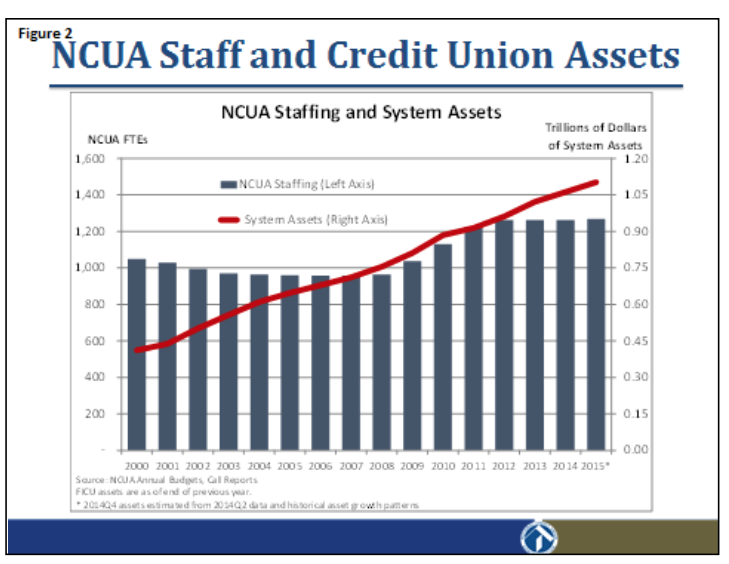
NCUA’s 2015 budget is $279.4 million, representing 1,268 employees in its headquarters office, its five regional offices and Asset Management Assistance Center. The budget increase for 2015 represents the addition of 4.2 positions, with the agency reallocating existing staff positions to greater specialization in capital markets, real estate, business lending, and IT/cyber-security. Seventy-two percent of NCUA’s budget goes to salaries/benefits and travel.
During the recent board meeting at which the budget was approved, NCUA Chairman Debbie Matz said the budget “ensures we have the resources to do our jobs…in a manner that is efficient and that recognizes that our operating costs are borne by the credit unions that we regulate and ensure...I know there will always be those who argue that NCUA should cut the budget. Cutting the budget is not an option.”
Specific line items in the 2015 budget include: employee pay and benefits, up 3.7%; travel, up 2.7%, rent/communications/utilities, up 2.8%, administrative, up 6.1%, and contracted services, 8.5%.
The agency’s retiring CFO, Mary Ann Woodson, said a “deep dive” on benefits usage helped to cut $650,00 in those costs.
More details on the NCUA budget can be found here and here.
Size of Budget Vs. Number of CUs
One argument made frequently is that with the number of federally insured CUs now below 6,400, the agency’s budget should reflect the smaller number of institutions that need supervision.
NCUA’s response is three-fold: the smaller number is made up of larger institutions with more sophisticated balance sheets; a previous reduction in examination staff resulted in huge losses to the insurance fund, and NCUA is much more efficient than other federal regulators.
“This agency made the mistake of cutting staff in the years leading up to the recession, cutting 71 FTEs between 2001-08, and we expanded to 18 months the time between exams,” said Matz, referring to reductions made under former NCUA Chairman Dennis Dollar, who championed “regulatory flexibility,” or “reg-flex.”
“The result was the agency was unable to identify many credit union problems early enough to save the losses,” said Matz. “This budget is designed to ensure expertise keeps pace with credit unions expanded risks.”
In remarks at the recent board meeting, Vice Chairman Rick Metsger focused on the efficiency of the agency, compared with other regulators, and also said the board has routinely rejected requests from staff to hire more people.
Noting NCUA insures 6,350 CUs with 1,268 staff and a $279-million budget, Metsger said, “In 2014, one of our sister agencies insured 6,656 financial institutions at a cost of $2.391 billion, administered by 7,199 employees…NCUA is 8.2 times more efficient per dollar spent, and 5.5 times more efficient per employee.
More of Metsger’s statement can be found here.
The 'Transparency' Debate
“Transparency” has become the most popular buzzword du jour when it comes to criticism of NCUA’s budget, with both CUNA and NAFCU arguing that the agency should be providing more information on how it arrives at its budget numbers. Some have argued that “transparency” is really a code word for the trade groups wanting to have more say on the budget.
“While NAFCU appreciates NCUA Chairman Matz's commitment to greater transparency, we believe that NCUA can do more to achieve even greater clarity in the budgeting process," said Berger. "The agency has not held a hearing on its budget in over five years and it does not currently publish detailed financial breakdowns for its various funds."
For more on the trade groups’ view of the NCUA budget, go here.
That NCUA isn’t “transparent” with its budget is a point with which Matz takes particular umbrage.
Matz has argued NCUA is a leader in budget transparency among federal agencies, and that the agency now discloses far more information than it has in the past, including detailed expenses from all of its offices. Matz said the agency is also preparing to post four “fact sheets” related to its development process, its Information Technology Prioritization Council (which was created by Matz to weigh cost/benefits of all IT), its procurement process, and its efforts at transparency.
“Our budget process is extremely transparent,” said Matz. “I challenge anyone to point to any other federal regulator that provides as much or more information that we do.”
The Demands For Changes
Both CUNA and NAFCU have demanded that the budget process not take place behind closed doors. NAFCU CEO Dan Berger, for instance, called on the NCUA board to “look at each line item of the budget with the explicit goal of achieving cost-savings.”
CUNA also raised concerns over what it called a lack of a systematic process for credit unions to provide input on the budget, and complained there is no public information provided on how the NCUA's resource allocation helps to accomplish the agency's strategic goals.
More specifics on what the trade groups are seeking can be found here.
The Divided Board
The icy divide on the NCUA board between Matz and McWatters was more than apparent during the Nov. 20 board meeting when McWatters not only said he was “dismayed” over the NCUA budget process, but then proceeded to outline the reasons for his dismay, while sparring with Matz on several other issues. Matz and Metsger are Democratic appointees to the board, while McWatters is the Republican appointee.
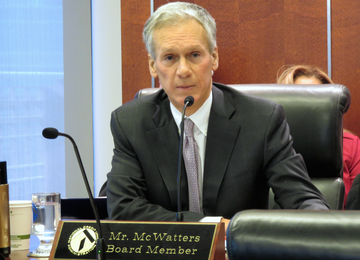
NCUA Board Member Mark McWatters.
For example, after Matz noted that NCUA is far more “efficient” than the Fed or FDIC, McWatters said, “I don’t think I am held to a standard by what the FDIC or the Fed does.”
Later, referring to Matz’s reference to “regulatory capture,” McWatters termed that “absurd,” and went on to suggest credit union and trade group representatives be allowed to offer input during board meetings on the NCUA budget. “
That led Matz to counter, “I strongly disagree. In years where there were public hearings there was an effort to keep our budget in lines with the requests made at those hearings, and the result was a reduction in budget and reduction in FTEs and almost at total failure in 2008.” When Matz told McWatters, “I am not sure what it is you want other than to have the trade associations come here and sign our budget for us,” McWatters answered, “Wait a minute. I didn’t say that. Don’t say that I said that.”
A broader transcript of the board meeting can be found here.
The Overhead Transfer Rate
As is the case every year, for 2015 a portion of the NCUA budget will be funded by funds taken from the National Credit Union Share Insurance Fund, a process known as the “overhead transfer.” Factored into that transfer are costs associated with supervising state-chartered credit unions that do not pay supervisory fees to NCUA.
For 2015, the “overhead transfer rate” is 71.8%.
The OTR has long been a sore point for the National Association of State Credit Union Supervisors (NASCUS), which represents both state regulators and state-chartered credit unions, and it objected again this year to the increase in the transfer rate. “The NCUA board today announced another increase to its OTR from the already staggering previous year’s rate of 69.2% to 71.8%,” NASCUS stated in a release. “At the same time, the NCUA decreased the federal credit union operating fee by $0.72 million, or 0.90%.”
“The inequitable nature of the high rate is frustrating,” said NASCU CEO Lucy Ito. “There seems to be no ceiling for this rate.”
For more info on the NASCUS perspective, go here.
For more information on NCUA’s budget, including Chairman Matz’ statement, the 2015 Budget Action Memorandum, the 2015 BAM Attachment, the 2015 Office Budget by Cost Element, a slide show of the 2105 Budget, and more, go here.