

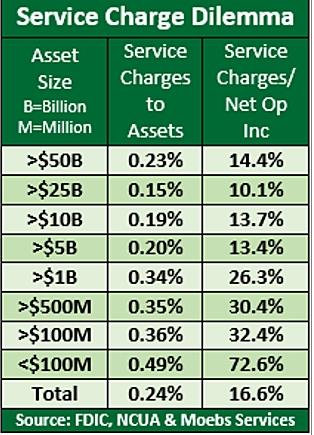
LAKE FOREST, Ill.—A new study indicates financial institutions face a “service charge dilemma,” and that problem may be larger for credit unions.
The news comes at the same time one analyst expects greater scrutiny from the CFPB on how service charges at Main Street and Wall Street institutions differ.
A study from Moebs $ervices on service charges shows that service charges on deposits for all banks and credit unions are at $41.9 billion.
“While this is a modest increase of 1.1% from 2014, when taken as a percent of assets of all financial Institutions this is a 5% decrease. This is the service charge dilemma,” said Michael Moebs, economist and CEO at Moebs Services.
Service charges are flat or declining when related to the number of new checking accounts and/or growth in assets of FIs.
“For Main Street FIs this is a huge problem since they depend on a much greater percent of service charge revenue to net operating income than do the Wall Street FIs,” explained Moebs.
CU Service Charges Double Banks'
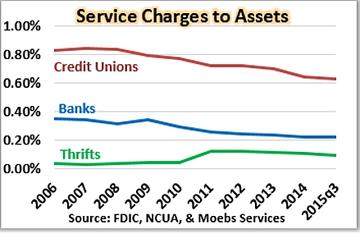
Credit unions collect twice as much service charge revenue than banks and thrifts combined, the report shows. For 2015, service charges to assets are 0.63% for credit unions compared to 0.23% for banks and 0.10% for thrifts.
“This has been the case for many years,” remarked Moebs. “While CUs charge less in fees, they do not waive these fees like banks and thrifts do for a consumer or household who has a relationship with other services. This leaves CUs vulnerable to factors causing price changes and puts their service charge revenue at risk.”
Compliance concerns have caused many FIs to rethink and even curtail service charges, explained Moebs.
“This is quite apparent with the larger FIs that have established relationship pricing to offset traditional fees with compensating balances and rates from other services,” said Moebs. “This form of pricing limits regulatory scrutiny associated with higher service charge prices. Main Street FIs are not using relationship pricing because the service charge revenue is an important source of income. The smaller the FI the more important fees, either measured as a percent of assets or net operating income.”
Financial institutions often give little consideration to alternative pricing strategies or tactics, said Moebs.
“Pricing appears to be dominated by increases with no attention paid to consumer needs. Using tactics such as penalty pricing or treating services such as overdrafts and check cashing as ‘parking tickets’ with higher fees does not meet consumers’ needs,” stated Moebs. “Price/volume tactics, where lower prices drive volume, give consumers what they perceive as value, and FIs prosper. It’s a win-win.”
CFPB Impact
What does 2016 have in store for service charges?
As CFPB Director Richard Cordray and Senator Elizabeth Warren start to realize regulations aimed at service charges will substantially impact Main Street FIs more than Wall Street FIs, compliance directed at transaction accounts could be limited, said Moebs. Also, the CFPB’s efforts to eliminate payday lenders could produce more service charge revenue for depositories that would welcome this business, he added.
“There are two fundamental directions banks, credit unions and thrifts need to examine,” observed Moebs. “First, focus on the user’s value experience at all channels of delivery and, second, as is often the case with fee-based services, see if more revenue can be generated by greater volume produced from lower fee prices.”