

BRISTOL, U.K.–Many credit unions will fail in planning for the long term, but the real futility lies in even attempting to do so and looking in the wrong places for guidance, according to one expert.
During a CO-OP Financial Services’ THINK Strategic Growth Forum on “Navigating Uncertainty with Adaptive Thinking,” Dr. Margaret Heffernan, a Professor of Practice at the University of Bath, Lead Faculty for the Forward Institute’s Responsible Leadership Program, and who has given TED talks viewed by more than 12-million people, said the world’s most top-notch forecasters in the current environment are able to see “maybe, maybe” 400 days out.

“If you’re like the rest of us your time horizon is maybe 150 days,” Heffernan said. “So, for all of us going over three-year plans, five-year plans, this really is uncharted territory.”
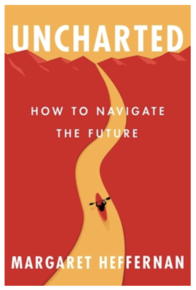
Heffernan is the author of six books, one of which is named just that, “Uncharted Territory.” Her comments are being featured as part of a series in CUToday.info examining how strategic planning is changing in 2020 as a result of the coronavirus pandemic and resulting economic and consumer behavior changes. The first installment in the series can be found here.
Heffernan said a credit union leader would be mistaken to simply give up on doing the planning work themselves and instead turn to the “experts," whom she said are also “likely to get it wrong.”
With the traditional three-legged stool of management–forecast, plan and execute–one leg has now fallen off, suggested Heffernan: Forecast.
“Forecast is based on assumptions and many of those assumptions have changed, and actually quite quickly,” she said. “Imagine if you were in the business of manufacturing plastic straws. When assumptions change, models necessarily simplify, and often it’s the things we leave out that catch us by surprise. What’s fundamentally changed over last 30 years is we have moved from a world that was quite complicated to one that is quite complex.
“Complicated is a world we can control, where environmental efficiency delivers phenomenal benefits,” Heffernan continued. “Complex is a different ballgame. There are so many factors in play that you may not be able to see all of them at once. It’s where very small things, like the virus, can have a disproportionate impact, and where change appears to be so random it’s very difficult to keep up. It’s a world where the last thing that happened very rarely predicts what happens next.”
What It All Means
What all this means, said Heffernan, is it’s a very different operating environment in which credit union leaders must start thinking about what they can do to truly make their organizations robust.
“What do we do when we are face to face with uncertainty? What most organizations do is call for more data, and when they don’t get what they want they call for more data,” said Heffernan. “The problem isn’t that the data is useless, it’s that it’s historical and there is an assumption that was true will continue to be true, and the data is only really as good as the questions asked. And there is the temptation to continue to ask the same questions.”
Complicating the challenge is whether a credit union is asking the most relevant questions for today, or whether it knows what to ask at all, she said.
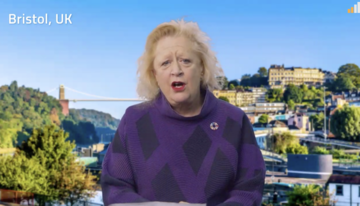
Dr. Margaret Heffernan speaking to CO-OP Forum.
The Network That’s Needed
When it comes to better forecasting Heffernan said all organizations, including credit unions, would be best served by looking to a resource they already have in-house: literally.
What organizations must have is a strong network of “intelligence-gatherers,” according to Heffernan, people who are highly alert to times when things don’t quite add, who can collect seemingly random pieces of information and piece them together into insights, people who “ask what’s new, what’s different, what’s changing in this highly volatile, highly uncertain environment.
“Asking those questions depends on everybody. This is not a top-down process. Increasingly, we need to think of our organizations as networks, bringing questions from all points,” she continued. “This is about asking, ‘What does this mean when it connects with other pieces of insight, and what might that mean?’ This is the ability to see new things coming at us.”
Didn’t See it Coming?
In doing research for a book Heffernan noted how often she kept hearing from organizations that had faced a great crisis that “nobody could have seen this coming.” But in the process of digging deeper it initially became apparent that yes, some people did see it coming she said, and then after even digging deeper, “everyone saw it coming, just no one said anything. There is always so much more information in our organizations than we notice or seek out or use to make sense of the world.”
Big organizations that are rocked by change, Heffernan emphasized, were not rocked by information that was hard to come by but by information the workforce already had for months and even years in some cases.
The Opportunity
With credit unions deep in discussions about how to respond to the coronavirus pandemic and changes in consumer behavior, Heffernan said that in the current environment it’s about capturing where the huge opportunities are now.
“It’s about identifying those and being able to jump on those quickly, try things out, and adapt to an environment even as it’s changing. It’s not about waiting until things settle down,” she said.
Heffernan said during times of dynamic change organizations must conduct experiments and be careful not to be rooted in assumptions from the past.
For example, she noted that over the last 30 years organizations have been enthralled with the concept of efficiency.
“There’s nothing wrong with that, but efficiency only really works when you control the environment completely,” she said. “In business, where control is not sure, now instead of just-in-time we have to focus on just in case. We stopped preparing for pandemics because we hadn’t had one. Just-in-case preparation is a hallmark of an effective organization. This can be very counterintuitive, especially in financial institutions, because the abiding characteristic of uncertainty is it can’t be quantified.”
Not a Cost Center
Heffernan noted the history of business is a history of viewing people as a cost rather than as a generator of value. That has to change, she said.
“At the end of the day the only truly sustainable resource we have is human,” Heffernan said. “The question for credit union leaders is what are we doing to restrain judgement by staff and how can we liberate it so that we get more of their intelligence, imagination and creativity?”