PALM DESERT, Calif.–To really know how to create an innovative culture at a credit union, it’s important to understand “horses’ butts.” And that’s important, because times of chaos such as the current environment are ripe with opportunities, according to one expert, who shared strategies for driving change inside credit unions.
Speaking to the California and Nevada Leagues’ REACH Conference, Jeremy Gutsche, the CEO of TrendHunter, an author who runs workshops on driving innovation, told the meeting there are ways every credit union can innovate and get to the next breakthrough, but people aren’t going to like it—and that most particularly applies to leadership.
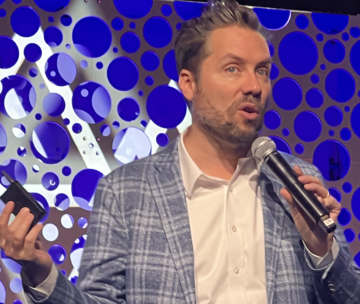
Jeremy Gutsche speaking to REACH meeting.
No, literally aren’t going to like it, he explained, because it involves change and not relying on how things have always been done. But Gutsche also noted there is a series of tactics individuals and organizations can use to create effective change.
And that includes overcoming a near-term obstacle, he noted.
“Right now, we are at the highest rate of change, but we have been so distracted by things causing people to miss these revelations,” said Gutsche.
The Traditional Problem
Gutsche said there are opportunities that are so close they can be grasped by organizations, such as new products and services, but there is a traditional problem: tradition.
As an example of how seemingly unrelated factors and practices can become embedded in any organization, he cited how “horse dimensions” from a thousand-plus years ago played a role in the dimensions of rocket boosters on the space shuttle.
Roman chariots, he explained, used two horses side by side, which led to the distance between the wheels of those chariots being 4’8” wide. That standard would go on to influence the width of railroad tracks a millennium later. When the manufacturer of the rocket boosters knew it would eventually need to ship those boosters from its Utah manufacturing facility to Florida via rail, the width of those rails played a role in the size and design of the boosters, he explained.
“That’s what determined the width of the booster, two horses’ butts,” he said. “The width is stupid and we’re probably worse off for it, but we are more dependent on past decisions than we think. Realistically, we don’t break from the path. This is known as ‘path dependency’.”
Most organizations just stick to the path, the result being that new ideas die because “it’s just easier to do nothing.”
As an illustration of path dependency, he shared the example of a credit union leader arriving at their CU and pitching an idea, but there is pushback. “There are rules, policies, procedures. You hear, ‘We’re not big enough, not nimble enough, we need to hit goals, we need results’.”
When he asked for a show of hands from REACH attendees for how many in his audience had heard those objections, nearly every hand was raised. “And if you didn’t raise your hand, you’re the one who said it,” he said.
Envying Credit Unions
In a previous life, Gutsche, who is a chartered financial analyst, worked in banking and at Capital One when it was just a card issuer, where he oversaw a $1.5-billion portfolio. He shared a surprising viewpoint from those days.
“We envied everything you did at credit unions,” he said. “This was before Capital One bought a bank. You have a membership, a loyalty, a way to connect. At times of chaos like now, when people start hating banks and rising interest rates, there is a great opportunity at credit unions to steal away marketshare. We used to study that, envy that.”
As part of what he called the Trend Hunter Chaos Framework, Gutsche said the COVID-19 pandemic is not unique, as there have been prior pandemics, such as the Spanish Flu pandemic of a century ago. He suggested there are parallels to be found.
“You don’t go to the new normal right away. You go to a new period of chaos. Individuals start reprioritizing what’s important to them,” he said. “If you ask your members, ‘What do you want?’, it’s a weird time period. It’s not a normal world yet, and now there are fears of a recession. But we have done this 19 times.”
The Grand Reprioritization
Gutsche repeated his point that chaos creates opportunities credit unions can capture.
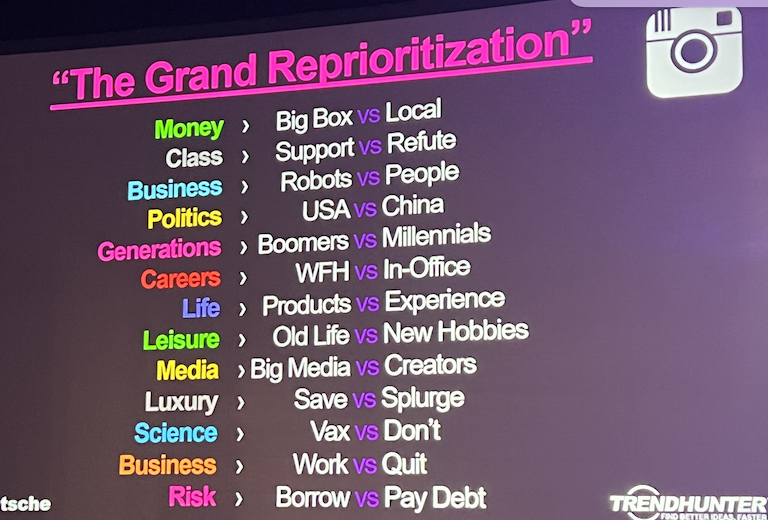
“It shuffles who’s in the lead. Pandemics cause people to want to make up for lost time,” he explained. “I believe the Roaring 20s are coming back. It’s in recessions when all the most dynamic companies get founded. Right now is when consumers need change. At TrendHunter we call it the Grand Reprioritization. We look for tensions, where people haven’t figured out on which side of the fence they are.”
He pointed to a dozen different tensions in the marketplace and among consumers, which are outlined in the slide below.
The Best Businessman Ever Known
To make a point, Gutsche shared the story of one of the most successful business people he has ever known: his father, Sig Gutsche, who died of a heart attack in 2013 at the age of 63.
A born entrepreneur, as a boy Sig Gutsche was sweeping floors in a Canadian grocery store when he noticed all the food that was being thrown away. He made a deal with the store to get the food, which he then sold door to door. At 16, he used a fake ID to become a nightclub owner. Later he bought for 10 cents on the dollar a restaurant that was going bankrupt, realizing he could use its two-story façade that faced a busy street as a billboard that would help him break even before serving his first meal. Jeremy Gutsche related how his father then knocked on countless doors asking people to come visit over a beer and a burger and to share their input on how to improve the restaurant. “And pretty soon you had the new local watering hole,” he said.
‘Lazier Than You Think’
“Your competitors are lazier than you think. Not everyone is willing to knock on the doors. Not everyone is prepared to do it, but if you are in a period of chaos and reprioritization, you will win,” Jeremy Gutsche said.
With his growing success, later Sig Gutsche made a loan to the then owner of the Canadian Football League’s Calgary Stampeders. When the team went bankrupt, as the only loan on the team’s books Gutsche became the owner of the franchise.
Lost Everything
“Truthfully, he took it on and lost everything. He lost his house, car, business, investments. He had to think harder about how to turn it around,” Jeremy Gutsche explained.
Sig Gutsche had players call people about buying tickets and he worked the stands asking those few in attendance to come back with friends. Eventually, the team went from averaging 15,000 fans per game to selling out, and the Stampeders would go on to finish in first place in five of the six years Sig Gutsche owned the team. It would also win two Grey Cups, the Canadian Super Bowl.
What if Amazon Ran a CU?
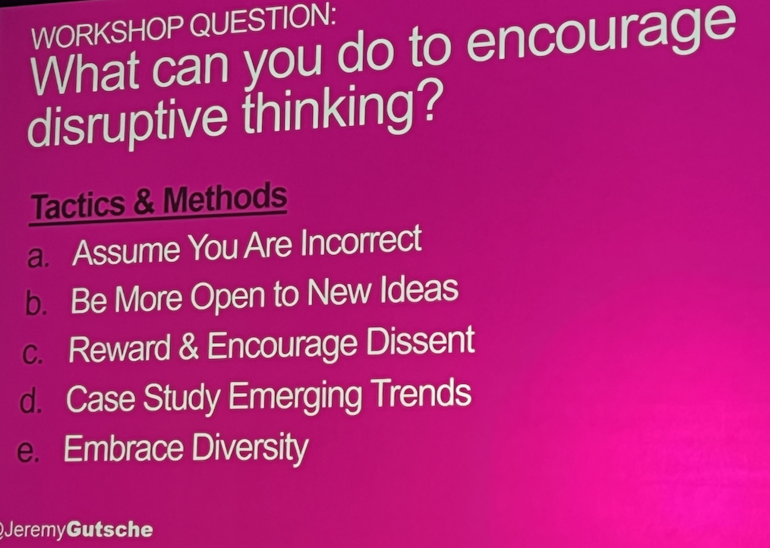
“Be Insatiable. Push Harder. Never give up,” urged Jeremy Gutsche. “You have to put in some work to get to new ideas and that is done in workshops. We have done more than a thousand. You want workshops that get you and your team to look at your challenges from different lenses. What if Amazon faced this problem? What if Facebook ran a credit union? Putting yourself in that perspective will cause you to unlock new ideas.”
He encouraged CU leaders to go on “trend safaris” at other non-financial companies to see what they do.
“Innovation is not fluffy, it’s science. If you put yourself through the work you can retrain your brain,” Gutsche said. “Everyone wants change to happen but most people don’t break from the path.”
Gutsche said opportunity starts off subtle and it’s awkward.
“The (market) leader is often disrupted by the very thing they created because we overestimate our level of control,” he told the meeting.
What CEOS Say Vs. Believe
That isn’t to say there aren’t some large internal challenges. He cited research showing 97% of CEOs list innovation as top priority, but 50% don’t believe their organization has a strong innovation plan, and an equal number don’t believe their organization knows how to turn ideas into reality.
“We are pre-wired to plant whatever led to last year’s harvest. We became farmers. If you get good at something, we start to farm it.”
How does an organization counteract that tendency and plant new seeds? By being curious, insatiable, willing to destroy and willing to ask outsiders for opinions, he said.
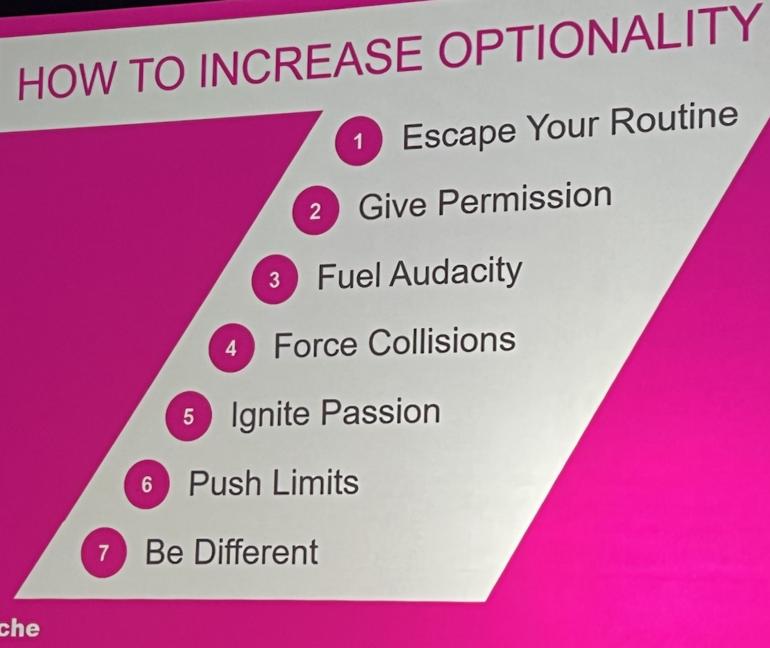
“Now is a good time to try things that give us high optionality,” Gutsche added. “We focus on short-term objectives, but we have to have meetings where we only focus on things that are out of scope.”
“Say yes to something uncomfortable, even though it’s easier to say ‘no’,” he continued. “The last trap is the ease of inaction. Innovation isn’t always about the big ideas. Often, it’s the little ideas that make you big.”
For those interested individually or as organizations in learning more about where they stand with innovation, Gutsche said there is a free analysis that can be conducted on www.TrendHunter.com/assessment.