

By Ray Birch
LAKE FOREST, Ill.—2024 will be the “year of the checking account,” according to one expert’s forecast, who said it’s fitting it’s the Year of the Dragon.
That prediction is coming even though after three years of record balance growth, checking deposits have fallen in 2023 by 2.5%.
“Will this continue or not? I think 2024 will be the year of the checking account,” stated Michael Moebs, economist and chair of Moebs $ervices, who is warning that those organizations that merely have “cooks” devising checking strategies will fall behind those employing “chefs” who pay attention to using the right “ingredients.”
“What we need to realize is that pre-COVID, checking was just another player among all other financial services. After COVID, checking has become king of the financial services jungle,” Moebs suggested.

Moebs said the focus and bottom-line impact of checking accounts has shifted, noting checking is no longer the loss leader it was for many institutions and is now a “profit leader.”
Cooking Away
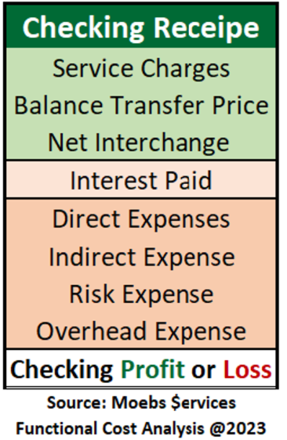
“The solution for successful transaction accounts is cooking away in the financial services kitchen. The checking recipe is the most complex among financial services,” offered Moebs, citing data from Moebs $ervices 2023 Functional Cost Analysis. “What ingredients are free? What ingredients are most costly? These days it requires each FI to have a chef onboard and not a cook.”
Moebs said the checking profitability recipe includes key ingredients.
Three Categories
“The ingredients are defined in three categories: revenue, interest paid and expenses,” he said.
Service Charges. “These include, but are not limited to, overdraft fees, charges for falling below minimum balance requirements, official checks, paper transactions in lieu of digital (statements and notices), etc.”
Balance Transfer Pricing. “What are deposits worth? Three methodologies decide this. Are deposits a profit center, cost center, or no cost—just part of overhead? The profit center approach incentivizes deposit operations to go after low-cost deposits and compensate employees who get this done,” Moebs said. “The cost center approach treats deposits as gasoline which feeds the loan engine. The no-cost approach can impact effective loan price—understating loan value while treating deposit operations like your dog who should be happy with one meal a day.
“The profit center approach is used in the checking recipe and integrates cost, volume, deposit relationships and the financial risk,” he continued. “These profit center pieces are then translated to an income type statement showing profit or loss of just the service. The profit center approach is often excluded by FIs in determining transaction account success.”
Net Interchange. “This is consumer transaction revenue from swiping credit/debit cards. Interchange revenue exceeds OD revenue and is a vital revenue source to obtain transaction account profitability.”
Interest Paid. According to Moebs, “One out of five transaction accounts pay interest. Rates paid are less than 25 bps until $100,000 in balances, then rates rise to 4% and more. The higher the balance the more interest paid affects transaction accounts.”

Michael Moebs
Cost to Operate. “This involves non-interest expense for direct transaction account costs: tellers and salespeople; indirect costs—IT software, risk cost; OD losses and fraud and overhead costs, branch expenses. Most FIs dismiss expenses from transaction account profitability—a basic mistake in measuring to determine if transaction accounts are winning or losing at the bottom line.”
Other Predictions for 2024
Mobes provided other observations and recommendations for 2024, including:
- Use pricing to thwart transaction account loss is critical ranging from paying higher interest to lower fees and balances
- Successful FIs use one transaction account, like Walmart who nets $20 profit on average per account
- Maximize transaction account competitiveness with digital wallet applications—more transactions are better
- Give incentives to deposit sales personnel to obtain and maintain transaction accounts with high transactions
- Reward interchange usage by using interchange value to offset fees on consumer deposits and loans
- Purge unprofitable transaction account, unless the household relationship is profitable
- Consider introducing free transaction accounts with interest paid by tiers
- Raise the interest paid for higher balances maintained
- Encourage large deposits and balances beyond deposit insurance $250,000 limits
- True transaction account profitability comes only by using all of these elements to measure profit or loss
Year of the Dragon
“The Chinese Zodiac Calendar shows 2024 as the Year of the Dragon, which fits the strategic approach to transaction account profitability, since the Chinese dragon symbolizes strength, power, and good fortune,” concluded Moebs. “Financial institutions need to have the strength to determine their transaction account profitability as well as the power to correct unprofitable accounts. Do so and good fortune will flow in 2024.”