

TUCSON, Ariz.–There’s a very good chance the content of this news story wasn’t delivered to your social media channels because it doesn’t sufficiently outrage you—even though it should—and that’s a big threat and problem, according to the person who was behind the enormous leak of internal data from Facebook that led to congressional inquiries and more.
Indeed, the current state of social media is not only tragic, it’s contributing to even more tragedies, according to Frances Haugen, who shared with a credit union audience just how most social media and other online algorithms really work and affect people, and who today is a global advocate for transparency and accountability in social media.
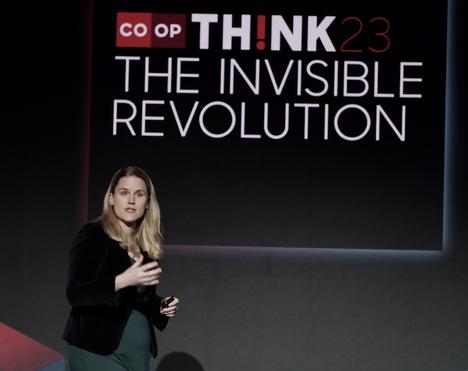
Haugen, a data scientist and algorithmic product specialist who holds a degree in electrical and computer engineering and an MBA from Harvard University, began her career with Google in 2006, before joining Yelp in 2015, Pinterest in 2016, and Facebook in 2019, where she became a product manager on the Facebook civic integrity team that was dissolved after the 2020 election.
In 2021, she provided the Wall Street Journal and Congress with tens of thousands of internal documents from Facebook that made clear the company was—counter to its public stance—well aware of the damage its algorithms can do to its users, including political extremism, self-harm, suicide, sexual trafficking, bullying and more. She later sought legal protection under the Whistleblower Act.
Responding to Critics
In remarks to Co-op Solutions’ THINK 23 Conference, Haugen—who still recalled the feeling of getting her first account as a child at what is now GreenState Credit Union in Iowa—said those who downplay the risk from social media or attempt to deflect any criticism must be answered.
For example, she cited those who have used some version of the statement that, “We know more people die than would otherwise because of car accidents, but no one talks about getting rid of cars,” as a reason to not bring greater scrutiny to social media. But it’s a false analogy, she said.
“Just since 2000, more people have died from car accidents in the U.S. than every war the U.S has fought in,” said Haugen. “But what’s important is the number of deaths from motor vehicles actually went down, and then started going up again. We have an assumption cars always get safer, but over the short term dangerous is cheaper, but it’s only cheaper while it’s a secret.”
The Difference a Book Made
She pointed to one turning point in addressing public threats, Ralph Nadar’s landmark 1965 book, “Unsafe At Any Speed,” about the dangers of GM’s Corvair. That book revealed that car companies were spending about $6,000 in today’s dollars on voluntary styling changes, but only spending $2 on safety.
“Companies were afraid to talk about safety, because if they are the first mover people will ask why they are talking about it,” said Haugen, noting the Department of Transportation was created in 1967, and in the wake of its new safety rules, automobile fatalities declined. “But I would contend that’s not what drove the car accident rate down. What happened is there was the ecosystem of accountability; it’s litigators who know what a cut corner looks like, its investors who manage for long-term returns over short-term profits.
‘What Keeps Me Positive’
“When people get down about social media and question whether we can get better, what keeps me positive is I have seen what happens when mothers get ‘MAAD’,” she continued. “When we work together, when we have the ecosystem, we can make systems safter.”
Haugen said in her discussions with investment firms and litigators what she has discovered is they often don’t know what questions to ask when it comes to social media companies and practices.
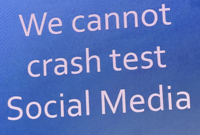
“We can crash-test cars, we cannot crash-test social media,” Haugen said. “When it comes to social media or any other opaque system, those that run on chips, you can’t inspect, we can’t control them, and it uncovers really big problems we need to talk about as a society. All we get to see is what is on our screens, and that opens us up in vulnerable ways.”
Haugen said social media companies, especially Facebook, have responded to such criticisms by saying while the situation can be tragic, it’s also “anecdotal.”
Refuted by Own Documents
But Facebook’s own documents said otherwise, according to Haugen. For example, the company ran the same study four times in which it would click on or search relatively innocuous subjects, such as “eating healthy.” And yet over time the algorithm still pushed users toward more and more extreme content, such as self-harm, as the data show people then spend even more time online. People on the left politically, for example, would get pushed to content about killing Republicans, she said.
“It can have serious impacts on public discourse, and as Facebook learned later, on children’s mental health,’’ she said.
Facebook later responded with a white paper by saying it would use artificial intelligence tools to get rid of the “bad things.”
“The only problem, and this is in the white paper, is inferring the semantic meaning of speech with high precision is not remotely close to being solved,” said Haugen. “Even humans are bad at semantic meaning. When you ask computers, ‘Is this hate speech?’ they don’t do well. If they actually want to fulfill the promise of getting rid of the bad things, it will mean sacrificing a lot of good content, too.”
Slowing Things Down
Haugen said social media can be especially harmful to children, even though there is already technology in place for addressing the threat.
“Right now, one thing that is hurting kids is that when you start to be a little anxious, you start self-soothing with Instagram and you end up staying up until two at night,” she explained. “We treat this now as if we have no ability to deal with it. We’ve known for 20 years that if you slightly slow down a user interface, people use it a lot less, even if it’s so little time you can’t perceive it. So, let’s imagine a world where your daughter or son stays up until two o’clock scrolling and the next day you get a pop-up that asks when do you want to go to bed at night? Two hours before bedtime Instagram gets a little bit slower and slower. They get tired and go to bed. The crazy thing about this feature is it’s live on Instagram today.”
The Super-Use Supremacy Problem
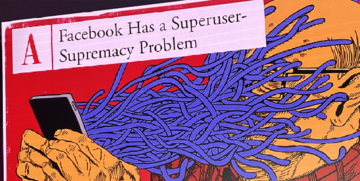
According to Haugen, the 99th percentile Facebook users, those who actually look at 2,000 or 3,000 posts per day (which Haugen said is “not a healthy lifestyle”), were also identified as people who were also most likely to post angry messages.
“If it had this feature, it would mean these people could also go to bed,” Haugen said. “They are stuck in the loop. And the worst part is that person who doesn’t want to go to bed impacts what everyone else sees, because they leave a 100 times more content.”
What Can be Done?
If Facebook has “lied over and over again,” as Haugen alleged, what can be done?
Haugen noted that one of the things that came out of her disclosures of Facebook documents was passage by the European Union of the Digital Services Act. A similar law has been proposed in Canada.
“It’s based on the idea that if we can’t interact with content—because content censorship doesn’t work—we can design upfront things like helping people to go to bed,” Haugen said. “The EU law is simple: you need to tell us when you know there are problems and you have to answer questions when we ask them.
“For these companies, transparency can feel like punishment, but transparency isn’t about punishing people, it’s about giving people tools,” said Haugen. “When we know we are going to be held accountable, we make more responsible decisions. Transparency and accountability is about how we build collaboratively.”
What Does It Mean For Credit Unions?
What does all of this mean for credit unions?
According to Haugen, “We are entering a very interesting period technologically. ChatGPT and AI are going to be transformative. But it also means we are going to have another opaque technology running more and more of our economy.”
How can the power of transparency be harnessed?
“The first thing to do is to ask what you are doing in your own organizations to ensure you are living transparently,” Haugen said.
To that end, she recommended:
- Ask your employees, “Are we being transparent?”
- Give your members real choices. “Think intentionally about being transparent with your members. One way you can differentiate is to say; you own the credit union. You have a right to know what’s going on.”
- Invest in educating the public. “People love to feel like they are trusted and respected. When asked to be a participant in how your money is managed and how an organization is run, that’s how you build loyalty.”
Living in the Truth
Haugen said with Gen Z increasingly in the workplace, there will be greater demands and expectations around “living authentically.”
“The thing about lies is lies are liabilities,” said Haugen. “When we don’t live transparently, we are asking people to pay a small cost every day. At Facebook, after I was there two years I was more senior than 85% of the company. Gen Z wants to live truthfully. So, we have to ask how we can build corporate cultures where people can live in the truth.”