

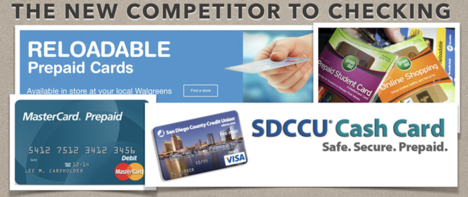
LAKE FOREST, Ill.—A new report indicates that reloadable prepaid cards are now firmly competing with checking accounts.
“Reloadable prepaid cards (RPC) have always been used to service a segmented consumer type, such as the underbanked or Millennials,” said Michael Moebs, economist and CEO at Moebs $ervices. “However, the RPC is beginning to make the transition into a service that can compete alongside the checking account.”
Currently, about one in five of all depositories offer an RPC, almost doubling the total from five years ago, the study shows. The growing appeal of prepaid cards has been well documented in CUToday.info reports. Moebs believes that consumer interest in the service will continue to rise.
CUs Leading Way Among FIs
But just who is leading the way in prepaid offerings? The Moebs study reveals it is the non-traditional banking companies, such as Walmart.
“But credit unions and large banks, like Chase and Wells Fargo, are beginning to successfully compete,” noted Moebs. “Depositories find value in offering an RPC for the consumer-friendly option as well as its ability to bring in more interchange revenue.”
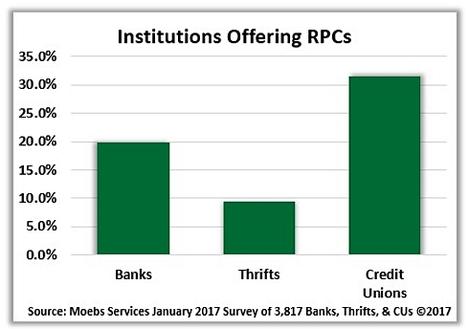
The report also shows that more than 30% of CUs offer reloadable prepaid, while about 20% of banks offer the service (see chart).
As would be expected, the increasing number of institutions offering prepaid cards is going hand in hand with the number of consumers who are using the cards, the report shows. RPC volume has more than doubled in the past five years, going from 6.7 billion transactions to more than 14 billion in 2017. That number exceeds the combined volume of both paper checks and domestic ATM transactions, Moebs explained.
“Credit unions and large banks are taking advantage of the RPC’s interchange revenue and overall low costs,” stated Moebs. “A large majority of financial institutions offering RPCs do not allow it to overdraw, lowering the risk and overall cost of maintaining this service—a major reason why AMEX and Chase have continued to strongly promote their RPCs.”
Duck Billed Platypus
Moebs compared reloadable prepaid cards to “a duck billed platypus—it is not classified as a checking account, credit card, or debit card. Similar to a checking account, the deposits are both FDIC and NCUA insured. However, there have been little to no regulations put on the RPC, allowing financial institutions to characterize it to their liking. The Consumer Financial Protection Bureau’s recent regulation on prepaid cards, scheduled to go into effect Oct. 1 of 2017, has failed to clarify which type of service the RPC best fits.
Moebs reiterated that reloadable prepaid cards are moving away from being a service offered only to a segmented group of consumers.
“Many factors contribute to the success and growth of RPCS, including consumer friendly features, interchange revenue, low risk, low cost, and rapid volume growth,” said Moebs. “RPCs are the newest innovation in the checking account business since the Wells Fargo Gold Account in the early 1970s.”