

By Ray Birch
LAKE FOREST, Ill.—How much of a toll is the pandemic taking on financial institutions’ fee income? Enough so one analyst is recommending CUs consider making a couple of moves.
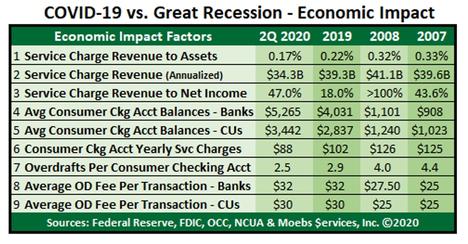
The spread sheet line item for service charges on deposits has shrunk more in the first half of 2020 than any other category on financial statements, according to a new study that also uncovers a big opportunity to deepen relationships with consumers, one analyst believes.
The decline, reminded Michael Moebs, economist and CEO at Moebs $ervices, is due to the pandemic-induced recession.
Moebs noted that during the Great Recession of a little more than a decade ago, which was driven by the mortgage crisis, fee income at FIs actually increased.
As many analysts have suggested, comparing the current recession to the Great Recession delivers insights, and Moebs agrees.
“Service charges this year fell five basis points, representing a loss of $5 billion in fees collected by banks and credit unions,” said Moebs. “In comparison, during the Great Recession $1.5 billion in fees was gained.”
Moebs said the comparison makes it clear the decline in fee income in 2020 is a direct result of the economic stimulus.
Moebs explained this gave depositors more money in their checking accounts, reducing the number of overdrafts.
“The fee income gain during the Great Recession was due to the price increase of overdrafts,” explained Moebs. “While this move increased revenue, it also prompted the consumer to reduce OD usage reflected in the decline of ODs per consumer checking account. With the COVID recession, the consumer used government stimulus money to increase deposits.”

Michael Moebs
Record Levels
Moebs added the bulk of the funds, even from other deposits such as CDs, went into checking accounts, which Moebs previously reported, pushing checking funds to record levels.
“Thus, providing a cushion preventing overdrafts. The same cushion did not happen in the Great Recession,” he reminded. “Consumer bank checking balances were almost 500% less and CU consumer checking balances 300% less during the Great Recession.”
What to Do Now?
Moebs said depositories need to lower fee prices during the current recession, especially overdraft price, so the consumer pays less and uses the service more, and also focus more on relationship pricing.
“The move to use balances to avoid fees signals a desire by consumers to use other services to avoid fees and deepen relationships with their depository,” said Moebs, who emphasized FIs need to take advantage of a change in the mindset of many consumers. “This is relationship pricing. An unprofitable checking account can still be a profitable relationship when combined with other services, so the checking service charges may be waived.”
Moebs pointed out the Great Recession began a steady decline in service charges to assets, from 33 BPs to the current 17 BPs, said Moebs.
“Fees represented 43.6% of FI net income before the Great Recession and 18% before the health crisis,” Moebs said.
The average annual charges to consumer checking has fallen 30.2%, but still is over $7 a month. The bulk of consumers’ service charges on the average account is overdrafts. Since the Great Recession banks have increased OD price 28% as volume has fallen 56%. Credit unions have seen their price rise 20% and experienced the same declined in volume—58%.
The Recommendations
To address what is happening, Moebs recommended the following for credit union decision-makers:
- Reduce the price of all service charges to drive volume increases and the bottom line
- If the member has two or more services and one is a checking account losing money—but the relationship is profitable—waive the fee