

By Ray Birch
LAKE FOREST, Ill.—A new overdraft study shows that all of the moves to reduce overdraft charges are having an impact on financial institutions’ revenue—but surprise, it’s going up to record levels, especially at credit unions.
The second quarter Overdraft Study from Moebs $ervices also reveals credit unions were already getting a bigger piece of the revenue pie prior to the decisions made by many major banks and credit unions to cut those fees.

“Overdraft revenue, for the 12 months ending June 30, 2022, is highest since the Great Recession, when OD revenue peaked,” said Michael Moebs, economist and CEO at Moebs $ervices. “At $34.4 billion, OD fees are only $2.4 billion, or 6.9%, off the highest amount of OD income ever at $36.8 billion.”
Credit union overdraft revenue has hit a historic high of $7.3 billion.
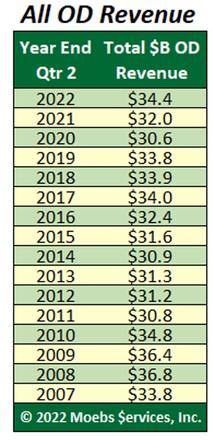
“This is an increase from the low of $6.1 billion at the start of the pandemic, or an increase of almost 20%,” said Moebs, noting that banks and fintechs have been making more reductions in their overdraft fees than credit unions. “In contrast, banks for the same period have increased only 10%. This is good news for the credit unions.”
Moebs $ervices surveyed more than 3,109 financial institutions statistically selected by George Easton, a professor of mathematics and statistics at Emory University in Atlanta, which represent 36.1% of all 8,603 depositories offering checking.
‘Old Thinking is Gone’
“Overdraft revenue is increasing, and soon will be the highest ever because the OD price is falling,” said Moebs. “The old thinking that OD price was inelastic is gone. When the price goes down, volume goes up and so does revenue. Banks, credit unions, thrifts and fintechs are slowly shifting their measurement of OD price, and those lowering the overdraft price are leading the way by making more revenue.”
In measuring what consumers are paying for overdrafts Moebs $ervices has found that for several years the median price has been about $30. But Moebs said that median price is not a true reflection of what consumers, as a group, are paying across the nation when they overdraw.
Instead, he said there is a better way to gauge the average price consumers are paying, and he believes this new method is what the CFPB should be focusing on as it digs into overdrafts.
CFPB Zeroes In
As CUToday.info has reported, the CFPB has been clear that it is zeroing in on overdraft programs. The agency recently fined Regions Bank $50 million for its overdraft practices.
“The old method determining overdraft price surveyed only the price for FIs offering checking,” Moebs explained. “The new method weights the OD price by the number of checking accounts at each financial institution, which truly gives the most accurate price picture. Think of this OD pricing measurement approach as a market of 10 providers of checking. Nine of these depositories charge $30 per OD transaction, while one charges $10. The one charging 10 has 75% of all checking accounts in the market, while the other nine have 25%. The old fashioned way calculates the market price as $28 an OD.”
Making a Comparison
In this example, the new method employed by Moebs $ervices uses checking accounts multiplied by OD price, shows the average price is $15. According to Moebs data, the average price consumers across the nation are paying for an overdraft today is $22.52.
See the table below for a comparison of the two pricing survey techniques.
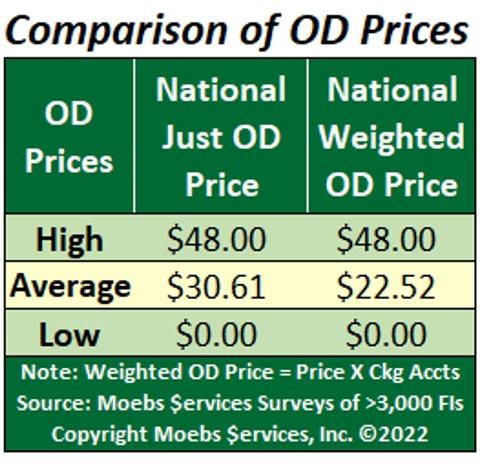
“The traditional technique is to report the average OD price for all 3,109 depositories surveyed, or the unweighted average of $30.61,” said Moebs. “The weighted average OD price of $22.52 takes into consideration the number of checking accounts at each depository surveyed. The difference between the weighted vs. unweighted average is $8.09, or 36%. A significant disparity that makes it worthwhile to change survey pricing. Consumers would view the weighted OD price as more representative of their market.”
Distinct Strategies

Michael Moebs
According to Moebs, high and low overdraft prices show distinct OD strategies in the marketplace:
- High OD price represents those depositories that do not want to do unsecured credit and establish a high price as a penalty for having an OD. Examples are small community banks and small CUs, Moebs said.
- Zero price represents those FIs that do not want overdrafts and just do not offer the service, like Ally Bank or Chime.
- "Then there are those like Walmart and Bank of America who charge $15 and $10 for an OD and are gaining market share," Moebs said.
“The government, like the CFPB, needs to base decisioning and research on the most current pricing methodology and correct market data,” said Moebs.