

LAS VEGAS—What could you do to put your credit union out of business? To kill it, in other words.
It’s the kind of question every credit union leader needs to be asking themselves, but asking questions—especially the right questions-- is a real weakness of most leaders, according to a futurist, consultant and author who spoke to the CUNA Marketing and Business Development Council here.
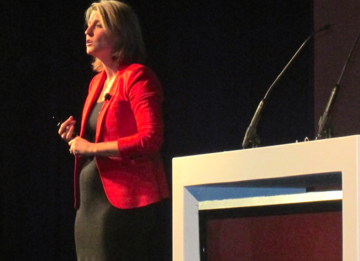
Lisa Bodell speaking to CUNA Marketing & Business Development Council meeting in Las Vegas.
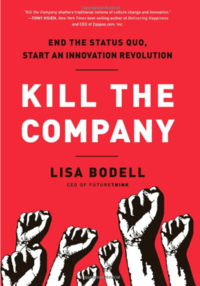
“Killing the company is not about killing your organization but making it better,” aid Lisa Bodell, CEO of futurethink and author of the book “Kill the Company: End the Status Quo, Start an Innovation Revolution.” “The very things we put in place to better innovate are often the very things that hold us back in the first place. Meetings. Policies and procedures. They can become the only thing you do and become the excuse not to do anything at all.”
What is most effective—and most difficult to do when it comes to fostering change, said Bodell, is getting rid of things.
But getting rid of things and making other changes can mean awkward and uncomfortable moments for leaders who must be willing to be challenged themselves. Bodell said she was purposely seeking to make people feel discomfort. “Change doesn’t happen when we all agree. It’s when we have contrast. Not conflict, contrast. I want to challenge your assumptions.”
Bodell’s company has 17 employees around the world who work with numerous Fortune 500 companies as “futurists,” which she defined as a “structured way to think about change. Futurists teach people how to come up with possible, probable, and preferable change. Do you have your antennae up? Do you anticipate change?”
'What You Need to be Thinking About'
One mistake many credit unions and other companies make when it comes to their position in the market is a very fundamental mistake, said Bodell.
“Who you are is not what you need to be thinking about,” she said. “What you need to think about is who you are becoming, because that’s going to affect where you go, the messages you create and the people you hire.”
Among the companies with which she has worked and the types of “change” on which they are exploring:
* Shell. Shell Oil, said Bodell, is making big investments in innovations and taking big risks, many of which fail. It is seeking to move from geo-science to bio-science, from extracting energy to to growing energy. It is seeking to ire bio-scientists, and there aren’t enough of them to go around.
* BMW. By 2030 70% of the population will be living in heavily populated areas, where there is little room for more vehicles, and where people will have lower incomes and be lower educated. BMW is exploring different modes of transportation for its future. Bodell noted that in India entire cities are being built around public transportation and walking, with few roads. So BMW is moving from selling cars to mobility services. It has also partnered with pharmaceutical companies to explore ways to distribute drugs and medicines via vehicles and to use cars to monitor health.
* MacMillan Publishing. With the publishing business struggling, MacMillian has established a venture fund charged with making its current business obsolete. “They gave a VC $100 million and said ‘You can only acquire companies that will put us out of business.’ It’s not about e-books; that’s so 10 years ago already. They’re now talking about sensory books, where there is some sort of hardware that comes with it.”
In Brazil, noted Bodell, Huggies has introduced “TweetPee,” a diaper that alerts parents’ mobile devices that the diaper needs to be changed.
Two Different Things
“What things are now and what they are going to become are two different things. So what you need to think about is what will your industry do 10 years from now that you don’t do now. Who would you partner with that you would never think of now? BMW? Phizer? What are these companies doing? They are taking care of problems before someone does it to them. It’s about proactive obsolescence. Things are going to evolve and change; how can you take control of that and influence it?”
Change is something that can be controlled, reassured Bodell, noting that identifying change is about emerging issues analysis. “Where trends start is never, ever where they end,” she said. “
Bodell said two things happen in companies when the status quo is not challenged: complexity and complacency.

The Pod, one of the companies in the trade show at CUNA Marketing & Business Development Council meeting.
Too often, she said, strategic planning sessions are all about discussions of strengths and weaknesses and not about the really tough conversations, such as what the credit union could do differently or get rid of?
“Three things, I think, hold you back,” posited Bodell. “One, managing, not leading. Many organizations are breeding skeptics. Two, process over culture. We put a lot of attention on systems, but not on behavior change. Three, doing over thinking. We’ve gotten good at doing, but thinking is a daring act. Our first reaction to someone who is just thinking is ‘Get back to work.’”
Bodell observed that for many executives, including at credit unions, what makes for a great leader is what also makes for a bad innovator. “You don’t look at individual pieces of information anymore, you’re looking for patterns. Your job isn’t to be the best at what you do, your job is to be the only one doing what you’re doing.”