

LAS VEGAS–A unique initiative that has reviewed a year’s worth of credit union merger disclosure forms filed with NCUA has found that in many cases those mergers might not have happened had those CUs turned to two potential options: CUSOs and the “broker model.”

In addition, on the flip side, many of the CUSOs that now exist are in danger if the number of credit unions continues to shrink, making it a matter of survival for both types of organizations, according to a session titled “CUSO-Driven Alternatives to Merger” that took place during the NACUSO Network meeting here.

Liz Winninger at NACUSO Network meeting.
The study—which was inspired by the ongoing updates that are reported by CUToday.info on mergers in credit unions--was conducted by the Michigan-based CUSO Xtend and overseen by long-time credit union and CUSO leader Vic Pantea. Pantea joined Liz Winninger, CEO of Xtend, to share insights gleaned from the analysis during a session at the NACUSO event.
“The decline in credit unions having a significant impact on CUSOs. We think it’s valuable to talk about that,” said Winninger.
According to Winninger, the study’s official objective was to identify and publish alternative strategies and tactics that can reduce the continuing decline in the number of credit unions due to merger and dissolution.
Creating a ‘Playbook’
Winninger said Xtend is seeking to create a “playbook” of scalable solutions that can be implemented by credit unions considering a merger and supported by CUSO-based operations and services.
The study reviewed all merger disclosure forms filed with NCUA between Oct. 1, 2021-2022. The sample size represents 212 applications.
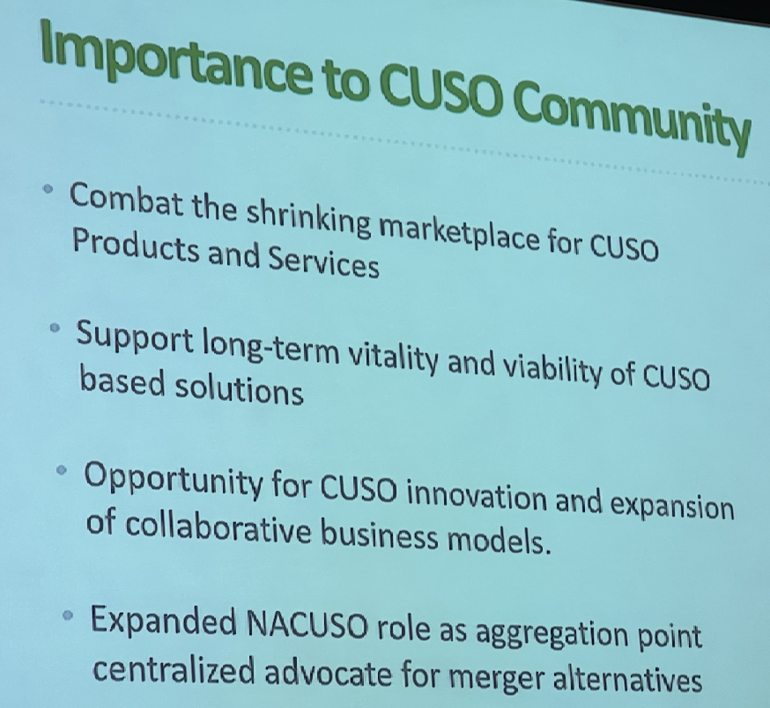
“The more minds we can get thinking about this, the better,” said Pantea. “Perhaps you have lost a credit union client to a merger, perhaps you haven’t lost any, but it’s pretty much inevitable. If this is not on your strategic map it probably should be.
“It really does disappoint me when I see the number of credit unions that have filed applications to merge, as do just the general discussions with credit union leaders around the country,” Pantea continued. “So many select the option that it’s just inevitable that the number of CUs will continue to shrink. When I started my career there were more than 20,000 credit unions. It’s something I’d like to see all of us address. We want to do everything we can to address whatever the issue is.”
Why CUSOs Were Created
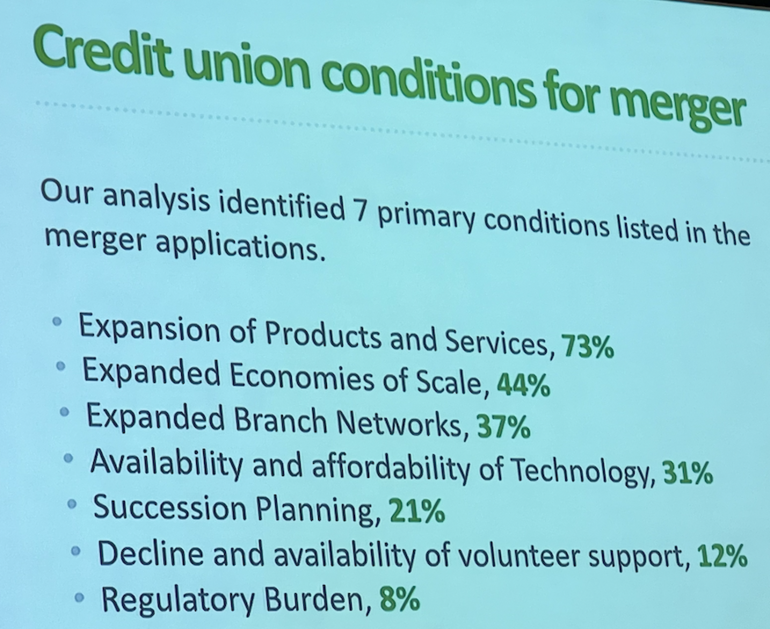
Winninger noted that often credit unions that are merging—which are typically smaller CUs—cite a lack of financial means to offer the solutions members want, which is one of the core reasons CUSOs were created in the first place.
“CUSOs were created for economies of scale,” Winninger added, pointing to another reason often cited by credit unions as a reason for merging.
Pantea said he found some “surprises” in reviewing the disclosures.
“I have heard a lot in the last five years about succession planning. I was surprised that only 20% of the applications for merger listed succession planning. I thought it might be a lot bigger,” he said. “But if you read between the lines of the applications for merger you can read that many credit unions, especially small CUs, are challenged by the compensation issues, the benefits issues they would face if they had to go into the marketplace to identify a new CEO and senior staff.”
A ‘Total Surprise’
Like Winninger, Pantea said one issue that “totally surprised” him was the number of CUs citing “expansion of products and services” as a reason for merging.

Vic Pantea at NACUSO Network meeting.
“We’ve done a lot at NACUSO to talk about CUSOs so that credit unions of any size could expand their products and services,” Pantea said.
Winninger urged credit unions that want to survive to adopt the following mindset:
-
Reject any thinking about being “too small.”
Adopt the strategy of “never say no” to a member - Build a financial model that reduces balance sheet risk and recognizes an e-driven income statement
- Identify shared resources for backoffice ops
One Potential Model
Pantea and Winninger both suggested one potential model moving forward for CUs that don’t want to merge would be to become financial services “brokers.”
“There are thousands of independent brokers in the insurance business and the financial advice business,” said Pantea. “They own the relationship but don’t own the products. They buy those from manufacturers who manage the asset or liability side. I think one of the big challenges for small and medium-size credit unions, and I know the difficulties, is how we distribute product, which is more difficult for a $25 million or a $100 million credit union. The credit union can still be the relationship manager, even if the sale and servicing is by a third party.
“One of the most difficult expenses is managing the balance sheet,” he continued. “Many small credit unions don’t do it well. You can’t just say I’m going to do this; it has to be a strategic objective to be a financial broker and become an expert on how my member can best benefit from this product. If credit unions take the time to look at the opportunities, they will see there are ways to partner with trusted people. You have to reject the idea you are too small to do anything.”
Support From CUSOs for Model
How can CUSOs support the broker model?
According to Winninger, that support should include:
- Identify, publish and market special pricing models to support and subsidize small credit unions
- Build strategic support among your owners for these “merger alternative” programs
- Don’t become the competition
- Identify yourself and build capacity as a “manufacturer: for the brokerage business model
View from the CUSO Side
“There has to be some thought on the CUSO side in supporting these credit unions. You have to create resources for the questions that come from the broker credit union,” Pantea suggested. “Building integration into the core systems of these broker credit unions has to take place.”
Winninger said the Xtend analysis examined the insurance and the financial advisory business models and further looked into how to build a collaborative solution set with other CUSOs customized for
“We have to recognize the individual credit union brands, regardless of size or growth,” she said.