

WASHINGTON—The failure of two large banks has not just the federal government, regulators and the banks’ customers scrambling to respond, but also the nation’s credit unions, regulator and trade associations, which are offering a number of viewpoints, including whether any similar systemic risks exist within CUs.
As CUToday.info reported here, the Federal Reserve, Treasury and the FDIC acted over the weekend to take the unusual step of designating both Silicon Valley Bank (SVB) in Santa Clara, Calif., and Signature Bank in New York—both of which are now under government control—as a "systemic risk to the financial system," which provides regulators with additional flexibility to guarantee uninsured deposits. That is especially critical for SVB, where one estimate was that as much as 90% of deposits were over the insurance cap.
CUToday.info has separate reporting here on what credit union CEOs are saying in response to the bank failures.
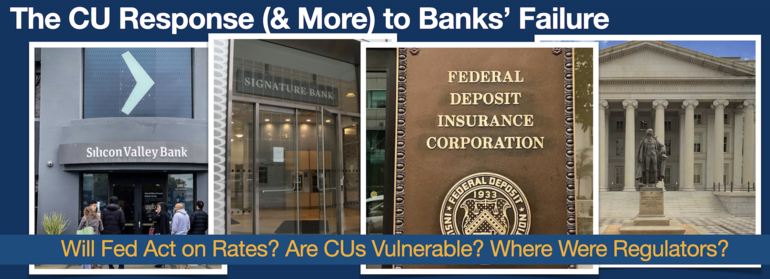
The collapse of the $212-billion Silicon Valley Bank is the second-largest failure of a financial institution in U.S. history. And one point of irony: Among those on the board of the failed Signature Bank is Barney Frank, the former Massachusetts congressman who championed his namesake Dodd-Frank Act, which was passed in the wake of the financial crisis and designed to stop big bank failures, among other things.
Responding to Fears
The move by the federal government came after there were fears heading into the weekend that customers that were billions and billions of dollars over the deposit insurance cap would lose their funds. The federal government’s announcement that even those far over the FDIC insurance threshold would be insured led one national voice to state that “banking is now officially a government-backed business, if it wasn’t before.”
The banks’ failures prompted critical questions similar to those in credit unions during the corporate CU crisis over where were the regulators; raised again the issue of concentration risk, and prompted critics to speak up after it was learned employees of one bank received their annual bonuses just hours before the bank was seized by regulators.

Michael Barr
Barr to Lead Review
The Federal Reserve has announced Vice Chair for Supervision Michael S. Barr is leading a review of the supervision and regulation of Silicon Valley Bank. The review will be publicly released by May 1.
"The events surrounding Silicon Valley Bank demand a thorough, transparent, and swift review by the Federal Reserve," said Chair Jerome H. Powell.
Added Barr, "We need to have humility, and conduct a careful and thorough review of how we supervised and regulated this firm, and what we should learn from this experience.”
The Significant Developments
Here are some of the more significant developments related to the bank failures both inside and outside credit unions:
What About Fed & Rates?
Some have speculated the failure of the banks may lead the Fed to pause its ongoing effort to push up rates, as rising rates are partly to blame for the banks’ failures (given management’s failure to hedge). But NAFCU’s chief economist, Curt Long, said the Fed is more likely to be influenced by the latest Consumer Price Index numbers, which are to be released today.
What About Risks for CUs?
When asked about any vulnerabilities credit unions might have with available-for-sale securities in their investment portfolios that are similar to those held by the failed Silicon Valley Bank, CUNA’s Chief Economist Mike Schenk said, “I don’t think the vulnerabilities are that great. The capital ratio at credit unions, which would account for any unrealized losses, is 9.2%. That’s about two percentage points lower than prepandemic, but really a solid reading overall relative to the 7% standard regulators deem to be well-capitalized. So, it’s a pretty significant capital buffer. We have begun analysis of individual institutions on unrealized losses and it appears pretty low. We don’t see any outsize exposure to unrealized losses.”

Mike Schenk
Schenk noted Silicon Valley Bank had an unusual amount of concentration risk in industries that were vulnerable, primarily start-up tech firms.
‘Sketchy Collateral’
“Second, the collateral was kind of sketchy,” Schenk said. “Many of the loans made were backed by bonds issued by start-up companies. Third, one of the defining characteristics of that situation is they had this significant investment in long-term bonds, which generally speaking would not be a big deal if held to maturity. But the real problem is that institutions in particular seemed to have a very large amount of uninsured deposits. Over half of deposits were uninsured. That essentially is what caused the run and created the issue, and not just for that bank but for banks that had an association with Silicon Valley Bank.”
Schenk said approximately 8% of deposits in credit unions exceed the NCUSIF’s $250,000-per-account insurance limit and are uninsured.
“With rates close to zero, financial institutions have been searching for yield, so they went out a little longer than they typically would. Usually, that’s not that big of a deal,” said Schenk. “But in a rising-rate environment, those investments were losing value. That’s unusually manageable, but when you have that level of uninsured deposits it’s what happens when you are forced to liquidate at a loss.”
‘Unique to That Institution’
Similarly, NAFCU’s chief economist, Curt Long, agrees that many of the issues around Silicon Valley Bank were “unique to that institution.”
NAFCU’s SVP of government affairs, Greg Mesack, concurred. “Silicon Valley Bank and Signature Bank had profiles that were very unique, and not just for the huge number of uninsured deposits but also the focus on unique assets and their liabilities. Silicon Valley Bank’s liabilities were largely venture and startup businesses. Signature’s were largely crypto-related.”

Todd Harper
Statement From NCUA
NCUA Chairman Todd Harper issued a statement saying, “The credit union system remains well-capitalized and on a solid footing. The National Credit Union Administration continues to monitor credit union performance through both the examination process and offsite monitoring, and it will continue to do so into the future.
“Credit unions have access to a wide range of liquidity sources. The NCUA, along with its Central Liquidity Facility, is able to provide a back-up source of liquidity to member credit unions as needed.
“The agency continues to coordinate with the other federal financial institution regulators to ensure the continued resiliency of the American financial services system.
“As always, the NCUA is committed to the protection of credit union members and the safety and soundness of the credit union system overall. No one has ever lost a single penny of insured share deposits within the credit union system.”
Associations Respond
In California, home to Silicon Valley Banks and many of the tech start-ups affected by its failure, the California and Nevada leagues issued a statement that “local credit unions stand out as a reliable and secure option for consumers. Offering traditional financial products and services, credit unions are not-for-profit financial cooperatives primarily serving local consumers and small businesses in their communities.”
In its statement, the league said:
- California credit unions are among the most well-capitalized financial institutions, maintaining equity reserves and liquid investments that prioritize safety and soundness for their members. California credit unions have more than $29.9 billion in equity reserves. Combined with $51.4 billion of available liquidity, credit unions in California have the “reserves to protect their members and weather shocks to the financial services market.”
- All deposits at federally insured credit unions are protected by the National Credit Union Share Insurance Fund.
The CrossState Credit Union Association, which represents CUs in Pennsylvania and New Jersey, said it has issued “talking points” to its member CUs.
Credit Union Borrowings
In a posting on his blog, Chip Filson noted that prior to last weekend, liquidity was growing tighter for all credit unions.
“Share growth reversed in the second half of 2022,” wrote Filson. “The early results from 2023 show continued deposit challenges. Consumers are once again learning about the returns and liquidity in money market funds.”
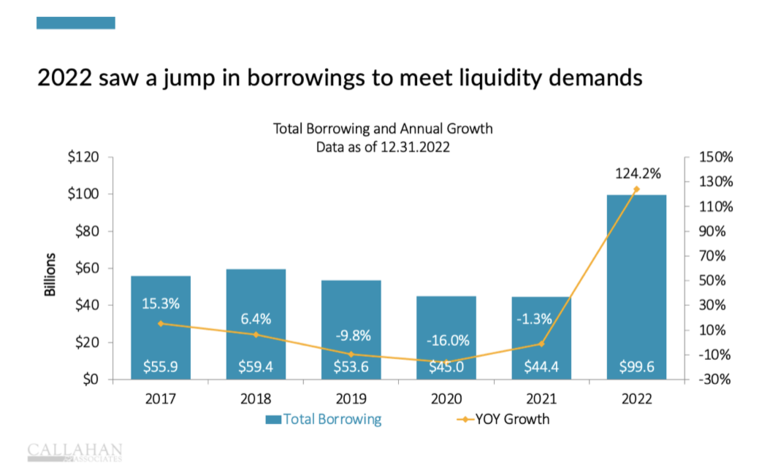
In his review of credit union data, Filson said that at year-end 2022 1,193 credit unions had borrowed a total of $99.6 billion, or 4.6% of total assets. Within these totals 797 credit unions reported $92.3 billion from the FHLB system, up 318% from the year earlier.
“In contrast 436 credit unions reported loans of $2.3 billion from the corporates. Several corporate CEO’s reported that their overnight short-term settlement loans had risen from only a couple of dozen a year ago this time, to over 250 per day in the recent months,” Filson wrote. “In Callahan’s Trend Watch call for Q4 2022, a whole new section of charts portrayed the system’s changing liquidity picture: the drawdown of investments and increased levels of external funds. The presentation reported that borrowing credit unions’ loan to share ratio was 82%. For those without borrowings, the ratio was 58%.”
Questions Over Bonus Payments
Silicon Valley Bank said it has historically paid employee bonuses on the second Friday of March, but this year’s timing has raised the ire of many. The payments were for work done in 2022 and had been in process days before the bank's collapse, according to one report. The payouts were made at the same time the bank was experiencing a deposit run and came just before the FDIC seized the bank. According to CNBC, the size of the payouts couldn't be determined, but SVB bonuses range from about $12,000 for associates to $140,000 for managing directors, according to Glassdoor.com. SVB was the highest-paying publicly traded bank in 2018, with employees getting an average of $250,683 for that year, a report by Bloomberg shows. More details can be found here.
New Bridge Banks
In the wake of the failures two new “bridge” banks have been created, similar to the bridge corporate credit unions that NCUA oversaw more than a decade ago. A bridge bank is a chartered national bank that operates under a board appointed by the FDIC.
Signature Bank had total assets of $110.4 billion and total deposits of $82.6 billion as of Dec. 31, 2022.
In the case of Signature Bank, all the deposits and substantially all of the assets of Signature Bank go to Signature Bridge Bank, N.A., a full-service bank that will be operated by the FDIC as it markets the institution to potential bidders. The bank has 40 branches across the country in New York, California, Connecticut, North Carolina, and Nevada
‘Everyone Wants to Know’

Travis Goodman
“So far, client concerns and member concerns have been limited; however, everyone wants to know how SVB’s failure will impact their credit union,” said Travis Goodman, principal with ALM First. “It’s likely too early to say but SVB had a significant distinction from the credit union industry in that its deposits were primarily above the FDIC’s insured limits and its capital ratio was well below what is considered normal in credit union land.
“SVB had a five-year asset growth rate of 256% compared to credit unions’ 49%. This is potentially an opportunity for credit unions to remind their members that they are a strong and reliable depository option that remains available due to their safety and soundness practices and high concentration of insured deposits,” Goodman continued. “We have seen a few credit unions highlight some of these distinctions and benefits to their members and expect to see more of this in the coming days.”
Monitoring the Situation
CUNA’s Jason Stverak said the trade group continues to “monitor” the situation and is continuing to communicate with its member credit unions and credit unions themselves.
“Obviously, this should not be taken lightly but everyone should be reminded America’s credit unions are safe and secure and not one member has ever lost dime in a federally insured credit union.”
New Push for Central Liquidity Facility Powers
Representatives of both CUNA and NAFCU said they expect to see a renewed push by NCUA to push Congress to extend the expanded authorities given the Central Liquidity Facility during the pandemic. The failure of the banks and the backstop funding Treasury has made available could add new impetus to pass such legislation, such as one bill currently before the Senate, said Stverak, who called the passage of such a bill “incredibly important” to provide assurance to “credit unions in case they run into any liquidity issues.”
The expanded CLF authorities expired at year-end 2022.
Scams Follow Failure
Not surprisingly, some fraudsters acted quickly to prey on the bank’s customers. Among the scams has been targeting customers of businesses that banked with SVB.
‘Let’s Admit It’
One national voice said the federal government’s actions send a clear signal.
“Let’s admit it: Banking is now officially a government-backed business, if it wasn’t before. Once the government guarantees all deposits, the ‘business’ of banking isn’t much of a business — and maybe shouldn’t be,” wrote Andrew Ross Sorkin, who oversees the New York Times’ Dealbook reporting. “This is likely to become the biggest debate of the coming weeks and months. The venture capital community, a group that includes a vocal group of libertarians, was just bailed out. Yes, these investors do good by funding start-ups, but they have also long lobbied for fewer regulations and also benefited from the special treatment of carried interest. This all looks particularly egregious after some of them spent the weekend begging for government help.”
Sorkin argued that if Silicon Valley Bank was just a small regional bank that did not have ties to loud, politically connected venture capitalists and the tech community, it might have been allowed to die — and its customers, individuals and small businesses, “would have suffered.”
Additional Points Raised
Sorkin also suggested in the Times:
- Regulators will likely force small banks to raise their capital requirements to a level similar to bigger banks, and as a result “costs for businesses and consumers will go up in the short term. That, of course, comes on top of higher interest rates.”
- Regulators “should have kept a closer eye on small banks. They spent too much of the past decade or so focused on the big banks, because they apparently didn’t think that small lenders posed a systemic risk. But guess what? We have now decided that regional banks are just as risky.”
- “Some of these institutions, including SVB, pushed back on more regulation, arguing that this wouldn’t allow them to compete with their bigger rivals,” wrote Sorkin. “Silicon Valley Bank wrapped itself in the flag, arguing that it was supporting small start-up businesses.”
Other Developments
- HSBC said it plans to buy the Silicon Valley Bank’s U.K. operations for a symbolic 1 pound ($1.21).
- JPMorgan and PNC Financial are reportedly still pursuing a deal for Silicon Valley Bank’s holding company, which includes asset management and a securities division and excludes the commercial bank now under FDIC control, the Times reported.
- Lever News reported that allies of Silicon Valley Bank had opposed a higher deposit insurance surcharge from the FDIC to protect customer money.
- One of the board members at the failed Signature Bank in New York is Barney Frank, the former Massachusetts Democrat whose name is half of the Dodd-Frank banking regulations put in place after the financial crisis of a decade ago.
- Similar to the scrutiny applied to NCUA in the wake of the corporate credit union failures, The Financial Times is reporting banking regulators face questions about how they missed red flags at Silicon Valley Bank, while the Wall Street Journal reported that venture capitalists were criticized as helping to spark a run at the lender.
- The New York Times said SVB executives are being criticized for mismanagement, including by failing to hedge against rises in interest rates.
- Silicon Valley Bank shareholders will see their holdings wiped out, with a number of analysts noting that is a key difference from the Troubled Asset Relief Program, the sweeping banking bailout that saved U.S. lenders during the 2008 financial crisis.