

By Ray Birch
LAKE FOREST, Ill.—Those credit unions that are most inefficient are going to be the big losers in the deposit war given the pressures to pay high rates, according to one analyst.
Mike Moebs, economist and chairman of Moebs $ervices, pointed out what every CFO knows all too well, that, as he observed, “A day does not go by without at least two offers of 5% or more on deposits for consumer or business funds. And they come via email, snail mail, phone, and even text. My first reaction—what recession?”
Moebs $ervices researched financial institutions that hold significant market share nationwide and control more than 53% of all deposits. Moebs termed the results “startling.”

“Depositories are starting to pay the riskless saver an appropriate rate,” said Moebs. “The saver was always in the backwater of financial gain. Paying the common person a rate competing with Wall Street is startling. The saver can still stay in riskless mode, putting part of their paycheck in deposits but be paid the proper rate. The other thing that startles me is Walmart is paying the highest savings rate.”
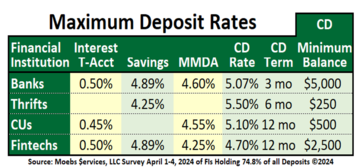
Specifically, the Moebs Services study revealed Walmart is paying 4.89% on the first dollar in a savings account.
‘Simple’ Reasons
Why are the high rates being offered? Moebs cited several, “simple” reasons:
- “The consumer and small business had an epiphany during COVID. Silicon Valley Bank failure signaled the federal government is going to protect every deposit dollar even beyond deposit insurance caps.”
- “About $1 trillion in stimulus funds are still in consumer and business checking, and $1.5 trillion in savings per Moebs Services surveys of over 3,600 FIs in January 2024.”
- “Deposits got more lookovers during work-from-home COVID compliance. Nationwide, less than 50% have returned to physical offices. Workers now can explore deposit options daily and still get their jobs done.”
- “Money moves faster digitally, with no in-person transfers necessary.”
- “Low-expense-to-assets-ratio FIs have seized a chance to pay more for funds to make more loans or investments.”
“Bottom line: Efficient FIs with fewer, but well-paid staff, are gaining market share, since these FIs can afford to pay higher cost of funds yet improve net interest margin,” said Moebs.
Who’s Paying

Michael Moebs
Moebs detailed who is paying the top rates, focusing on four deposit service categories:
- Interest Paying Transaction Accounts (T-accounts). “How do you keep the trillion sitting in T-accounts? Pay interest. Thrifts are excluded, since historically T-Accts are not their focus. Fintech Sofi offers the highest at 0.50%. Most FIs put higher rates on savings, MMDAs, and CDs with the hope of developing a relationship using pricing.”
- Savings. “As previously noted, Walmart is paying 4.89% on the first dollar in a savings account. The thrift Flagstar Bank and Citibank are near Walmart’s rate, too. It appears more than 4% is sufficient to stop the consumer from sending money to government money market mutual funds.”
- Money Market Deposit Accounts. “Thrifts and fintechs shy away from MMDAs. CUs and banks provide high rate MMDAs. Mountain America Credit Union and Huntington Bank focus on MMDAs with high rates.”
- Certificate of Deposits. “Low minimum balance to get high rates and short terms are prevalent in CDs. All four types of FIs compete for CDs. State Employee CU in North Carolina pays over 5% and beats Navy Federal CU, since State Employees allows only $250 to pay a high rate while Navy FCU requires $100,000 to start.”
As Crucial as Loan Pricing
Moebs asserted deposit rate pricing has now become as crucial as loan pricing and investment yield for all FIs.
“The times have changed,” said Moebs. “Depositories used to pay little or nothing on deposits. The saver is riskless and doesn’t want Wall Street risk—that was the old view. Yet the saver has learned, or forced their FIs to learn, government rates or even government money market mutual funds provide the same return as deposits and are the same as funds with deposit insurance.
“Most FIs have learned they must pay market rates for deposits and can do this by cutting expenses to keep a good bottom line intact,” continued Moebs. “The FI that tries to pass deposit rate increases onto loan borrowers will soon have no borrowers. The bottom line will grow by lowering costs as deposit rates increase. And the prosperous ones have accepted that the cost of funds will rise permanently. Deposit pricing is linked to lower expenses allowing higher deposit rates.”