

ANAHEIM, Calif.–Airbnb isn’t about finding or offering accommodations: instead, it’s about something far deeper and more connected, and as one of its executives made very clear here, it has found its brand’s value has something very much in common with credit unions.
Airbnb, which has exploded in popularity, now has about 1.5 million properties around the world, larger than any hotel chain, and it is now in the process of expanding into Cuba. But as one Airbnb exec made clear, the company is NOT about the rooms for rent that it offers nor the number of countries in which it operates, or its easy-to-use digital platform.

Andrew Shapiro of Airbnb speaking to CUNA Marketing & BD Council meeting in Anaheim, Calif.
Instead, stressed Andrew Schapiro, Airbnb’s creative director, the company is all about “community.” It’s a realization the company came to after a deep and comprehensive review of what it is all about as part of a rebranding that followed its rapid growth.
The story of how Airbnb got to its branding position and value proposition was shared by Schapiro during the CUNA Marketing and Business Development Council meeting here. It’s a story with a core lesson for the credit union brand.
“In the beginning of 2012 we were going global and our community was growing very quickly,” recalled Schapiro. “We opened 12 offices around globe in six months. A year later we began thinking of rebranding, but why, since things were going so well? There was a disconnect between a staid logo and the experience people were having with Airbnb.”
Schapiro said the concern within the company had become that it was growing quickly and word-of-mouth was robust, but users—both hosts and guests—were experiencing Airbnb differently from the way the company’s employees were.
“Many people were putting homes on Airbnb because they needed the money, so they opened their homes,” said Schapiro. “And yet the brand wasn’t building a real sense of trust. It was a real challenge for us.”
Similarly, from an internal perspective, the company was acting just as a Silicon Valley “teenage start-up” was expected to. “Our brand fit nicely into that, but the reality and the way we spoke of ourselves inside our walls was something much different. We thought of ourselves as a brand that could leave a brand on a generation.
The Core Reasoning
But the core reason for the rebranding of Airbnb—which was started when its CEO rented a living room in order to help pay the rent—was that when its three co-founders traveled to New York City where it had the greatest number of hosts, it heard a different theme when it visited with both users and hosts.
“They were literally building things overnight, and the site would change overnight based on that feedback,” said Schapiro.
One of the things that came out of that feedback: the Airbnb team went into people’s homes and took professional cameras. “Now their properties were showing up 10 times better than they could ever do on their own, which benefitted them but also benefitted us,” said Schapiro. “That idea sparked something much bigger, so today we have a photo program with 2,500 photographers around the world who are available free to shoot photos of their homes.”
But while the technical improvements were great, it still wasn’t what Airbnb was all about. When Hurricane Sandy struck New York City it helped to begin clarifying the vision. One of Airbnb’s hosts wanted to offer rooms free to people who were stranded, but the company discovered its coding didn’t permit free rooms. So it worked for 48 hours to change the code and make it work, and now Airbnb has a whole disaster relief platform.
“It all started with listening to one of our users,” said Schapiro. "The reality here is our community makes us better. Community is part of our DNA.”
“We realized that our community, these people, are our product. It’s not the website,” continued Schapiro. “Without them there would be no website; they are the ones who have created everything for us, and that’s why we needed to rebrand. So how do you design for a community driven brand? It’s not how you just design for this audience, it’s how do you design the brand itself.”
'Would I Want To Sit Next To This Person On A Long Flight?'
Schapiro said he and his team were charged with creating something that reflects the diversity of experiences Airbnb provides, as well as reflecting that Airbnb hosts and guests are stakeholders in the brand.
“We met with nine different design firms from around the world and had them present to us. We challenged them, and thought about how they would map back to our values,” said Schapiro. “One question we would ask ourselves, ‘Is this someone I would want to sit on a long flight with?’”
Airbnb finally selected London-based Design Studio, which he said showed “incredible passion” for Airbnb. When the San Francisco-based Airbnb staff traveled to London, they found Design Studio had built an Airbnb home in their office space.
“We challenged them to work more closely with us than they ever had with any client. We brought them to San Francisco and began with an immersion. We had them meet with 45 different people across the company,” said Schapiro. “After they had come to San Francisco, we had four members of the team go stay in an Airbnbs. We wanted them to meet our hosts and live as Airbnb travelers. We had a team of four who went to 13 different cities and stayed in 18 different Airbnbs.”
Some of the takeaways the team gathered from the Airbnb hosts:
- Hundreds of people have had my keys and I don’t think twice about it.
- It is a place where the world comes together.
- It is like a playground for your imagination.
- I came to Airbnb by parachute; now it is my life.
“All of this led to a realization that when we were creating design principles that this was key: the brand must be a reflection of the community,” said Schapiro. “We honed in on these principles and explored all the different possibilities. We had the team open up their process; we weren’t looking for a final keynote presentation; we wanted to know how they thought. All of this was around ideas and sketches, not final products.”

As it sought to develop its new brand Schapiro said the a-ha moment came at the recognition that “at the core of all of this is a feeling of belonging. We looked for a symbol of belonging. That’s what we heard from all of our customers and users. So the challenge from our CEO was not just about the logo becoming iconic, it has to be a symbol for connecting all these millions of people. And the challenge became how do you create a symbol of belonging. That was different for me, who had come into this thinking about a multi-state brand, and this iconic symbol idea was at the other end of the spectrum.”
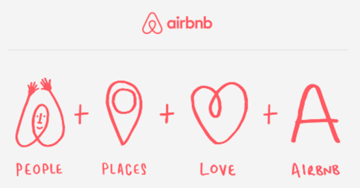
In the end the logo the company settled on was the result of People + Places + Love = Airbnb, according to Schapiro.
Consumers can now go to create.airbnb.com where they can customize the logo and brand and put it on t-shirts, business cards and more. “It’s all for our brand ambassadors. It lets you show your own unique place in the community.”
Rolling Out The Brand
In February 2014 the company hosted its first “One Airbnb” company meeting with more than 800 employees. It introduced the new brand to employees even though plans were to not roll it out for several more months. Later it did the same thing for some of its hosts. “We did this in veil of secrecy and we trusted them.”
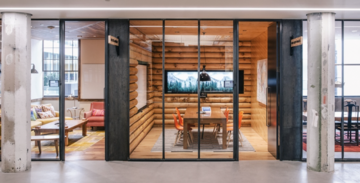
The offices of Airbnb, which are designed to reflect various properties its hosts offer around the world.
In July, 2014, the new brand was launched publicly with private web feed from San Francisco to about 100,000 hosts who were invited. “We were fully prepared with two war rooms set up for any response,” said Schapiro. “We had a social media war room, and another for responses from the Airbnb community. Some people in the community didn’t like it. Some people said ‘This looks amateurish’ or ‘You got it all WRONG.’”
The new logo was accompanied by a new tagline, “Belong Anywhere.”
“As we went out and listened more we heard more incredible stories,” said Schapiro. The company has compiled those stories at airbnb.com/belonganywhere.
“We thought beyond just digital. We wanted to experiment. People talk about leaving print for digital, but you don’t leave print behind,” said Schapiro. “We have experimented with print with a magazine called Pineapple, which shared stories of Airbnb members. This actually became one of our most talked about brand moments in 2014. It was also talked about in major media outlets. Print maybe isn’t dead; maybe print can still have an impact.”
With community at its core, Schapiro said the company has taken its employee meeting model and expanded it to include its hosts through events it calls Airbnb Open. “It allows hosts to see themselves as part of a community instead of a digital platform,” said Schapiro. A recent Airbnb Open in Paris attracted more than 5,000 people.
Today Airbnb’s offices area a physical embodiment of the connection it has sought to build between employees and hosts. Among those who report into Schapiro are architects and designers who have built meeting rooms at Airbnb’s offices that look just like various homes that are available on Airbnb.
“We experience our brand every day and are constantly reminded of this community outside our walls,” said Schapiro.
For those who want to learn more, visit airbnb-superbrand.com (do not add the www).
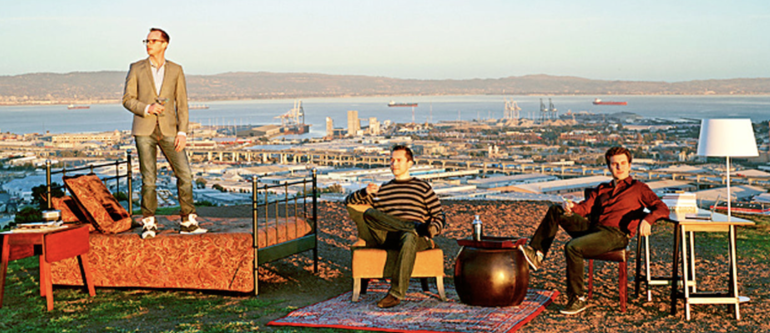
The cofounders of Airbnb.