

SAN ANTONIO—A new analysis that measures how prepared credit unions are to meet the innovation needs of members reveals some clear gaps between the “Early Launchers” and the “Laggers”—in other words, those CUs that are positioned to succeed vs. those that are not, according to one person.
During a panel discussion as part of the PSCU/Co-op Solutions Member Forum here, results of an extensive study of credit union leaders, members and others that resulted in the Innovation Readiness Index was discussed, with perspective shared by the researchers, credit union CEOs and PSCU/Co-op Solutions.
The ongoing study was conducted by PYMNTS.com and underwritten by what was then PSCU.
The panel was moderated by Brian Scott of PSCU/Co-op Solutions. Panelists included Karen Webster, CEO of PYMNTS.com; Paris Chevalier, president and CEO of South Bay CU; Chris Harlan, president and CEO of U of I Community Credit Union; and Denise Stevens, EVP, chief product officer with PSCU/Co-op Solutions.
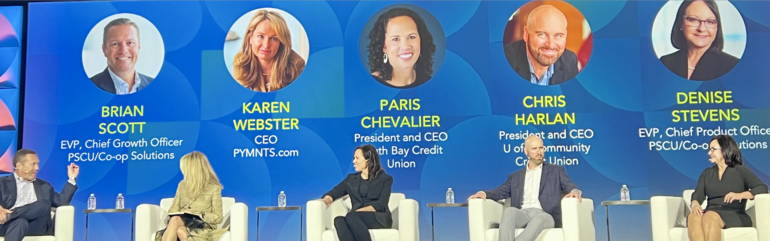
Here's what was discussed:
Q: This study was around innovation. What did you find?
Webster: For the last six years we have been taking the temperature of trends around the credit union member experience by talking to fintechs who partner with credit unions, members who actually take advantage of the services that credit unions offer, as well as credit union executives themselves, to get a sense of trends in innovation and direction and so forth.
This year we wanted to take a bit of a different approach. We really wanted to understand what is going to drive innovation and prepare credit unions to meet member needs not just today, but in 2030. We've got about five-six years to prepare for that, so we really wanted to understand a little bit more about that portfolio, credit union members and credit union executives, and fintechs. What was going to drive that experience?
So, we collected more than a million data points across those stakeholder groups. We examined a variety of different metrics within the credit union. We looked at business performance. We tested 50 different products and future sets that credit unions are making available today and examined their road map over the next three to six years.
Measuring Innovation Readiness
From that we used a bunch of statistical methods to create this Innovation Readiness Index. Two things we did that are worth noting is, one, we identified top performers. What is it that makes a top performer a top performer? A top performer is defined as a credit union that is meeting the needs of members today but positioning themselves for what members are going to want in the future, based on what credit union members are telling us about the features they use and the features they want to see being made available.
Then we asked credit unions to do a self-assessment of how innovative are you? Are you an early adopter of credit products and services that are on the forefront of mitigation. Are you a lagger? Are you a quick follower?
I’ll start with the self-assessment. What percentage of credit unions say they the early launchers? Eleven percent. What percentage are Laggers? About 21%, twice as many as Early Launchers. Forty-one percent characterized themselves as Quick Followers. The balance are Followers.
The Point of Separation
What separates the Early Launchers from the Laggers? When we cut through all the data we observed a couple of things. First of all, the early launchers are very much in on testing and learning ideas within the member community and with their own employee before they roll things out. So, they have a good sense of what members really want and they have an opportunity to kind of test and learn and refine before the big rollout happens.
We see the Laggers are really too product-focused and very much dependent upon what vendors are offering, very much dependent upon what third parties tell them they should be doing.
When you ask Early Launchers and Laggers what is the return on investment in innovation, not surprisingly, only 43% of Laggers say they feel they got a return on investment in that innovation they put into the market. One-hundred percent of Early Launchers say they're satisfied with the return on investment and innovation for the things that they have put into the market.
So, there's a lot of really interesting color commentary around the spectrum of how credit unions assess themselves and their ability to really involve, personalize and stay in touch with what members really want today.
Q: Are you an Early Launcher?
Chevalier: We are smaller (in assets) but we partner with our core to pilot and get things out.
Harlan: I truly believe we're a Fast Follower and there are definitely innovations, products and things that align with our strategy really well that we will act on very quickly. We've done alpha testing and beta testing, those different things, but in general I just feel like we have to be right more often than not because of our size and limited resources.
Webster: The interesting thing is how collaboration is fine with third parties, but it’s understanding that you are directing vs. they are directing. I think that’s why some of what we see in the ROI calculation is, is this off the shelf or is this what is right for the member?
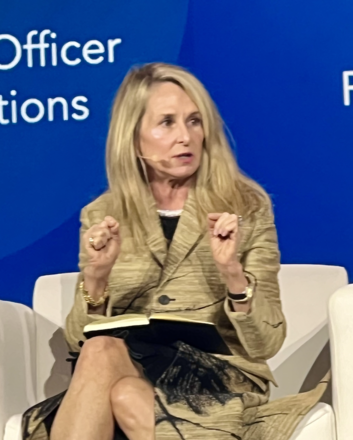
Karen Webster
(In the research) the Fast Followers have seen a 40% increase since Q4 2022. It’s a sign that credit unions understand you don’t necessarily have to be first, but you have to be quick.
Q: You get to see a lot of CUs and where they are in the innovation spectrum. What do you see?
Stevens: I’m not surprised by the data. We have credit unions that when we go out and say, ‘Will you help us pilot something?’, they sign up right away. Others are more hesitant. They say, ‘Hey let me see some other credit unions use it first.’ I see a pretty wide range and I think that the point is it’s going to be a little bit balanced. Innovation doesn't all have to be groundbreaking. It really is about understanding what your membership needs and wants and then being able to show up for that.
Q: What about member churn as it relates to innovation? Tell us about that.
Webster: Not surprisingly, there is a strong correlation between member churn and a reticence to integrate innovation into the credit union roster. The top performers. see 4.7% churn. They invest in innovation more, about 13.78% (of budgets). More innovation, less churn. These are also the credit unions that are very much in touch with member needs today and anticipating member needs tomorrow. The Laggers see 7.5% churn and they invest less. You can see the correlation.
Q: Tell us about churn at your credit union.
Chevalier: Our churn is very low. We lose 10 to 15 members a month and we do look at that very closely. Most of it is because they're deceased and if it's not, then we do look and reach out to that number to find out why did they closed their account. We really want to make sure that that churn is very low. If they give us an idea, like ‘You didn't do XYZ’ or ‘You don't provide this service,’ then our team really does take that to heart to see how can we provide that. It doesn't have to be aggressive, but it does need to be really refining it or something you do with our touch points to make it a little more member friendly.
Harlan: Our churn rate is just below 5% and it’s improving year over year, as well. I think it’s that PFI relationship that is creating that. They are engaging in mobile banking. The products are portable. In the raw data, the main reason for closing is charge-offs, which I’m not that excited about, but it shows the reason for leaving is they are not always self-selecting.
Stevens: There are three main factors for churn. You have to have a digital strategy. You have to understand who your member is. The data should be your best friend. It tells you true behavior, but also the changes. They have an expectation you will show up for their behavioral changes. And the third is around streamlining processing. You know how complex payments are, but members don’t care about the complexity of payment services.
Understanding all these points is critical.
Q: Where are your next investments?
Harlan: We think about the member first, so we have looked to member-facing technologies as the place to start. We find the pain points and try to solve through technology. That’s the first step. Where we lag is in creating innovation on the backend, especially automation. I think we have a tendency not to invest in those areas because our staff is picking up the pieces.
That’s the next piece for us in creating efficiencies that the member will see and feel, but it’s not as visible.
Q: What does the research show about contactless cards?
Webster: Seven percent of Laggers offer contactless; 84% of leaders have contactless. Thirty-two percent say in the next three years maybe we will get to it, and 14% say they will never, never be offer contactless. It’s table stakes. It’s a basic requirement. People want a contactless card. Without it, it’s the bottom of the barrel. That’s puzzling.
With mobile wallets, we see similar things. Ninety percent of top performers offer mobile wallets, 10% of bottom performers do. You kind of wonder why they say they will never get there. Mobile, contactless, digital--with Gen Z, it is integrated with what people do every day.
Q: What about Gen Z?
Webster: This is people ages 12-27. It’s 69-million people, 20% of the U.S. population. It’s the future. This is a digitally native population. With the iPhone, they didn't adopt it, it was part of their experience growing up. So, it’s not surprising the expectation is digital first. It's on-demand, it's on my phone.
That’s the table setting in terms of their expectations of financial services and credit unions in particular.
These are people who switch. Forty percent said they have switched financial services providers over the last 12 months. They follow financial services providers that give them the things that are relevant to them, and not everything is.
‘What’s Important’
Think about this age cohort and what's important to them. It's the basics. They want cards for people who are just getting into a financial services relationship. They want instant issuance cards so that they can use them in their mobile wallet. They want financial advice, which I think is interesting, and they want that from their credit union. That's an opportunity to really nurture relationships over time with a generation of consumer that is open to getting advice from their financial institution.
They want things that are not necessarily on the agenda of credit unions today, but buy now, pay later (BNPL) is very important to this cohort. So are small dollar, short-term loans to carry them over between paychecks.
The relationships that credit unions have to have with this cohort is very much digital first. This cohort doesn’t think of BNPL as credit. They see it as a payment plan, a budgeting tool.
Q: What else is unique about Gen Z?
Webster: They are fickle. They do change financial services providers at two to three times the rate their parents did. They won’t hesitate to bail. It’s easy for them to pick up and go. I think in many ways Gen Z could be the level playing field for all financial services organizations. I think it’s a really terrific opportunity for credit unions.