

By Ray Birch
WASHINGTON—The CFPB’s credit card late fee proposal appears to have more credit unions than banks up in arms over its proposal to limit credit card late fees, at least judging by comment letters filed with the Bureau.
That proposal would reduce the credit card late fee safe harbor to $8, down from the current $30 for a first violation and $41 for a subsequent violation within the next six billing cycles.
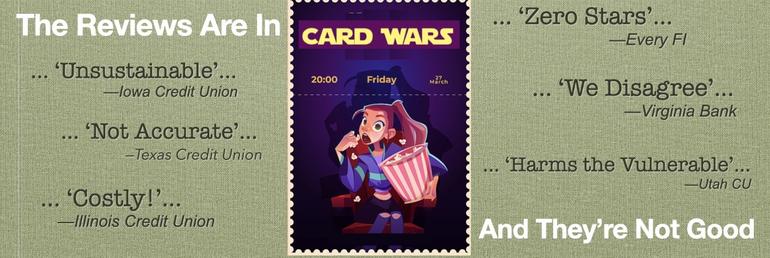
Following a review by CUToday.info of comments submitted on the proposed rule to the Bureau, the majority of those sharing their opinions are credit unions, their members and their trade organizations. Banks have also been submitting their perspectives, as well, but in smaller numbers and from smaller-sized institutions, the review shows.
The comment deadline was May 3.
In the comments offered, commenters share many of the same arguments over the plan, suggesting:
- The $8 fee is too low and does not reflect a reasonable charge to recover costs
- The small fee will encourage more account holders to be late with their payments
- A lower charge will lead to a tightening of credit and higher rates
- The CFPB did not conduct thorough research before producing the proposal
Both NAFCU and CUNA are objecting to the proposed credit card late fee safe harbor, citing similar concerns, as CUToday.info reported here.
Many of the responses reviewed by CUToday.info are form letters, including one from a credit union CEO who did identify herself but failed to fill in the blanks. Moreover, one credit union was responsible for numerous comment letters, Oregon State CU, which apparently did a good job of rallying member support for their cooperative’s perspective.
Can’t Recover Costs
Veridian Credit Union in Waterloo, Iowa, is among those that emphasized the $8 fee does not allow the organization to recover its costs of managing late payments.
“Reducing the safe harbor fee to $8, or as little as 25% of the required payment, would not cover the increased costs of administering an account with late payments,” the $7-billion CU wrote. “As a result, fewer credit unions would be able to issue credit cards to consumers when they are unable to cover their internal costs. Those able to subsidize the additional operating costs would still find it difficult to provide access to all consumers, especially consumers who are building or rebuilding their credit. As such, lowering the safe harbor fee to $8…would make these lines of credit unsustainable and less accessible to consumers.”
One of the most frequent concerns shared by commenters is a reduction to $8 would eliminate the deterrent for late payments, creating more late payments on more accounts. Veridian CU stressed that point, as well.
“Issuers would be forced to find other means to recoup the loss this creates, and it’s likely that many would turn to increasing rates,” Veridian said.
Concerns Over Consequences
Credit Human FCU, San Antonio, emphasized it supports the reasonableness and appropriateness of fees charged to consumers, but added, “However, we have concerns about the unintended consequences of this proposal.”
One consequence, the $3.7-billion CU stated, will have a noticeable effect on collections departments.
“To reduce credit card late fees down to $8…Not every financial institution is set up the same way and collection costs can vary across the industry,” CHFCU wrote. “The proposal’s blanket statement that $8 will cover collections is not accurate. It does not consider the varying expenses that financial institutions, especially smaller institutions, incur to be able to offer credit cards to our members.”
The credit union expressed additional concern about the proposal leading to members worsening their credit scores without a fee that prompts behavior change.
“A one-time charge of a higher late fee ($25) has more potential to change behavior than the smaller $8 fee. If the safe harbor is reduced to only $8, the consumer may end up paying more $8 fees over time due to the lack of change in their behavior,” the CU wrote.
A defense often shared by credit unions and their trade associations against fees targeted by legislators, such as overdrafts, has often been that CUs credit unions work to keep fees at a minimum.
‘The Only Fee Assessed’
I.H. Mississippi Valley CU, Moline Ill., argued that point in its comments.

“With regards to our credit cards, the late fee is the only fee that is assessed and passed along to our members and there are no other fees, besides cash advance fees. which are initiated by our members,” IHMVCU wrote. “Historically, our credit card late fee policy has worked for us and on average only 10% of our revenue is from credit card late fees and overall is a small percentage compared to other loan types. On average, IHMVCU assesses approximately $20,000 each month for credit card late fees.”
Further, the $2.1-billion credit union pointed out that if a member is not actively making payments on their credit card, it charges off the credit card within 90 days from the delinquency date.
“Therefore, if the member doesn’t make subsequent payments, then the member would only be able to receive a total of three late fees in the total of $75 prior to us charging off their credit card,” IHMVCU said. “We strongly discourage the CFPB from requiring financial institutions having to implement staggered late fees or to set rules on subsequent late fee amounts based on how many consecutive months they have been late. This would require financial institutions to make major updates to our core systems, which is often times out of our control, costly, and from an operations standpoint difficult to manage to ensure it is charging correctly.
“We also discourage additional notice requirements for members who have automatic payments set up and feel as though these payments should not be treated differently,” I.H. Mississippi Valley CU continued. “The proposed rule would impact our ability to serve our members and would not allow us to continue to offer our current credit cards products.”
Proposal is an ‘Assault’
There were fewer comments file by banks, but the Community Bankers Association of Illinois in Springfield said it “strongly objects” to what it called the CFPBs “assault” on bank fees. The trade group said credit card late fees are “legitimate, necessary, fully disclosed, accepted by the consumer, and applied equally to those that do not make their required charge card payments on time.”
“To mischaracterize fees as the Bureau continues to do is as unjustified as it is offensive,” the group wrote. “It is also inappropriate for the Bureau to interfere with the banks it regulates in their legal offering of products and services because the CFPB has chosen to find the practice objectionable despite evidence from consumers and bankers to the contrary.”
Not A Profit Center
First Bank and Trust, Lebanon, Va., stated it does not charge fees as a means of creating another profit center.
“FBT imposes fees to recoup the costs and expenses as a result of a consumer mishandling a financial product, not as a means to make significant financial gains. FBT works to keep fees reasonable for consumers and align fees with community banking peers in our geographic markets,” the bank wrote.
The bank said it understands the CFPB’s intent is to protect cardholders by keeping credit card penalty fees reasonable, but added, “However, we disagree that late fee amounts should not exceed 25% of the requirement minimum payment. FBT credit card late fees are well within current safe harbor limits and actively serve as a deterrent for cardholders in making timely credit card payments.
“The CFPB’s proposal to reduce maximum late fee amounts does not take into consideration how associated late fees act as a reasonable consequence for cardholders making late credit card payments,” it continued. “By reducing maximum late fee amounts, cardholders may not be as incentivized to make timely payments due to the lesser consequence of making a late payment.”
What is the Thinking?
The $2.1-billion Oregon State CU, Corvallis, Ore., which as noted above marshalled significant support from members who weighed in on the proposal, was among a number of commenters that questioned the CFPB’s thinking and research behind the proposal.
“It is unclear under what framework the CFPB has developed their proposed credit card late fee model; however, it appears to have bypassed the full evaluation process,” Oregon State wrote. “By not convening a small business review panel in accordance with the Small Business Regulatory Enforcement Fairness Act (SBREFA), the CFPB has greatly understated the harmful effects their proposal will have on not-for-profit financial institutions through reduced fee revenue and how it will negatively impact consumers who will bear higher costs for credit.”
The SBA Weighs In
The U.S. Small Business Administration shared a similar perspective.
“For this particular rulemaking, the CFPB estimates that there are approximately 3,780 small banks, of which approximately 498 report outstanding credit card debts on their balance sheets. The CFPB also estimates that there are approximately 4,586 small credit unions, of which 2,785 report credit card assets…The CFPB does not have sufficient information to indicate that small institutions contribute to the problem that is the target of the regulation.”
Unclear Reasoning
Utah-based Mountain America FCU joined in in suggesting the CFPB’s rationale for the proposal is off the mark, arguing it fails to provide insights into how the $8 fee was determined.
In addition, Mountain America said, the rule is going to have some negative, unintended consequences on consumers if enacted as proposed.
“The objective and reasoning for the proposed changes is unclear, and rather than improve the credit card market the changes will serve to harm the most vulnerable populations,” the $17-billion, Sandy, Utah-based CU wrote. “In the proposed rule, the Bureau suggests that the current safe harbor limits are neither reasonable nor proportional, discounting the rule making process followed during the implementation of the CARD Act. At the same time, the proposed rule does not provide evidence regarding how the proposed $8 safe harbor limit was determined. The data referenced in the proposal has not been made available for review and analysis, thus raising questions about how an $8 safe harbor was determined to be reasonable and proportional and how it would serve to deter consumers from making late payments.
“The Bureau requested comments on this preliminary determination but a lack of transparency into the data referred to in the proposal makes it impossible for commentors to provide researched and reasoned responses to the proposal,” the credit union wrote.