

RALEIGH-DURHAM, N.C.–To really think about what debt means for people—how debt feels for people—it’s best to think of it in terms of “financial citizenship.” And to make people full financial citizens, credit unions were told they need to change their approaches to financial literacy.
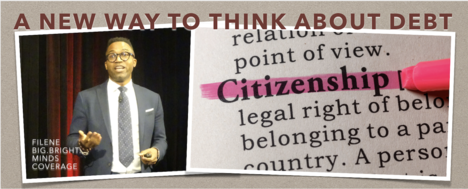
“Citizens have a membership card, live where they want, work without special permission, and have a defense from outside aggression. And you may even be called upon to participate in that defense,” explained Dr Frederick Wherry, a professor of sociology at Princeton University in remarks to Filene’s big.bright.minds meeting. “When we think about credit and debt, the way we think about citizenship is how they experience their financial lives. When they don’t have a credit score, you are not able to live wherever you want to, you can’t get a job or a promotion at work. And people in a lot of debt will tell you people feel they can treat you any way they like.”
Wherry said that point was driven home to him in a “sad way” in remarks made by one person in California who was in debt and who said the founding principles of the United States did not resonate with him as he felt so disrespected and lacking in freedom.
Even credit scores, which are ideally a “neutral number,” can have non-neutral effects, according to Wherry. “It’s better to have a neutral number. But what if the same number has a different effect by virtue of whether you are a different gender or color?
For credit unions and other lenders, Wherry urged his audience to understand numerous pieces of research show lack of credit and carrying debt has a strong influence on self-esteem. But Wherry said that understanding must come at a deeper level, as how debt and credit are perceived is different among different groups.
Class Differences
“If you are middle class, the first thing you want to do is get some credit card debt, because it indicates to you you’ve arrived in adulthood,” he said. “It has a positive effect. If you are from a lower economic background, it has no effect. But lower class people see a positive in total education debt, as it indicates sacrifices to invest in the future. When you follow the same people over time self-esteem starts to go down when it appears you are never going to get out of the debt. It’s about what you’re able to do with debt over time.”
How Financial Education Must Change
Wherry called on credit unions to rethink their well-intentioned financial literacy efforts, much of which he suggested goes wasted.
Knowledge may be power, said Wherry, but education isn’t enough. He cited an analysis of 201 different studies that found financial literacy explains a tiny 0.1% of the variance in financial behaviors.
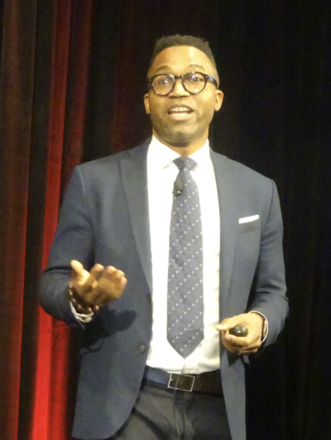
Dr. Frederick Wherry speaking to Filene meeting.
There are several reasons for that, said Wherry, who pointed attendees to the website www.dignityanddebt.org.
“It’s not what you know, it’s who you care about,” he said. “What we do know is if you look at people who are similarly situated and look at the sets of social networks and family ties they have, if you have more family members who have a lot of need for help, you have less money available for asset building and feel like you have less choice. It’s the network effect.”
Another failing, said Wherry, comes in approaching the challenge by attempting to get people “to do something else.”
“One of the problems is we try to fix people, but maybe the solution is to fix ourselves,” said Wherry. “They have decision power—they are a citizen, they get to make choices. Make sure to respect their time using coordination, and try to pull down some of the risks and worries.”
The View from Debtors
Wherry said he and other researchers poured through 25,000 CFPB complaints around non-federal loans. The typical complaint was how their debt was affecting their families and relationships, he said.
“People feel harassed about debt,” Wherry explained. “Whatever the complaint, nothing happened to them. They got a letter about the rights of the lender to make claims. But one thing that really mattered to consumers was it was endangering or damaging the people they loved and bosses also being contacted. People with children felt child support money was being taken away. So the hidden costs are family troubles, risks to employment and diminished hopes for the future.
“It’s not just that people are telling us that there is a lot of debt and they don’t know how to repay it, they say when it really hurt is when it affected people who matter,” Wherry continued. “The other piece is the sense of ‘I have autonomy, I make decisions.’ They kept telling us, ‘They won’t work with us. All I need is to have my monthly payments lowered and they won’t do it.’”
No Hope For Opportunity
Returning to his theme of financial citizenship, Wherry pointed to the fundamental American value of hard work and doing what you can leading to a future forged by the individuals. But when it comes to student debt, he said many borrowers are so overwhelmed that piece of the American Dream doesn’t feel reachable.
“One of the difficulties here is that at the moment these young adults are investing in their future, they are facing assaults on their sense of self-worth,” said Wherry. “We will see time and again in the (CFPB) complaints people describing their experience as ‘vile.’ Some people say it ‘feels like I’m in a financial prison.’ After you go through all this, after doing the thing you were told you should do, you start asking what was the point of college? What was the point of all this debt?”
Questions & Answers
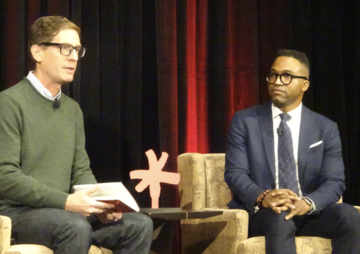
George Hofheimer of Filene, left, with Dr. Frederick Wherry during big.bright.minds meeting.
Following his presentation, Wherry participated in an audience Q&A moderated by Filene’s George Hofheimer. Here is some of what was discussed:
Hofheimer: Talk a little to the point of perceptions of consumers and how those could mesh with the needs of financial institutions in the room.
Wherry: When you talk to people about debts, if they have something of quality and understand why they got it, they are actually quite happy. One of the difficulties that happens is when thinking about totality of debt and getting your balance sheet to look pretty, what people are thinking about is how do I arrange my balance sheet in a way that I feel respected.
Audience Question: I think I heard you say that fin lit resources must be coupled with other resources.
Wherry: For people setting up a new account, we can put them in a session where we talk about the importance of setting up a new account, or we can have them in a session where they set up a new account. It’s not about telling people what they might do; it’s about getting them engaged. It’s one thing to say please avoid payday lenders, it’s another to say instead of going to the payday lender, go here, and we will treat you as nicely as the payday lender.
Part of what we are learning is people are frustrated by being told you don’t know stuff, instead of being told ‘Here is something useful you could use, instead.’ If you are going to do education, do it in real time. People say, ‘I already knew it was bad for me, but no one is trying to facilitate how to get that thing done.’
Audience Question: There are probably enough resources in this room to solve this problem. What is your actual suggestion to this group to solve this?
Wherry: For me, when someone comes in for service, can we do a better job in those encounters if we have stuff that is better than the other stuff out there? Can we do a much better job of saying, ‘You don’t have to get it here, but if this happens, we can help and we’re good at it.’ Part of it is about how to plant seeds so it doesn’t feel like you are pushing something, but that also demonstrates you are there to help in a meaningful way for the future.
When people ask me what the solution is, I like to ask them to ask people who are getting the solutions about what the solution is. I like to ask them, ‘What do you wish would have happened?’ Sometimes the way we see those solutions is very different from the way people are experiencing them.
For credit unions wanting even more information, Hofheimer pointed to two Filene reports: Report 433: Generational Money Chatter, and report 415: Millennial Money Chatter: A guide to Millennial Financial Disclosure.