

LAS VEGAS–A former presidential candidate and a member of one of America’s best-known families outlined for credit unions here an overview of where he believes things stand in the country, ranging from a Fed that “doesn’t know what it’s doing,” to references to the Sopranos, to why “artificial intelligence” is a bad name, to four things to be optimistic about. And more.
Speaking to Origence’s Lending Tech Live meeting, Steve Forbes, the long-time publisher of his family’s Forbes Magazine and son of Malcolm Forbes, and a presidential candidate in the 1996 and 2000 Republican presidential primaries, offered a generally conservative and Libertarian view of the world, largely in line with his long-time positions on issues.
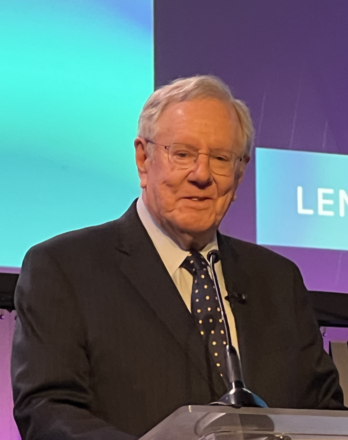
Steve Forbes speaking to Origence Lending Tech Live meeting in Las Vegas.
Forbes said he expects the Biden Administration and Congress will eventually reach an agreement on the contentious federal debt ceiling issue, noting that “the wings of both parties on the right and the left are denouncing it, which is probably a healthy sign.”
Whatever the outcome, Forbes said he expects the ultimate effect of any agreement will be a “little bit” of budget restraint.
Forbes covered a broad number of issues during his hour-long remarks. Among them:
Praise for CUs, Capital Markets
Forbes, who praised CUs for the role they play in the economy, said the U.S. system of capital markets has created a much stronger market than that seen in Europe and Asia, which are more dependent on big banks, he said.
“That’s one reason those countries don't create new businesses, don't have the kind of consumer services that we take for granted. That’s why every generation, until recently, in this country saw the creation of 50 to 75 new businesses that became large businesses. No other country creates new large companies the way this one does and that's because of our capital structure has a depth and a complexity that no other country has and you're part and parcel of it.”
The IRS & The Middle Class
Speaking specifically to one aspect of the debt ceiling agreement, he suggested plans to hire 80,000 new IRS employees, 70,000 of whom he said will be in the area of enforcement, will only hurt the middle class.
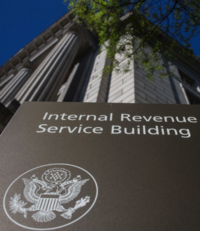
“This is why I have tax lawyers,” said Forbes, who estimated to be worth more than $440 million. “They say they're going to collect the money from the rich people like Jeff Bezos. As you well know, people with those kinds of means have plenty of defenses. They’re going to go after is middle class and small businesses and with all the subtlety of Tony Soprano. They're going to come in and say, ‘Well, we think you've done this or you haven't done that, but we'll settle for a say two or three or four thousand dollars. You’re going to have to spend several times that to fight it so why don't you just pay it.’ Outside of the government that would be called extortion. Inside, it's called tax enforcement. It’s just going to be a huge strain on small businesses, a huge strain on middle class.”
What happens with the IRS in the future will be determined by the 2024 elections, according to Forbes.
Community FIs
The consolidation of banks is not good for consumers, according to Forbes.
“We have a community bank in my town that’s been around for over 100 years. They've decided they want to do something very different, so we all got a notice the other day that unless you have $20,000 in your checking account, your CD accounts, you're going to get charged $50 a month for your checking account: i.e., get lost,” Forbes said. “That's your opportunity—the services you can provide at a lower cost because of the tax structure. Look out for your partnerships and the like… That's especially true among young people who like convenience, who don't like these hidden fees.”
Failed Regulators
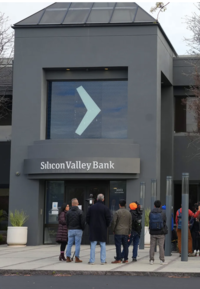
Forbes said in the aftermath of the Silicon Valley Bank failure and others, instead of regulators figuring out what they might have done wrong and what they missed, they have instead begun seeking to implement new regulations.
“That means that bank liquidity is drying up at the very time the economy is going into choppy waters. Talk about bad timing. But that's the way, unfortunately, the regulatory structures work these days. Every time you need lending, you're going to get less of it, so there's sort of a slow walk credit squeeze coming. You already know what's happening to consumers in terms of their credit card debt.”
Artificial Intelligence
AI, said Forbes, should not be seen as an enemy to be feared, but as an opportunity, especially in fintech partnerships.
“I’m annoyed it’s called artificial intelligence. It sounds forbidden. It’s being described like nuclear war, the end of the world,” Forbes told credit unions. As a friend of mine said ‘You don’t call airplanes artificial birds, or automobiles artificial horses.’ It can be misused, but it can also do things at a scale and with speed that could never be done before. AI means changing things, but it also is your friend.”
Modern Socialization
After describing the traditional model of socialism, Forbes said the big challenge today is what he called “modern socialization.”
“You don't have to acquire companies. You make their survivability, their profitability, their durability dependent on regulation. That is kind of a good thing for them, because if something goes wrong you can blame the terrible executives rather than the government itself. But the regulations are very real. It's been estimated in the last 18 months new regulations are costing the economy about $300 billion a year.”
Fossil Fuels & Renewable Energy

“This crazy fight they have against fossil fuels is bizarre. If people want to go and drill for oil and gas in an environmentally sound way, let them do it. But instead they slow-walk permits. We’re getting far less production--probably two-million barrels of oil a day less than we should be doing--which makes us more dependent on places like Venezuela, Saudi Arabia and even, despite the sanctions, Russia. That is not a good thing.
“In terms of climate change, yes, when you have eight-billion people on the earth, you do have the challenges of people's behavior affecting the climate. That's not the debate. The question is what do you do about particular problems as they rise up. The way we've been approaching it, and I'm going to be blunt here, has been hugely expensive and hugely ineffective.”
Forbes said $5 trillion has been invested globally in renewables to produce very negligible reductions in the use of oil and gas.
He said plans to have two-thirds of all vehicles in the U.S. be electric by 2023 is “not going to happen,” and he outlined how much of the earth will need to be “dug up” to get at minerals needed for renewable energy.
He further argued a gas turbine-powered electric plant the size of a “small house” can provide energy for 75,000 homes, while the windfarm needed for a similar level of power would require at least 10 acres, would use more nonrecycable plastic than all the plastic straws in the world put together--900 tons—as well as thousand of tons of concrete.
The best energy alternative, he told the credit union audience, is expanded nuclear power.
Inflation & The Federal Reserve
According to Forbes, after being founded in 1913, “You would think Fed would know something about money and inflation. They don’t. They think you fight inflation by making people poorer. That will not fight inflation. Yes, that will knock down prices, but it will not fight inflation.”
Forbes said there are two kinds of inflation: non-monetary and monetary inflation.
“Monetary inflation is reducing the value of your currency, usually by creating too much of it. Even before COVID, the Federal Reserve was creating too much of it. They were already brewing trouble. Inflation that came from the monetary inflation would have been even worse, except the Fed resorted to a gimmick you probably are familiar with--reverse repurchase agreements. It’s like creating dollars out of thin air, even better than manna from heaven as it’s not sticky…Only a central bank could do something like that--print money and still lose money on it.”
Forbes predicted big changes are coming to the Fed and the way it operates.
He emphasized all the essentially free money the Fed made available is what created the inflation the country is seeing and is the reason taming inflation is taking so long.
“The Fed printed a lot of money. There’s been no research, no historical experience, that would suggest that if you suppress the price of renting money that stimulates the economy. In fact, it did just the opposite.
Reasons to be Optimistic
After 45 minutes of a rather pessimistic-sounding message, Forbes said there are reasons to be optimistic. Those reasons include:

- Big changes in how things are doing in the country, including education savings accounts/vouchers so parents can choose schools.
- Taxes. “A lot of states are cutting taxes. Some are going to zero. Some are going to flat tax. I love that even more.”
- Big changes in health care. “Now, 20% of the economy goes to health care. The problem in health is there are no free markets. It’s all third parties. Where does the consumer fit? Nowhere now. But the power of consumer in health care market is increasing. Now, they get this power from negotiating with third parties, not with you. People are paying more out of pocket than ever before. People want to know what things cost.”
- The future of health care, Forbes suggested, can be seen by visiting Sesamecare.com, and in the example of Surgery Center of Oklahoma, which takes no insurance. Its costs are about 25% of most hospitals and its prices are posted online.
- Graphine. A form of carbon, it is the strongest material ever tested, 200 times the strength of steel, but also the lightest material every constructed, according to Forbes. It is also one-million times better than copper at conducting electricity. It was extremely expensive to manufacture, but now 18 companies are working on it, boding well for the future, Forbes said.