

ST. PETERSBURG, Fla.–Speaking on the third anniversary of the “chaotic” final day of the U.S. pullout from Afghanistan, the man who oversaw the jam-packed flights out of the Kabul airport is sharing what he learned that day when it comes to leadership, how to view “rules,” and more.
Alex Pelbath, a former Air Force officer who was the air mission commander during the evacuation from Kabul, shared with attendees at the Defense CU Council’s annual meeting his experiences on a day that was widely documented in worldwide media coverage as desperate Afghans stormed the airfield and attempted to crowd onto planes to flee the country.
The situation reminded him, he said, of the Mike Tyson observation that “everyone has a plan until they get punched in the mouth.”
And during the 16 days the U.S. pulled out of the country, there were a lot of punches to the mouth, as Pelbath made clear.
But as he also emphasized, It was a great example of a saying in the Air Force that “flexibility is the key to air power.”
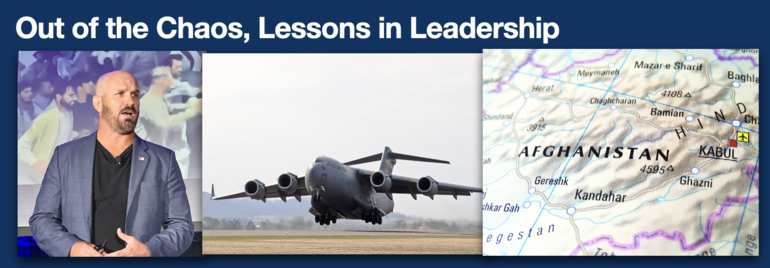
Wild & Dangerous
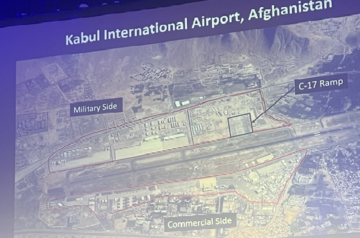
Pelbath began by describing the wild and dangerous environment at Kabul International Airport, where thousands of people had breached the perimeter and it was also surrounded by the Taliban’s soldiers.
Pelbath, a C-17 pilot, was responsible for overseeing numerous C-17s as they landed at and departed the airport. He described the people who were desperate to leave as a “tidal wave” that filled runways and the tarmac.
“For those of us who were there, there was only one word that can be used to describe it: chaos,” he said, adding that helicopters were flying low in an attempt to disperse the crowd.
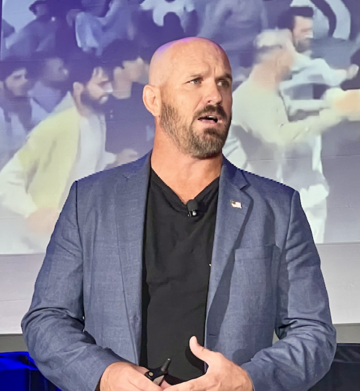
Alex Pelbath speaking to DCUC meeting.
Among the most lasting images of the day is of the people who had tried to hide in one C-17’s wheel wells who fell to their deaths as the planes took off, he recalled, further reminding that those 16 days would “turn out to be the largest airlift evacuation in history.”
What Great Leaders Do
“One of the first things our senior leaders understood was that when faced with chaos, sometimes they have to break the rules,” Pelbath said. “Military leaders are held to a very specific standard. We're never going do anything illegal, immoral or unethical, but everything else is a judgment call. Rules are written for a reason, but you can't possibly write a set of rules that are clear for every situation.”
One example: A C-17 is designed to carry 134 people. Some flights were leaving the Afghan airport with more than 800 people on board.
“A leader’s job is not to obey the rules. A leader’s job is to apply judgment in the application of the rules,” he said.
Give Intent, Not Orders
As the operation continued, normal communication systems quickly became overwhelmed, said Pelbath.
Typically, he noted, if there is an issue or an obstacle that prevents someone from following orders, it is run up the chain of command and then back down the chain of command, but in this case, “that was just not possible.”
“One of the things that chaos breeds is unpredictability,” he said. “We were facing things in this operation we never imagined we would face.”
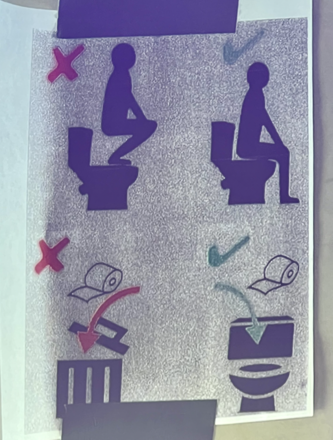
Instructions for how to use a toilet.
Child Births & Toilets
That included one woman who went into labor on a flight and delivered a baby (the call sign for the Air Force operation was “Reach,” which is what the mother decided to name the child). It also included significant sanitary issues, as the C-17 has only one restroom.
Many of the refugees had also never seen a toilet before, which led the Air Force to hurriedly create instructions on how to use one.
Hosing out the mess in the aircraft after each flight was taking so long crews moved to cover everything in plastic to speed the process, Pelbath noted.
“When we give intent, we allow frontline leaders to find creative solutions to complex problems now,” Pelbath said.
Understand Your AOR
Another key to adjusting to the chaos, according to Pelbath, is the military abbreviation AOR, or “area of responsibility.”
“We were facing a lot of frustrations. In fact, one of the hallmarks of chaos is frustration. There was frustration with knowing the answer and being unable to implement it due to external factors,” Pelbath said. “The problem is frustration kills dynamics, so as leaders we have to come back and understand our AOR. It’s another way of saying focus on the things only you can control. It is inevitable that there are going to be things outside of our control.”
A Traffic Jam
As an example, Pelbath said the Air Force had been so effective at getting people out of Afghanistan that it created a traffic jam at the air base in Qatar to which the refugees were being flown. Unable to find parking spots, and with the ground temperature 120 degrees and contributing to violence among some Afghans, pilots remained in the air sometimes for as long as five hours, occasionally being refueled by tankers.
Amid all the tension, and with many of the refugees being children, Pelbath said he marveled that someone on the ground had found three bounce houses and inflated them to entertain the kids.
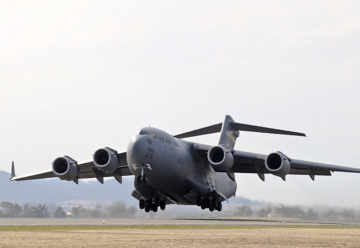
An Air Force C-17.
“That was a leader who fully understood their area of responsibility,” he said. “There was nothing he could do about the backlog of people on base, but he or she leveraged their influence in what they could control.”
Bomber Suspected to be on Plane
Back in Kabul, meanwhile, Pelbath said word came to him that another suicide bomber had made it over the fence at the airport and that he was believed to be on Pelbath’s plane. Earlier, a suicide bomber had killed numerous people.
“We calmly and quietly called out a security team. We deplaned and searched people,” Pelbath shared. “I realized two things: if he’s here he’s not going to give up and he’s going to push the button, and two, there’s nothing I can do about it. I thought of my family and pulled out my cellphone and sent a quick text to my family group chat. And then I went back to work.”
The Final Mission
Pelbath oversaw planning for the final mission, in which he led five C-17s that were to leave in the middle of the night. There were also three “spare” C-17s circling overhead, with support from UAVs, fighter jets and ground support.
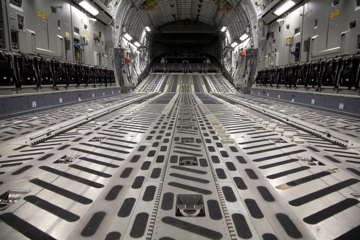
The interior of a C-17.
Begging the Question
“Thankfully, we safely executed our mission nearly flawlessly, despite the fact that at this point the Taliban had the airfield surrounded. You could see them everywhere,” Pelbath said. “When I think about this final mission it begs the question: how do you get hundreds of people, with multiple disparities and very little time to plan to execute such a complicated mission so flawlessly? You have to have trust. The most important leadership trait for thriving in chaos is we must create a culture of trust. But here's the thing--you can't wait for the chaos to arrive and expect that trust to be there. It starts long before. It has to be built.”
Where to Begin
How is that culture of trust created?
Pelbath said it begins by being a good decision-maker.
“Good decision-makers have two traits: a bias for action and humility. Default to doing something and then admit when you’re wrong,” he advised.
Other traits for building trust include, according to Pelbath:
Value Inexperience
Pelbath shared a story of flying over the ocean as the radar was being painted colors indicating heavy thunderstorms. He climbed the C-17 to its altitude ceiling, 41,000 feet, but the storms were taller. With no option but to fly through the storm, Pelbath admitted, “I was pretty nervous. I couldn’t come up with any ideas.”
That’s when a young lieutenant on his first flight asked why the everyone didn’t put on their night vision goggles.
“I could immediately see the outlines of the clouds. I am convinced that helped us avoid catastrophe. Why didn’t I think of that? Because a groove in my brain said NVGs were for takeoffs and landings only. So, value inexperience.”
Crave Feedback
Pelbath said the Air Force has done a “phenomenal job” of creating a system for feedback.
For example, midway through the evacuation mission, someone said, “You’re pushing us too hard. Someone is going to die.”
“That presented us with a challenge as we were essentially attempting to solve a math problem. We had to keep pushing. And we were getting results. By all metrics, it was working,” said Pelbath. “What we weren’t seeing was a negative unintended consequences. The stress and fatigue could have been catastrophic.
‘We Trust You’
“We called all pilots into a theater, put this feedback up on a screen and said, ‘You’re right. We are pushing you hard. But we are doing so because we trust you. And we trust you to take a knee when necessary.’ Sometimes, doing the right thing can have the right results with negative consequences.”
Three Steps
Pelbath said building that culture of feedback will benefit from:
- Make it easy. “In the Air Force you can do it right on your phone.”
- Immediately confirm the feedback you have received
- Find something to action.