

WASHINGTON–Bipartisanship in Congress? It may surprise many in credit unions–and America–that not only is there a core group in the House many haven’t heard of that is dedicated to bipartisan work and “getting things done,” they have actually been doing it.
Two of its members offered insights into the group’s work with CU leaders, including one area “ripe” for agreement.
Rep. Tom Reed (R-NY) and Jimmy Panetta (D-CA) are both members of one of the most powerful committees in the House, Ways & Means, but both said they belong to an organization they consider even more powerful: the Problem Solvers Caucus. The group of 50 members—25 from each party—was formed to find bipartisan ways to solve problems at a time partisanship feels like it has never been stronger.

In remarks to NAFCU’s virtual Caucus, both congressmen talked about the Caucus with NAFCU’s Brad Thaler. Here’s what they had to say:
Thaler: Why was the Problem Solvers Caucus formed?
Reed: I founded the Problem Solvers Caucus with Rep. Josh Gottheimer (D) from New Jersey four years ago, and we were officially incorporated as the only true bipartisan caucus in Congress that has bylaws. There are 25 Democrats and 25 Republicans. We want it balanced. We have an operating agreement where if we have a 75% consensus on an issue we will agree to vote as a bloc on that legislation. We meet every week on issues of all kinds.
We have banded together to change the House rules. In the last Congress, we changed something not done in 70 years to make it more friendly to bipartisan legislation, and that is if you get 290 co-sponsors, you are guaranteed to have that see the light of day in the House and get a vote.
Fundamentally, at its heart it’s all about bringing Caucus members all together from the far left, the far right--it’s members committed to being pragmatic and wanting to govern. We have a culture of trust. We have conversations. We discuss policy, what’s going on. We do it respectfully. We don’t leak. We agree that what you ask will not be used in a campaign against you. It’s completely off the record. It’s the best work I’ve done in Congress, and I serve on Ways & Means. This is the work I’m most proud of and it will have a legacy affect.
Panetta: I wholeheartedly agree with Tom. Working with Tom on the Problem Solvers has led to something I’m very proud of and that’s our relationship on Ways and Means. We have developed that trust that allows us to come up with legislation in Ways and Means and to bring it forward. There are a couple of keys. It goes back to that underlying trust and how you get it: and that’s face to face, sitting down, building relationships every week. It’s Democrats and Republicans sitting at the same table getting to know not just each other but their constituents and their concerns. You get to know the kinds of members you need to work with on certain legislation. It's not about finding our differences, it’s about finding our commonalities.
It’s real easy to be in Congress these days and not interact with people across the aisle. But as most members of the Problem Solvers will tell you that’s not why they were sent to Washington. It’s the one meeting where we all feel like we’re getting something done.
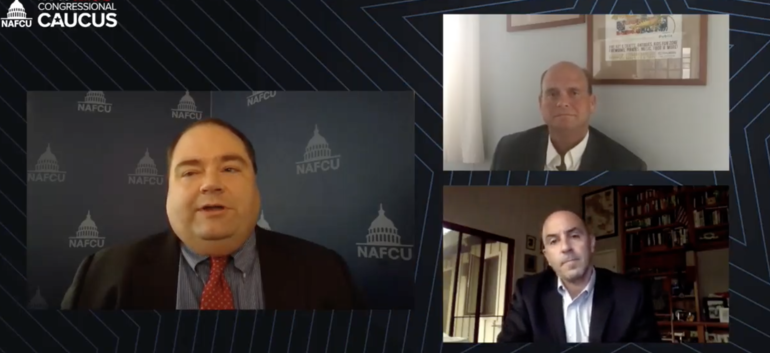
At left, NAFCU's Brad Thaler. At right, top, Rep. Tom Reed; bottom, Rep. Jimmy Panetta.
Thaler: What led you to create and to join the Caucus?
Reed: After six years in Congress I got very frustrated. We’re very polarized; we’re reflective of the country. It’s so political in Washington now it’s even frowned upon to even form relationships and friendships across the aisle. I was fed up with it. What the Problem Solvers Caucus is representative of is those who want to govern. They want to debate. They want to tackle the tough issues and the easy issues.
For example, we had a piece of legislation related to Gold Star families that addressed a tax penalty for family members of those who are lost in war. Due to a quirk in tax law there was a penalty, but because of (the soldier at the center of the legislation) they wouldn’t fix it for him. It was tied up for nine years. We in the Problem Solvers Caucus got that done and included in last defense bill. We had Gold Star families suffering from a politically suffering system.
I said enough is enough, I’m sick of this. Be proud Republicans, be proud Democrats, and be proud of what you believe in. This isn’t about selling out. What we have found out, especially in the beginning, is we would scream and yell at each other like a lot of people in America in the political debate, but we never left the room. After 10-15 minutes of yelling what we found is amazing. We’re still Americans at our core and that’s what brings us together. Once you get through the rhetoric, you can find pretty solid common round, where 80%, 90% is a victory. And that really helps the American people.
Panetta: That is correct. I’m a proud Democrat and I come from a very blue district. I will never sell out those values. But we are in Washington, D.C., to make it work for the people of our districts. They understand that takes bipartisanship, working with people from across the aisle to get things done. That’s how you create long-lasting legislation. What Tom has been hitting on is right; it’s real easy to just be in your camp in Washington.
When I was running for Congress someone said to me, ‘You know what, it’s easy to be an average congress member. You go, you vote party line, you serve constituents and you go home and run for reelection. I shared that with my father (a 16-year member of Congress). He laughed and said, ‘It is easy. But it’s fun when you get stuff done.’ And when you get stuff done it’s about working with Democrats and Republicans on long-lasting legislation. In the Problem Solvers, and I can’t stress this enough, the foundation we lay is other members see this, and to me it’s a template for how things need to be done moving forward.
Thaler: How is the Problem Solvers Caucus viewed among peers?
Panetta: Initially, you see skepticism. But you start to see belief when they start to see the results, which can be seen in some of our involvement in the current negotiations between the Democrats and the administration and in some of the pieces of legislation.
One of the reasons I got involved in the Problem Solvers Caucus was in the beginning of my freshman term there was this (effort to) repeal the Affordable Care Act, and people said, ‘Let’s not blow it up, let’s find ways to make it stronger.’ We came up with a wonderful proposal to do that. It’s not one or the other.
Reed: Leadership has a love/hate relationship at times with us. We are a pragmatic group. We keep our leadership involved in what we’re doing. Right now, as an example of our credibility after four years, it was the Problem Solvers Caucus that the White House reached out to on the coronavirus. (Vice President) Mike Pence knew that in order to get bills through Congress he needed a group like ours to work with. We are kind of the bellwether, the trial balloon.
A lot of people think we’re the centrist group, but we have some far left, some far right members. You don’t just get to join. Leadership will lean into you pretty hard to follow the party line and you have to be willing to stand for what you believe. To join you have to find another member of the other party, and you have to be approved. You have to walk the walk and talk the talk. And you can’t campaign against a member of the Caucus. How can you have trust if you do?
Panetta: That’s a crucial aspect—knowing other members aren’t going to be campaigning against you. As I said, I’m from a very blue district and I don’t have to be a member of this. It’s more difficult to be a part of it. I have a challenger from my left because I talk to the other side. But our constituents want us to get things done and to work together. Some extreme Republicans, some extreme Democrats don’t like it. But it’s about getting things done.
Thaler: How does one join?
Reed: There is a waiting list. It is about finding a pair, and then coming in and not breaching your word. In the beginning I had two experiences with members who broke the rules and I had to ask them to step aside from the Caucus. Your word is very important in Congress. We vet our members pretty carefully. It’s OK to bring an ideology into the room, but you have to have respect and be a straight-shooter.
Panetta: Being so straight forward is how Tom and Josh deal with other caucuses. I can’t stress enough how much their transparency gives us credibility. We’re not trying to take the legs out from under leadership.
Thaler: How does one bring an issue before the Caucus, and do you establish priorities?

Panetta: It’s all about the members. It really is a grassroots type initiative. The members not only bring it up, they have to work with other members and get their support, not just at our meetings but in late-night sessions on legislation.
I won’t forget one time we were working on immigration and Dreamers and DACA and we had a late-night session and I was walking away with a member who had been in Congress for a decade and he looked at me and said, ‘You know, I’ve never done that before, had that kind of grinding conversation around legislation.’
Reed: The initiatives all come from the members. But obviously, we are reactive to the issues of the day. That’s where the consensus calendar has been so critical to our success. We’re right in the middle right now in discussion on the COVID-19 relief package, which needs to be done in my opinion, and on police reform. Those are very sensitive issues we are weighing into. We’re not waiting for the perfect bill; we are willing to accept 80% of the loaf and say we’ll come back and get the rest later. We’ll take what we can.
Thaler: What are priorities for the Caucus for remainder of this Congress and looking to the next Congress?
Reed: The COVID relief package and police reform. One of the top priorities of whomever wins the election that’s ripe for us to be involved in is infrastructure. There is still going to be a hangover effect from the virus, but money is cheap right now and we should bite the bullet. We already know what we need to do.
Panetta: For me, infrastructure is one we can address. But for me, too, it’s immigration reform. I think we’ve done that for the Dreamers. It’s making sure we find our similarities in the legislation. Drug pricing is another thing and finding a reasonable, practical way to reduce that.