

By Ray Birch
LAKE FOREST, Ill.—A new study suggests all the sacrifices credit unions have been making to keep members afloat are affecting CU staffing levels.
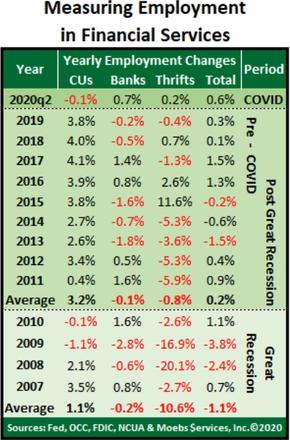
The report from Moebs $ervices also reveals credit unions continue to struggle with efficiency, especially when compared with banks.
The report shows during the first six months of this year, CUs reduced staff while banks and thrifts showed slight increases. Bank staffing is up 0.7%, thrifts up 0.2%, while credit union staffing is down 0.1%.
“In the nine years prior to COVID credit unions had increased staff 3.2% yearly,” stated Michael Moebs, economist and CEO at Moebs $ervices. “So the slight decline in 2020 for CUs is a significant change of over 3%. To grow CUs need to build capital. Their only source of capital as cooperatives is net income. Reducing staff is a step in the right direction to weather COVID, maintain positive net income and grow.”
The Moebs’ report reviews financial institution employment changes for the past 14 years, finding bank employee numbers peaked in the Great Recession, fell through 2015 and have been rising ever since—even during the health crisis.
Thrift staffing levels fell from the Great Recession to 2014, then rose from 2015 through 2018, fell in 2019, and have now rebounded during the pandemic.
“Credit union employment rose until the Great Recession, fell through 2010, and had been rising ever since. So, a decline during COVID, even a small decline, is a true change in credit union employment,” stated Moebs.
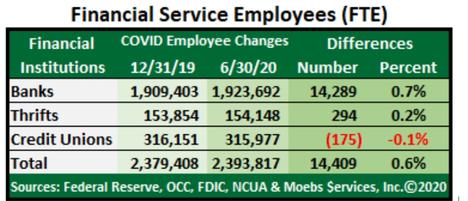
As CUToday.info has extensively reported in its series on cost-cutting measures credit unions are taking not only to preserve the bottom line but jobs as well, many CU leaders—particularly early in the pandemic—stressed they would not cut staff. However that sentiment began to swing as the recession wore on and some have questioned their abilities to protect jobs.
Banks Vs. CUs on Productivity
The Moebs report also examines the productivity of banks, thrifts and credit unions.
“Productivity can be measured by the amount of assets an institution has divided by full-time equivalent employees, or FTEs,” Moebs said. “The Moebs Research chart (right) shows banks and thrifts are very similar at $10 million assets per FTE. Credit unions fall short by 50%, at $5 million assets per FTE.
Moebs explained the peak of employment at all banks, CUs and thrifts was in 2007, right before the Great Recession.
“Since then, employment for all depositories, collectively, has fallen to a low of almost 2.3 million in 2015, and then rose slightly even during the pandemic,” said Moebs. “So, in this era, starting with the Great Recession, assets per million per FTE has risen: 179% for banks, 170% for CUs, and 151% for thrifts, or savings banks.”
An Important Note

Michael Moebs
Moebs believes assets per FTE captures the steady population of employees for the last 15 years and the consistent rise in overall depository assets, recently driven by the large growth in deposits.
“However, it is important to note in 2007, the base year for the analysis and also the peak of the good years before the Great Recession, the ratio for credit unions was quite low, normal for thrifts, and below par for banks,” Moebs said.
Moebs added that if cost, defined by total non-interest expense (NIE), is added into the equation, direct differences between financial institutions emerge.
“When measuring NIE divided by assets, CUs are the most expensive to operate at 3.03%,” he said. “NIE cost is typically 50% employee benefits and compensation. Thrifts are 92% as expensive as CUs, and banks 86%.”
What to Monitor Now
Moebs said the pandemic is now creating new complications in modeling employee productivity.
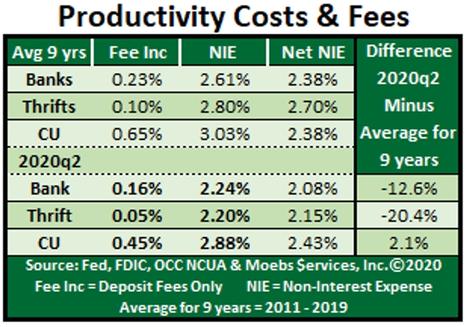
“COVID heavily impacted deposits, expenses, and revenue,” he noted. “Banks and thrifts lowered expenses while CUs lingered. Banks reduced by 14.2%, thrifts by 21.4%, while CUs increased 5%. Simultaneously, fee income fell seven basis points for banks, five BPs for thrifts—but 20 BPs, or 30.8%, for CUs.”
Moebs said the consequence of relying on fee income, which data show credit unions do more than banks (see chart), to boost productivity is risky.
“Sticking to FTE counts, assets and costs can be safer,” he said. “Now is the time to monitor employee productivity to retain the rapid deposit growth.”