

WASHINGTON–Analysts, lawyers and politicians of all stripes spent the weekend offering forecasts on what a momentous Supreme Court decision on Friday will mean, and that includes for NCUA and the CFPB.
While differing views came from the left and the right, there appears to be some consensus around what the decision by the Supreme Court to turn back a 40-year-old precedent related to Congress and regulatory agencies will mean: the courts are going to be clogged with challenges to countless regulations, and a scenario many would think impossible could become a reality—an already gridlocked Congress could move even more slowly due to a lack of staff and in-depth policy knowledge.
The early analyses would suggest that credit unions could be among those going to the courts to challenge regulatory decisions made by NCUA. In its forecast, for example, Fortune said that “the banking sector is certainly to be among the hardest hit…”
And it won't just be banking. “(The) decision will define how we think about challenges to government regulation for the next generation,” Alston & Bird partner Kevin Minoli said in a statement to Bloomberg Law. “(The) decision unquestionably means that more government regulations will be overturned by the courts.”
The Decision
As CUToday.info reported here, the Supreme Court voted 6-3 to turn away a 40-year-legal precedent known as the Chevron doctrine that was based on a decision in Chevron v. Natural Resources Defense Council, which essentially held that when a legislative delegation to an administrative agency on a particular issue or question is not explicit but rather implicit, a court may not substitute its own interpretation of the statute for a reasonable interpretation made by the administrative agency.
In other words, courts have for four decades been deferring to regulatory agencies on many issues.
But no more.
‘Chevron is Overruled’
In the decision in the case Loper Bright Enterprises et al v. Raimondo, Secretary of Commerce, the majority cited the Administrative Procedure Act, which governs how federal agencies handle regulations, and said the APA “requires courts to exercise their independent judgment in deciding whether an agency has acted within its statutory authority, and courts may not defer to an agency interpretation of the law simply because a statute is ambiguous; Chevron is overruled.”
The case was originally filed in February 2020 when New Jersey–based Loper Bright Enterprises filed a lawsuit in the United States District Court for the District of Columbia alleging that an ambiguously worded act providing management for some U.S. fisheries does not give the National Marine Fisheries Service the right to require onboard monitoring of its vessels.
Loper Bright challenged a program, enacted under the Trump administration, that required the fishing industry to help cover the costs of federal compliance monitors on their boats. The plaintiffs argued that federal law did not clearly authorize the government to seek cost-sharing from fishermen. Later, the Biden administration shut down the program and refunded any funds paid.
‘No Special Competence’
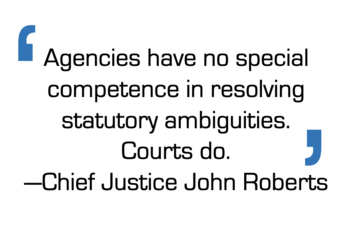
“Agencies have no special competence in resolving statutory ambiguities. Courts do,” Chief Justice John Roberts wrote for the court, joined by Justices Clarence Thomas, Samuel Alito, Brett Kavanaugh, Amy Coney Barrett and Neil Gorsuch (interestingly, Gorsuch’s mother, former EPA Administrator Anne Gorsuch, made the decision that the Supreme Court upheld in 1984).
“Even when an ambiguity happens to implicate a technical matter, it does not follow that Congress has taken the power to authoritatively interpret the statute from the courts and given it to the agency,” Roberts said. “Courts, after all, do not decide such questions blindly,” but rely on the detailed briefs and evidence the parties submit, including the often voluminous records and reports of the expert agencies involved, he said.
‘Judicial Hubris’
In her dissent, Justice Elena Kagan argued that the majority had damaged the public interest by diminishing the role of expert agencies and reduced the democratic accountability of policy decisions by shifting authority from executive branch officials working for the president to the unelected judiciary.
“Agencies know those programs inside-out,” some of which “present policy choices, including trade-offs between competing goods,” she wrote, joined by Justices Sonia Sotomayor and Ketanji Brown Jackson.
Kagan added that by overturning a decades-old “cornerstone of administrative law…a rule of judicial humility gives way to a rule of judicial hubris.”
Legislation Would ‘Sunset’ Certain Agency Rules
Roberts wrote that the ruling is not retroactive, but in the aftermath of the decision,“ Rep. Mark E. Green (R-TN) announced he plans to introduce legislation to require the federal government to start sunsetting all agency rules upheld by Chevron unless Congress takes action to uphold them.
“Chevron Deference not only usurps Congress’ lawmaking authority, but gives unelected and unaccountable bureaucrats in Washington enormous control over the lives of Americans,” Green said in a statement. “My legislation seeks to right this imbalance and restore Congress and the judiciary to their rightful places in our constitutional system.”
White House Response
White House press secretary Karine Jean-Pierre said the decision “takes our country backwards” and undermines the ability of agencies to use their expertise to protect the public.”
Jean-Pierre said President Biden “has directed his legal team to work with the Department of Justice and other agency counsel to review today’s decision carefully and ensure that our administration is doing everything we can to continue to deploy the extraordinary expertise of the federal workforce to keep Americans safe and ensure communities thrive and prosper,” she said.
America’s Credit Unions Responds
“The Supreme Court’s decision to overturn the Chevron doctrine that required courts to defer to administrative agencies’ interpretations of ambiguous acts of Congress has immense implications for highly regulated entities like credit unions," said America's Credit Unions' chief advocacy officer, Carrie Hunt, in a statement. "While agencies, including the NCUA and CFPB, possess subject matter expertise, rulemakings and other agency actions must comply with the Administrative Procedure Act. This decision will have a momentous impact in the rule making process. While agencies’ rules may be easier to overturn, the rule making process itself will likely slow and be more cumbersome. We expect this decision will be both a help and hindrance to credit unions going forward.”
Defense Council Responds
“(The) decision by the Supreme Court in the Loper case effectively overturned the Chevron doctrine that has empowered regulators and agencies to enact rules and regulations not approved by congressional action," Jason Stverak, DCUC chief advocacy officer, in a statement. "While the full effect of this decision remains to be seen, DCUC’s aggressive advocacy team remains fully engaged with members of Congress, the executive branch, and the NCUA to ensure that credit unions’ interests are represented.”
NCUA Responds
It is not known what effect, if any, the decision could have on NCUA. In a statement to CUToday.info, the agency said it is “reviewing the decision and will have no further comment at this time.
CFPB Responds
Similarly, a spokesperson for the Consumer Financial Protection Bureau said it is also reviewing the decision.
Other Responses, Viewpoints & Predictions
Not surprisingly, there has been considerable response from analysts and organizations across the country to what the decision will mean moving forward. Here is an overview of some of that:
‘Banking Industry to be Among Hardest Hit’
“While the decision whether to overturn the 1984 case Chevron, U.S.A., Inc. v. Natural Resources Defense Council will take years to fully evaluate, the banking sector is certainly to be among the hardest hit, with agencies including the Federal Reserve System, the Federal Deposit Insurance Corporation, the Office of the Comptroller of the Currency, and the Consumer Financial Protection Bureau all likely scrambling to see how it will impact them,” stated Fortune in its analysis.
The Result of ‘Chasing Headlines’
Lindsey Johnson, CEO of the Consumer Bankers Association, told Fortune the decision will take “years to unfold across not just the financial regulatory landscape.”
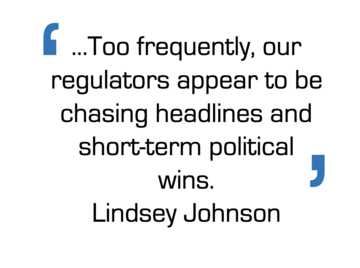
”We would not be at this point today if government agencies were more prudent and consistent about staying within their statutory authorities, grounding their rule makings in empirical facts, and heeding appropriate procedural safeguards,” Johnson said in a statement to Fortune. “Instead, too frequently, our regulators appear to be chasing headlines and short-term political wins.”
The CBA statement further says it expects that agency actions that “lack a clear delegation of authority from Congress” will be increasingly easy to defeat in legal battles as a result of today’s decision.”
American Bankers Association: ‘Crystal Clear Message’
In its statement, American Bankers Association President and CEO Rob Nichols said, “While we are still reviewing the full implications of today’s Supreme Court decision, the ruling sends a crystal-clear message to federal agencies that their powers are not unlimited. This is an important win for accountability and predictability at a time when agencies are unleashing a tsunami of regulation — in many cases clearly exceeding their statutory authority while making it harder for banks to serve their customers. We will continue to fight to ensure that bank regulators follow the law every time they exercise their powers."
A ‘Watershed’ Decision
“Friday’s ruling is a watershed in a series of Roberts Court decisions curbing federal power, whether exercised by Congress or the executive branch agencies it created,” wrote the Wall Street Journal in its analysis. “In abandoning the doctrine called Chevron deference, the justices have given parties unhappy with agency decisions—typically businesses and property owners—more opportunities to overturn regulations by persuading federal judges that officials exceeded their authority.”
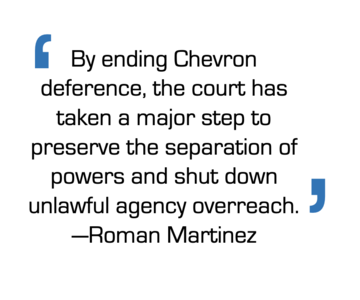
Added Roman Martinez, who represented a fishing boat company called Relentless in one of the regulatory challenges before the court, in a comment to the Wall Street Journal, “By ending Chevron deference, the court has taken a major step to preserve the separation of powers and shut down unlawful agency overreach. Going forward, judges will be charged with interpreting the law faithfully, impartially and independently, without deference to the government.
Mirror Opposites
In a statement to the Journal, Suzanne Clark, president of the U.S. Chamber of Commerce said, “The Supreme Court’s previous deference rule allowed each new presidential administration to advance their political agendas through flip-flopping regulations and not provide consistent rules of the road for businesses to navigate, plan and invest in the future.”
But AFL-CIO President Liz Shuler had the opposite reaction, telling the Journal, “This ruling paves the way for corporate challenges to the actions of the Occupational Safety and Health Administration, the National Labor Relations Board, and other agencies with a duty to protect workers’ lives and rights, which would allow employers to get away with retaliation, union-busting and maintaining dangerous workplace conditions.”
A ‘Free-Floating Veto’
An opinion piece published on Slate opined that the decision transfers “an almost unimaginable amount of power from the executive branch to the federal judiciary. The ruling is extraordinary in every way—a massive aggrandizement of judicial power based solely on the majority’s own irritation with existing limits on its authority. After Friday, virtually every decision an agency makes will be subject to a free-floating veto by federal judges with zero expertise or accountability to the people. All at once, SCOTUS has undermined Congress’ ability to enact effective legislation capable of addressing evolving problems and sabotaged the executive branch’s ability to apply those laws to the facts on the ground. It is one of the most far-reaching and disruptive rulings in the history of the court.”
Judges to be ‘Radical Activists’
David Doniger, a lawyer and longtime Natural Resources Defense Council official who argued the original Chevron case in 1984, told the Associated Press he feared a ruling to overturn the doctrine could “free judges to be radical activists” who could “effectively rewrite our laws and block the protections they are supposed to provide. The net effect will be to weaken our government’s ability to meet the real problems the world is throwing at us — big things like COVID and climate change…For Congress, when it writes these laws, knows that it can’t foresee everything. It can’t get to everything in real time. You’re lucky if Congress visits a statute every 10 years.”
‘Misguided Doctrine’
But West Virginia Attorney General Patrick Morrisey told the AP the decision a fitting follow-up to a 2022 decision — in a case he brought — that limits the EPA’s ability to control greenhouse gas emissions from power plants. Morrisey noted the court held that Congress must speak with specificity when it wants to give an agency authority to regulate on an issue of major national significance.
Morrisey, who is now the GOP nominee for governor, called Chevron “a misguided doctrine under which courts defer to legally dubious interpretations of statutes put out by federal administrative agencies.”
Views From Law Professors
Two law professors shared similar views in comments to the Associated Press:
- “Federal judges will now have the first and final word about what statutes mean. That’s a big shift in power,” said Craig Green, a professor at Temple University’s Beasley School of Law
- The ruling will likely “gum up the works for federal agencies and make it even harder for them to address big problems. Which is precisely what the critics of Chevron want,” said Jody Freeman, director of the environmental and energy law program at Harvard Law School.
‘A Very, Very Big Deal’
Andrew Mergen, who spent three decades as an attorney for the Department of Justice Environment and Natural Resources Division and who now heads the Emmett Environmental Law and Policy Clinic at Harvard Law School.
Told PBS, “I think in the short term, it's a very, very big deal. I think that we're going to see an enormous number of challenges to government regulations in the environmental area in food safety, in the health care, health care administration. There will be many, many challenges.”
While Chief Justice Roberts wrote that the decision is not retroactive, Mergen noted Justice Kagan in her dissent observed, “That’s a very cold comfort. “
Added Mergen, “And I tend to agree. This is a very complicated question. It's sometimes very hard to parse out exactly why courts upheld regulations. And I fear that there will be many, many folks ready to test the limits here and to reopen past regulatory judgments and regimes.”
More Gridlock for a Gridlocked Congress?
Numerous analysts with experience in Congress expect the decision could bring even more gridlock to an already strongly divided Congress.
In its reporting, Roll Call quoted Nicholas Bagley, a law professor at the University of Michigan, as stating on social media, “The answer is not always going to be clear; Congress may mean to delegate without saying ‘we hereby delegate to the agency,’ Using words like ‘reasonable’ or ‘sufficient’ are clues, for example, and there may be many others.”
Tim Brightbill, a partner at Wiley Rein who specializes in trade law and who served as counsel to former Rep. John J. LaFalce (D-NY) told Roll Call the removal of Chevron introduces new complexities to congressional negotiations.
“While Democrats may push for greater specificity in the wake of the ruling, Brightbill said, Republicans may prefer broader language ‘giving courts greater power to rein in the agencies’,” Roll Call reported.
“It depends on the legislation, it depends on who’s in the majority, but there are ways to use the decision to either strengthen or weaken agency regulation,” Brightbill was quoted as saying.
The Devis is in the Details
Kaye Pestaina, a vice president at KFF, a health policy organization, told Roll Call the ruling could make it more difficult for Congress to pass laws if they have to include the smallest of details in legislation.
Pestaina observed to the publication that Congress often intentionally leaves gaps in legislation for agencies to work out in regulation, which makes it easier for Congress to come to agreements on some complicated issues. But now it could leave agencies vulnerable to lawsuits over regulations implementing those laws.
“You can’t possibly write every technical issue into a statute. It could also make it difficult for legislators to compromise on topics if they need to be more specific and put in more details,” Pestaina told Roll Call. “And for health care, it’s going to be the consumer that is impacted.”
Congress Lacks the Manpower
Similarly, J.D. Rackey, a senior policy analyst at the Bipartisan Policy Center and former staff member on the House Select Committee on the Modernization of Congress, told Roll Call Congress doesn’t currently have the staff or technical expertise to write more fine-tuned legislation. He noted that frequently, committees don’t have enough staff or in-depth policy knowledge to write the kind of specific legislation that would survive the scrutiny of the current Supreme Court.
“Even if you want a smaller government, if you want government to do anything, this ruling requires Congress to be much more proscriptive and to have the capacity to do so,” Rackey told Roll Call. “Outside of the larger policy goals that any one party might have, any future lawmaking is going to be impacted with this decision…I think the level of activity that Congress is going to need to exhibit is going to increase, and I’m not quite sure in the few hours post-decision that they’ve really reckoned with that reality.”
Cheers From Republican Lawmaker
Some Republican lawmakers have been cheering the decision.
Citing his social media posts, Roll Call quoted Sen. Mike Lee (R-UT) as saying the court decision represented the first step for Congress to make more decisions when writing laws.
In his posts, Lee said that for decades Congress has made “lazy” laws, frequently pushing off decisions about specifics to agencies rather than making the tough decisions themselves.
“Rather than making laws, Congress has in many instances made … other lawmakers,” Lee said on X.
Plans for More Oversight
As CUToday.info reported earlier, House Speaker Mike Johnson, Majority Leader Steve Scalise and Majority Whip Tom Emmer said in a joint statement that the Chevron doctrine that “led to a massive expansion of the federal government and a reduction of Congress’ role in the policymaking process.”
“Republican committees will be conducting oversight to ensure agencies follow the Court’s ruling and no longer engage in excessive interpretative license in administering statutes under their jurisdiction,” the House GOP leaders said in their statement.