

LAS VEGAS–Credit unions focused on Millennials and mobile services as the source of future growth and direction are making a mistake, says one expert.
Where they really need to be looking is at eight-year-olds—and to the extraordinary data-driven world in which they will always live.
Mike Walsh, founder and CEO of New York-based Tomorrow, told the joint annual meetings of the CUNA Technology Council and CUNA Operations, Sales and Service Council that a “profound sea change” is taking place at a generational level that is going to have lasting consequences on how credit unions operate, what their workspaces are like, who will work for CUs (and how), and who will emerge as leaders within credit unions.
“This is time to reinvent the way you reengage your members and coworkers,” said Walsh.
With a group of young credit union “Crashers” in his audience, Walsh said he had some “sad news” for Millennials.
“The game’s up,” he said. “They’ve had it good for a long time, but they are really the warm-up act. The people you have to be really scared about are eight-year-olds.”
Walsh asked his audience to think of the role they have played in conditioning eight-year-olds and their peers to a completely different way of engaging with the world.
“My theory on why they are so different is about something that has happened in their childhood,” he said. “At some point they started crying in your presence, and what did you do? You gave them a device. It’s like magic and instantly they stop crying. The moment you handed that device to the child you rewired their entire mind.”
Where Mistake Is Made
Where management at credit unions is making a mistake in envisioning the future is in thinking that it’s simply all about delivering services via mobile, according to Walsh.
“But what’s really going on here is the next big business shift will be driven and shaped not by mobile but by the data-driven experiences children are having every day,” he told the meeting. “There is now a thin layer of artificial intelligence and machine learning between you and the use of technology. That is conditioning the next generation to expect a profoundly different world. The other strange thing that’s happening is kids are getting used to not interfacing with technology in the way we do. Kids expect to talk rather than type with technology.
“If you think about it, your kids are probably first generation to be raised by artificial intelligence,” he continued. “If your kids have thousands of questions, who answers them now? Alexa. Siri. Google. Think about the impact on your kids. When you look at what’s happening you must look at the deeper implications.”
Those same children, Walsh said, will never lose their wearables, such as ear buds, because they have become “implantibles.”
“There will be a constant feed, and it’s the beginning of a new type of computing—conversational computing—and it will change how we interact with services,” said Walsh. “For your kids it’s not new; it’s pervasive, like electricity.”
Reinvent, Reimagine, Redesign
What all that means to financial services, according to Walsh, is that the future will be shaped by a generation of members who are already growing up in a data-driven, mobile-centric world of experiences.
“For business leaders that is a wake-up call to reinvent, reimagine and redesign your organizations,” said Walsh.
One way to respond to that wake-up call, Walsh said, is to stage a “next generation workshop” in which the credit union explores what its “digital proposition” to future members might look like.
Offering the first of what he called “mind grenades,” Walsh recommended that the credit union “recruit the next generation as alpha users, give them a clean sheet of paper. If they don’t come up with things that shock you, you aren’t listening hard enough. The next time you hire someone fresh out of college, ask what do they find the most strange about the way your teams work and come to decisions.”
Walsh joked that credit unions should get to those new hires quickly before they are trained in how to do things “right.”
How 21st Century Business Will Be Different
How will 21st century business be different and what does it mean to how organizations design for the future?
“We are in the process of trying to find a reconciliation with change,” Walsh said. “When I look at 21st century companies, in a way their operating systems, what makes them tick, is as much about culture as it is about code. You don’t get to the 21st century by upgrading your technology. That’s not enough. There are two groups here: technology leaders and operations leaders. Your future rests there. When you look at successful 21st century companies there’s no blueprint yet, but there is an emerging playbook.”
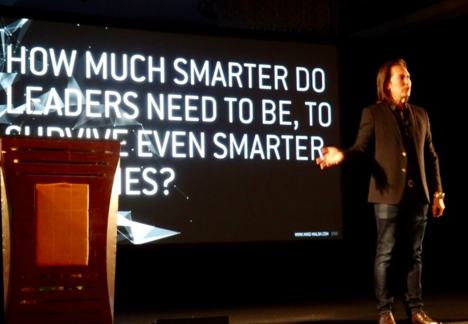
Mike Walsh speaking to credit unions in Las Vegas.
The playbook includes a chapter on agility, Walsh said. But even that comes with challenges.
“The question is is agility a process or is it a mindset? If it’s a mindset the question is what kinds of people do you need to hire?”
Walsh shared that the CEO of Netflix, Reed Hastings, often talks about his paranoia that his company will hire for process and not make mistakes as a result, but the minute there’s a shift in the market the company will be in huge trouble, because the process-driven people have driven out the performance-driven people who are needed to respond to shifts.
“The second thing I think we’re going to be called on to figure out is how do we scale up quickly to a new idea to capture a new market?” said Walsh. “It’s a weird paradox: If you want to scale up quickly, you’ve got to think small. (Amazon CEO) Jeff Bezos says keep your teams small enough to be fed with two pizzas. They have to be agile, adaptive and come up with genuinely new ideas.”
The Third Piece to Consider
Walsh said the third piece credit unions must consider as they look forward is the environments in which CU employees will work.
“I predict that in the future your best people won’t work for you full time. In a way you will be competing not with other companies for talent, but for their time and attention,” he said. “So the question is how do you design an office for people who don’t need one. It’s a reinvention of the workspace.”
He added that every CU needs to have more “fact-based discussions” around culture.
Walsh repeated that to keep pace with the future, 21st century CUs will need to redesign themselves for agility, innovation and high performance culture. “Hire for agility, prepare for rapid scale, build more social workspaces, change the way you communicate, and use data to hack your culture,” urged Walsh, who grew up in London’s famed Harrod’s Department Store, where his father was CEO.
What CUs Should Ask Themselves
Walsh said every credit union should ask itself if the investments in new technologies have to a corresponding change in culture, agility and work style? “Pick some high-profile projects and encourage those teams to experiment with new collaboration tools and workflows,” he said.
The world those eight-year-olds will grow up and live in will be dominated by much smarter machines, and that is going to have implications across cultures, organizations and more. It raises a question of how much smarter leaders will need to be to survive and even thrive among those smarter technologies, according to Walsh.
That’s because artificial intelligence and automation will not just be taking over basic-level tasks; higher-level tasks (and jobs) will also be lost to robots, chat bots and more.
“If something in your business can be automated, it will be automated,” he said. “It will happen. There is no process or job that cannot potentially be changed by automation and algorithms. There is a new generation of cognitive agents who are more than chat bots.”
As an example, Walsh cited a financial services chat bot named Amelia that has been created to respond to customer inquiries. If Amelia finds a situation it has never encountered, it elevates to a human being. It then listens to the conversation and whatever the human being does to fix that issue, the next time Amelia gets it right. He admitted that kind of adaptive learning has some people worried, especially as many call center agents will no longer be needed.
“The more interesting question is what will human intelligence look like in the 21st century?” observed Walsh. “Who will be the smart leaders, the one who not only survived but managed to thrive. These are algorithmic leaders who exist side by side with these technologies. Computational thinking is not the ability to code; it’s the ability to break things down in ways that computers can solve.”
Three Skills For The Future
Walsh said there are three skills future credit union leaders will need to develop:
1. Understand how data creates value in every business. “We are all software companies today. John Deere doesn’t sell tractors; it sells data about tractors.” He urged CUs to ask themselves what data they currently hold that is viewed as a cost but is really the most valuable asset.
2. Leverage opportunities to study human behavior. “Why did Amazon open a physical bookstore? Not to sell books; to get data. You have all these branches which are the ultimate laboratories for gathering data.”
3. Augment your team with the data they need to succeed. “We have to weaponize our data. We have to use that data to transform the experience for your members.”
“In an age of algorithms, automation and AI, 21st century leaders need to upgrade their skills and mindsets to not only remain relevant, but to lead the transformation that needs to happen,” he said. “Embracing the future means challenging everything we know to be true. I know it can be terrifying, but sometimes embracing the future means just that.”
As a final “mind grenade,” Walsh urged credit unions to examine in the future the kinds of roles that automation, AI and algorithms will take over in their management teams, and what will be the human capabilities most in demand and more valuable.
“I don’t believe the future is an upgrade on the present,” he said. “It’s more than that. It’s an invitation to think in entirely new ways.”