

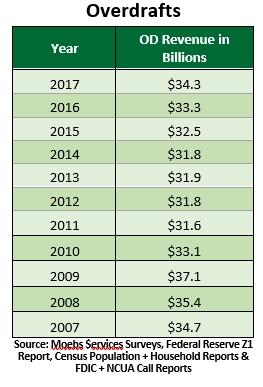
LAKE FOREST, Ill.—Overdraft revenue at financial institutions at the close of 2017 reached its highest level since 2009, according to a new report.
The latest Moebs $ervices overdraft study reveals that financial institution overdraft revenue increased to $34.3 billion at the end of last year, with credit unions playing a big part in the total.
“OD revenue increased 3% industrywide in 2017 from 2016, the largest increase since 2009, and is on pace to move to an all-time high above $37 billion by 2020,” said Michael Moebs, economist and CEO at Moebs $ervices, who noted that market share for overdraft revenue is 79% banks, 19% CUs, and 2% thrifts.
CU Percentage Growth Highest
But leading this rise in overdraft revenue in the past year are credit unions, which increased total OD revenue almost 5%, Moebs explained. Banks averaged 3% revenue growth for the same period.
“More importantly CUs have put together 25 consecutive yearly increases in overdraft revenue— the Great Recession and other recessions never disrupted the credit unions’ OD revenue,” said Moebs.
The Moebs analysis of overdraft revenue shows credit unions’ overdraft prices started at a much lower base than the banks 25 years ago, and CUs have been slower to increase price than banks.
Overdraft prices are no longer “inelastic,” said Moebs.
“Inelastic is an economic term used to describe when the quantity demanded or supplied of a good or service is unaffected when the price of the good or service changes,” he explained. “Overdraft price changes will affect the volume of overdrafts as more and more financial institutions are finding out. Many banks now recognize overdraft prices are price elastic, yet most credit unions do not.”
Community Banks
Community banks with assets under $100 million for many years have not increased, nor decreased their overdraft prices.
“These community banks have more overdraft revenue than their competitor credit unions of the same size, and on a relative basis a greater percentage of revenue than larger credit

Michael Moebs
unions and even the largest banks,” Moebs said.
The median community bank’s OD price in the U.S. is $25.
“This is one standard deviation from the median of $30 for all financial institutions,” observed Moebs. “Three thousand dollars is made for 100 OD transactions at $30 each. When the price is decreased to $25—about a 17% decrease—volume increases to 133 transactions, an increase of 33%, resulting in revenue going up $325, or more than a 10% increase in revenue.”
Aggressive Pricing
The largest financial institutions and the most price aggressive FIs charge $35 or more for an overdraft, said Moebs.
“Again, this is one standard deviation above the median of $30 per OD,” said Moebs. “Most of the largest and/or aggressive FIs are losing overdraft revenue, since OD prices are elastic and the consumer responds to the higher price by curbing usage. Community banks are learning—OD price is elastic, lower price produces more transaction usage by the consumer, and greater revenue for the financial institution.”
Banks and credit unions that lower their overdraft prices, especially those that drop under $20 per OD, will gain more revenue, more consumers using overdrafts, more checking accounts, and greater profits, said Moebs.