

BIRMINGHAM, Ala.—Voluntary mergers are good for the movement, but FOM rules governing federally chartered credit unions are getting in the way of many strong combinations, asserts Dennis Dollar.
Dollar believes NCUA should make some allowances regarding merger rules that will encourage more federally chartered CUs to participate in voluntary mergers as the continuing organization.
“While some bemoan the reduction in the number of credit unions that has continued at a rate of one per business day over the past 15 years, the reality is that voluntary mergers for improved member service and stronger financial performance are quite consistent with the credit union philosophy," the former NCUA chairman told CUToday.info. "And, putting on my former regulator's hat, voluntary mergers also prevent eventual involuntary mergers that put the Share Insurance Fund at risk."
Dollar, now principal partner at Dollar Associates here, noted that no credit union wants to merge in another credit union with only 3% capital, a situation that often leads the continuing credit union to ask for Share Insurance guarantees before it will absorb the struggling CU.
"How much better for both of the credit unions involved, and the NCUSIF itself, if those credit unions were allowed to merge when they both can come to mutual terms without needing NCUSIF assistance and while the merging credit union is at least adequately capitalized—even if the trend lines are down," said Dollar, who shared similar remarks during the recent NACUSO annual meeting in Orlando.
'Tight' FOM Interpretation
Dollar said that the biggest deterrent to voluntary mergers is the "extremely tight" interpretation of FOM that NCUA employs in a merger.
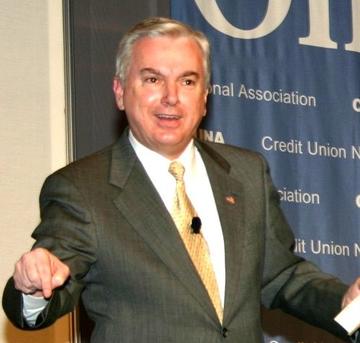
Dennis Dollar
"Currently, NCUA will not allow the joining of different FOM types in a merger where a federal charter is the continuing credit union," said Dollar. "SEG-based credit unions can merge with each other, but they can't merge with a community chartered credit union without having to give up all of their SEGs outside the community. And community charters can't merge with other community charters unless their communities are identical or within one another."
The result, suggested Dollar, is that some of the best fits for potential merger partners that would create the strongest continuing credit unions are eliminated by FOM restrictions.
"It is always bad policy when the strongest possible voluntary merger is prevented by regulation, interpretation or overly strict policies by any regulatory agency,” he said. “Voluntary mergers should be a free market decision made by the fiduciaries and approved by the members, not by the federal government substituting its preferences for who should merge with whom."
Dollar said that many state laws and regulations are "much more flexible" on FOM differences in mergers and, as a result, more and more voluntary mergers are taking place with a state-chartered credit union being the continuing credit union—a trend that Dollar says has placed federal charters at a distinct disadvantage in becoming the continuing credit union in many mergers.
"A workable approach, as I see it, is that if a case can be made with documentation that either credit union considering a voluntary merger may become less than well-capitalized in either net worth or risk-based capital within the next five years, those credit unions should be allowed to voluntarily merge and retain both FOMs if the fiduciaries and members approve," Dollar proposed. "We should not force credit unions onto their death beds before we allow them a transfusion. Voluntary mergers should be easier, not harder, if we want financially stronger credit unions serving their members better and having greater efficiency through economies of scale."
Dollar pointed out that when the U.S. credit union community peaked at about 25,000 credit unions, the industry capital ratio was around 3%. Today, with fewer than 6,000 credit unions, the capital ratio industry-wide is over 11%.
"Which is the indicator of a stronger industry—more institutions or more capital?" Dollar said. "The answer is obvious, I believe. Survivability as an industry depends upon both our mission and our margin. Either within itself is not enough. Economies of scale in credit union land—often driven by the voluntary mergers so many short-sighted observers criticize, even when mutually agreed upon by the fiduciaries of two credit unions and approved by vote of the members of the merging credit union—are crucial to keeping credit unions safe and sound.”
Dollar contends that as the number of CUs shrinks, credit unions’ standing in Washington won’t be damaged.
"The credit union industry has never been stronger, serving more Americans and impacting more lives, than today," he said. "I think our industry, the NCUSIF and our standing in Washington, in state capitals and in the eyes of the public is better served by stronger credit unions—even if there are considerably fewer than there were ten years ago."
Market Driving Mergers
Dollar emphasized that consolidation always has its critics in any industry.
“But the marketplace works,” he said. “Credit union voluntary mergers, while some wish the market challenges which bring about many of them would go away, are an indication of fiduciary boards who put the interests of their members above their own pride and perks as a board member. History has clearly shown that the wider the member participation in a merger vote, the larger the margin of victory for mergers. Members see the value. Often the fiduciary boards are seeing the value. The regulators, particularly those concerned about the strength of the NCUSIF, should also see the value."
Because the market conditions driving many mergers are “real and unforgiving," Dollar said any steps to discourage voluntary mergers of credit unions will leave the industry with only involuntary mergers.
“That would not be healthy for credit unions or the Share Insurance Fund,” concluded Dollar. “Mergers have been a fact of life in credit union land for over two decades, and I don't see it slowing down. NCUA and the states should make the environment as reasonable as possible for well-coordinated, member-oriented voluntary mergers that result in stronger credit unions."