

By Ray Birch
LAKE FOREST, Ill.—Financial data from 2020 suggests the nation today is in “uncharted territory” regarding how the economy might turn in the coming years, including the possibility of another big economic downturn.

Michael Moebs, economist and CEO at Moebs $ervices, says the data make the future unclear, since what happened in 2020 with money movement was very outside traditional activity and hefty government stimulus was involved. But Moebs also suggested a glance to the past may provide insights.
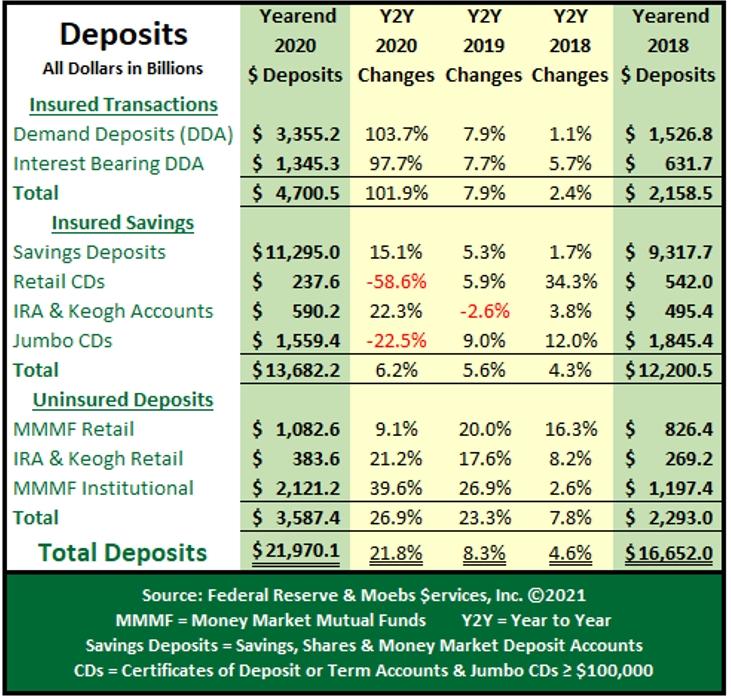
“After all the 2020 numbers for financial institutions have been scrutinized by armies of auditors, examiners, regulators, shareholders, members and stakeholders what do they tell us?” asked Moebs. “They let us know COVID pressed people to keep money short. Funds went to checking for fast withdrawal. CDs fell so money could be move out fast. Deposits showed COVID was here before China told the world. Deposit Insurance accounts won and lost big.”
Making Comparisons
Moebs said the data show that using 2018 as a base year for comparing the movement of funds through 2020, the changes were:
- +102% insured checking – no interest
- + 92% insured interest checking
- + 37% uninsured money market mutual funds/institutional
- + 18% insured IRA and KEOGH accounts
- + 13% insured savings and shares
- + 13% uninsured IRA and KEOGH accounts
- - 7% uninsured money market mutual funds/retail
- - 34% insured jumbo CDs
- - 92% insured retail CDs
“Overall, there was a 32% increase in funds flowing into all deposits, or $5.3 trillion,” said Moebs. “The result was $5 of insured funds for every $1 of uninsured funds. This is a huge historical jump in overall deposit growth.”
What does this mean for the future?
“2020 shows only the front end of the pandemic crisis,” explained Moebs. “In 2020 deposit accounts were moving money to checking. On the surface many banks, credit unions, savings banks, and fintech firms now foresee the consumer will spend some of this new found growth, but also move money back to long-term accounts like CDs.”
The Big Questions
But with further stimulus possibly coming the big questions are:
- How much of money in checking will be spent ?
- How much will stay in checking?
- How much will move to other accounts?
- What will be the mix between insured checking vs. insured deposits vs. retail and institutional uninsured deposits?

Michael Moebs
Moebs said all of these questions lead to an “unchartered situation.”
“The Great Influenza of 1918-20, which occurred at the end of World War I, provides some insight into what could happen,” said Moebs. “The Roaring 20s spawned a spending spree. Americans disillusioned by war and the Spanish Flu pandemic deaths coupled with prohibition of alcohol splurged on purchasing clothes, homes, cars and more. Then the Depression hit and squashed spending with 25% unemployment. Will the 2020s roar with a climax of another Depression?”
Repeat Unlikely
Moebs doesn’t believe the economic scenario of a century ago is likely to repeat today due to better controls by both the Federal Reserve and financial institutions. Still, Moebs believes the “wild card” is how the government addresses this pandemic-induced downturn.
“Until COVID, pandemics never had government subsidies, so the true economic implications are unknown,” said Moebs.
Moebs’ forecast is the economic recovery from the pandemic will initially follow patterns similar to those of prior pandemics.
“Very positive economic conditions will happen for several years, 2022-23, followed by economic downturns. As government subsidies subside the economy will face economic conditions such as a lack of workers coupled with rising unemployment,” he said. “Recent unemployment numbers rising and lack of workers for manufacturing are symptoms of potential economic weakness. Only the hospitality and leisure industry showed positive employment growth.”
The Next Step
Moebs believes herd immunity, with two-thirds of all Americans vaccinated, will happen this summer.
“Studying the effects of COVID-19 on the economy in 2020 is the first step for FIs to fully understand what happened,” said Moebs. “The next step is aligning checking and deposits to move quickly with designs to keep deposits in the financial institution. This means a few, simple checking and other deposit accounts can go a long way with well-trained staff who know what deposits to keep and what accounts to let go.”