

LAHAINA, Maui–Crypto and blockchain are going to be game-changers, but in the short-term it’s not going to be in the way many credit unions believe, according to one person.
While some CUs have plunged in and begun offering members the ability to buy and sell crypto, where the implications are most likely to be felt will be in payments, Tony DeSanctis, a senior director with Cornerstone Advisors and a former exec with Bank of Hawaii told the Volunteer Leadership Institute here.
After the first two iterations of the web—Web 1.0, which was all about consuming, and Web 2.0, which is about creation—now comes Web 3.0, which is about ownership and decentralized tokenization, said DeSanctis.
Blockchain
DeSanctis offered this graphic, below, for how Blockchain works.
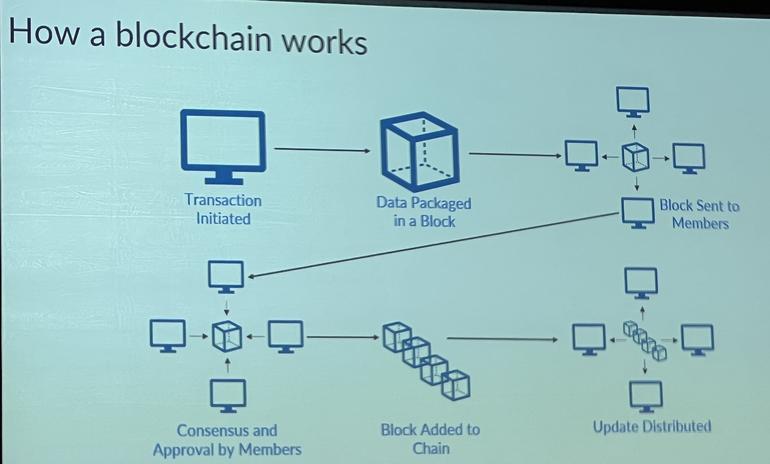
“There is no need for human interaction. It creates an efficiency and simplicity of ways to do things from a time and resource perspective,” said DeSanctis. “You don’t need to have a bunch of staff around to process things.”
The Use Cases

Tony DeSanctis at VLI.
DeSanctis offered the following as real-world use cases for blockchain:
- China Construction Bank. China Construction Bank has processed more than $140 billion on private blockchain, which has facilitated cross-chain and inter-bank transactions and reduced settlement time from two days to 10 minutes.
- Wells Fargo & HSBC. The banks partnered with Baton on international transactions. “Cross-border is the use case that makes the most sense for financial institutions today. It enables near instant payment and settlement,” DeSanctis said, adding that currency specific cut-off times are no longer a factor, and the settlement process can be completed in three minutes.
- JPMorgan Chase. Built on Ethereum blockchain, the bank has built out JPM coin. It has created a payment rail and deposit ledger allowing JPM clients to transfer U.S. dollars; cross-border payments can be settled in real time, and it can be used for cross-border payments. JPMorgan has three payment applications in new offering called “liink”: Route Logic; CheckMatch, and Confirm. “JPMorgan is spending billions of dollars to do this because there is something here,” said DeSanctis.
- USDF Stablecoin. Created by a consortium of banks to oversee domestic money movement using blockchain.
Use Cases for Credit Unions
As for one use case for credit unions, DeSanctis asked, “How many checks are we still processing? About 100% more than we should be.”
“Money movement is the primary place where blockchain is in early production, and still very much in pilot stages. But money movement across the blockchain is one of the biggest opportunities,” DeSanctis said.
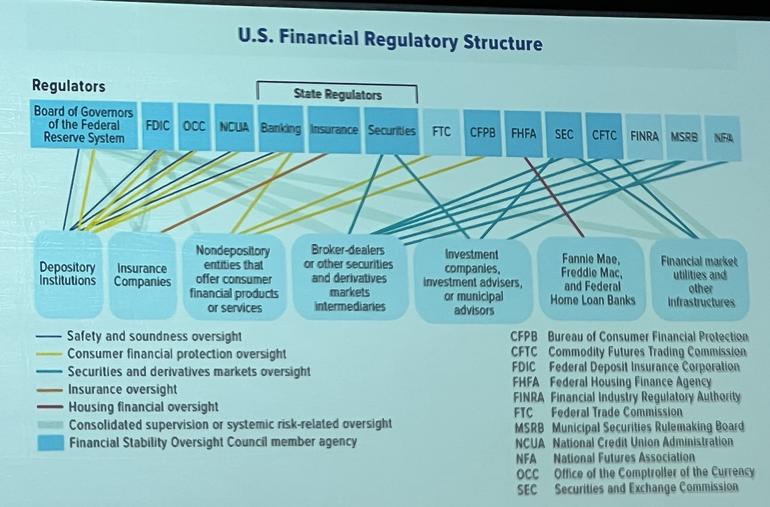
DeSanctis shared the slide above to illustrate the complexity of financial regulation. But movement is taking place in KYC/AML where private data is owned by the individual and stored in the blockchain. The benefits are it creates specificity and certainty, eliminates redundancies, and reduces network/database costs, he said.
“In this model there is no need for date of birth of Social Security number for verification,” DeSanctis told the meeting. “It’s unclear how all these things are going to work. Apple is trying to do this for themselves as a single company. But if you could have your own private blockchain that can be validated, then you will not need to store data with any company.
Where to Go?
Where should a credit union go from a blockchain perspective?
According to DeSanctis, there are three different levels: infrastructure providers, application providers and service providers.
“The vendor ecosystem is growing and becoming more complex, creating challenges for CU leaders. “You are more likely to find partners who have leveraged that blockchain technology inside their own product offerings,” DeSanctis observed. “I do think you will see some of our ancillary providers start to implement blockchain as part of their solutions. You want to aggressively push your vendors to get the most out of blockchain solutions that exist.”
Defi and Crypto
DeSanctis broke down assets according to whether digital or physical and fungible and nonfungible. Nonfungible tokens are physical representations of value, such as art, he noted, adding buyers are able to validate the item using the blockchain. But games like Minecraft and Roblox are digital assets on which real money can be spent.
“The other thing is the application of membership. That should resonate with everyone in the room,” said DeSanctis, adding that an NFT has real-world value but no physical form.
Stablecoins
Stablecoins are a cryptocurrency backed by external reference, an investment tool but also a medium of exchange on the blockchain network, DeSanctis explained. Some of those have legitimate value, others are “garbage,” he added.
Stablecoins can be:
- Algorithmic, which means they are not backed by a reserve supply and are controlled by an algorithm (most have failed)
- Fiat-backed, meaning it’s pegged to the dollar on a 1:1 basis
- Crypto-based, which means its backing occurs on the blockchain via collateral tokens.
Decentralized Finance
Decentralized finance is an opensource ecosystem where transactions happen every day. DeFi has six components: Wallet/Front ends; Aggregators; Defi Primitives; Oracles (designed as non-biased third-party validators of the criteria in the blockchain); Transactions, and Units of Value.
Where is the world today? According to DeSanctis, the daily trading volume crypto is approximately $1.5 billion.
“But a lot of the platforms have blown up,” DeSanctis said, referring to the FTXs of the world.
A lot of the discussions in credit unions has been how to help members buy crypto, which led to partnerships primarily with NYDIG.
“We want to show our forward-thinking ethos,” said DeSanctis. “But I’m not sure buying crypto through your credit union account is the best execution of that.”
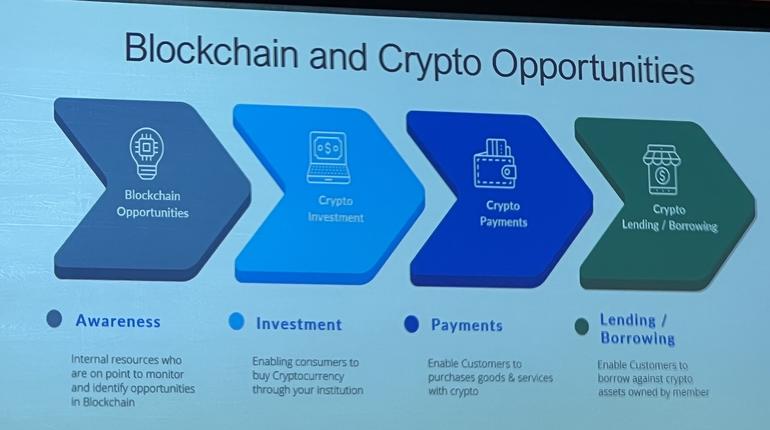
The Game-Changer
The most likely game-changer with crypto and blockchain is the payments space, predicted DeSanctis.
“More and more you’re seeing crypto as a payments type,” he said, reminding that interchange is among the most critical sources of NII for credit unions. “So, all of this on the blockchain is a potential headwind. These alternative payments types is where you can see the disruption.
The Big Takeaway
The big takeaway for credit unions isn’t that they need to do something about crypto, but instead that they have someone within their operation who is paying attention to and understands the crypto-space, DeSanctis said.
Blockchain and Crypto Opportunities Slide
DeSanctis said credit unions need to make clear to members if they get into this space “that this can go really badly. You better be doing a ton of education.”