

GDANSK, Poland–Of all the difficult repercussions of being a refugee, one that isn’t often thought of is the inability to get medical care, which is especially true for women. Credit unions and other donors in the U.S. and Poland have taken steps to address that problem in one country.
Through the Via Stella Foundation and with support from other organizations, two clinics are now operating several days each month just for female refugees from Ukraine who are now living in Poland.
Not long after Russia attacked Ukraine, the Via Stella Foundation was created in April of 2022 by Brian Branch, the former president of the World Council of Credit Unions, and Sue Mitchell, CEO of Mitchell, Stankovic & Associates. They in turn reached out to Rafal Matusiak, president & CEO of Poland’s trade association, the National Association of Credit and Savings Unions (NACSCU), who now chairs the Via Stella Foundation. From day one, Matusiak has emphasized NACSCU is covering all costs related to operating the foundation and 100% any money donated goes directly to those it seeks to help.
CUToday.info joined representatives of the Via Stella Foundationthis week as they visit with the various recipients of its assistance in Poland and Ukraine and discuss what else can be done.
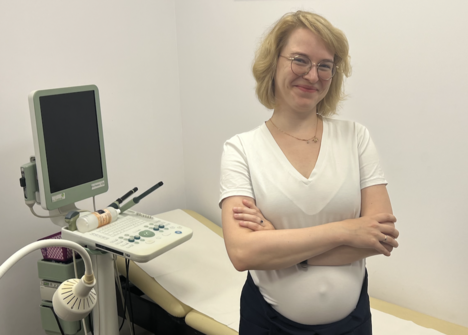
Dr. Stanke-Zblewska inside clinic.
Potential for Expansion
Among the plans it is reviewing is whether it can expand funding for the women’s clinics in a country where public health care is available, but often under strain, and where refugees may not know where to turn.
The rent on the two clinics is being paid by a subsidiary insurance company of the Polish trade association, while the Via Stella Foundation is paying for the doctor of gynecology when she is in the clinic.
That gynecologist, Dr. Stanke-Zblewska, who has been practicing for 10 years, readily signed on with the project six months ago and said it has been very good for the women with whom she has met to date. Last month, she consulted with approximately 40 patients, or 10-12 per day when she is in the clinic. About 90% of those women were from Ukraine. The patients have ranged in age from about 20 to 50, she said.
What’s Available
She said in the two clinics that have received support from the Via Stella Foundation, one in Gdansk—the home to Poland’s strongly resurgent credit union community--the other in a smaller town, she provides advice, performs lab tests, does exams and meets with women who are pregnant, although she sees few expectant mothers given that most of the Ukrainian men have remained in that country and are not permitted to leave.
It is in the smaller towns where women especially lack access to health care and gynecologists.
“In the poorer areas, there aren’t specialists,” Dr. Stanke-Zblewska said. “They may be refused health care in the public system. There can be terrible situations in the public health care system. In the small towns it is just not working. It’s not often that they are not treated, but it does happen. We are able to treat them as part of Via Stella.”
Long Waits
She added that in Poland’s public health system it can sometimes take weeks or even months to see a specialist, and in some cases women—and men—can’t wait.
Women from Ukraine try to use the public system, but it “can be tough even for Polish citizens,” she said with a wry smile.
Certain procedures can require even more time, which leads many Poles to turn to a private system of health care that operates alongside the public system, but that can be expensive.
NACSCU’s Matusiak explained that many Polish doctors work in both systems, meeting with patients in the public system from 8-4 every day, and then working in the private system for another four-to-five hours after that.
Dr. Stanke-Zblewska said she has not encountered many women who are suffering stress-related mental challenges as well as physical health issues since leaving Ukraine. She noted that is due in part because more than 500 days have now passed since the war started. But she did acknowledge she has seen a few cases of physical abuse.
The Stress of Being Away
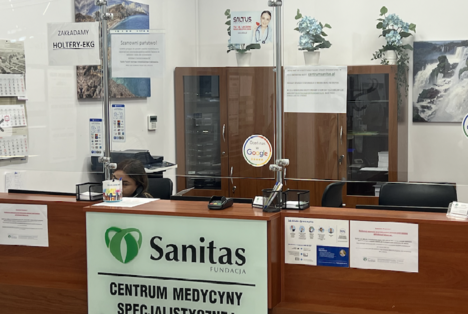
Reception area at clinic in Gdansk.
Naturally, some women do feel the stress of being away from their homes in Ukraine and from being alone in a foreign country, she said.
The Via Stella Foundation is now also providing funding for two psychologists who have experience in trauma counseling and who can meet with children who are haunted by the war.
How have Ukrainian women who are refugees in Poland learned of the clinics and the health care being made available by the foundation? In addition to information on the Via Stella website, staff at the National Association of Credit and Savings Unions have helped spread the word, as has the Ukrainian embassy and consulate.
“From month to month, there has been a growing number,” Dr. Stanke-Zblewska said.
‘Whisper Marketing’
Matusiak said one person with the association has also reached out to Scouting organizations in Poland, which have a very strong presence in the country and which have helped to spread the word. Places in Poland have also been created for Ukraine’s female refugees to meet with each other to discuss common challenges, and this has also become another main conduit for publicizing the clinics.
Dr. Stanke-Zblewska credited a global commonality, “whisper marketing,” or word of mouth, for its role in raising awareness. There have also been discussions online.
Matusiak reminded that at the beginning of the project no one knew what the Via Stella Foundation was or what kind of help it was making available.
“But then the patients starting talking about the clinic and we began to see a growing number of patients,” he said.
The Family Grapevine
Dr. Stanke-Zblewska learned of the Via Stella Foundation’s willingness to underwrite the costs of health care for women who were refugees from Ukraine from her sister, Gosia Gatz, who works for the Polish credit union trade association. Gatz has acted as an interpreter for CUToday.info during several interviews this week.
“I liked the idea from the beginning,” said Dr. Stanke-Zblewska, adding she would like to continue to treat the Ukrainian women for as long as possible, but that will depend on two things: the availability of funding, and the availability of another doctor, as she is pregnant herself with her second child, who is due in October.
“It’s hard to find doctors like Maria,” said Matusiak.
Dr. Stanke-Zblewska said she has the equipment she needs, but if additional funds and space were available it’s highly likely there would be capacity available to see even more patients.
Few Have Records
When Ukrainian women arrive at the clinic, only a few bring medical records or documents with them, with those who have had procedures and surgeries most likely to have the paperwork. Dr. Stanke-Zblewska said she is generally able to understand the Ukrainian documents, which are often also in English.
In some cases, she has had to use a translator to talk to a patient who struggles with Polish.
But regardless of the language, Dr. Stanke-Zblewska said the women all have something in common.
“They need and want to see a doctor,” she said.