


Daniel Pink
WASHINGTON–It’s a Buyer Beware World, right? Not anymore.
In fact, just the opposite—and that has big implications for credit unions seeking to persuade both prospective and current members, according to one person.
Offering credit unions the view from 30,000 feet, 10,000 feet and the tree top level, Daniel Pink told the opening session of CUNA’s Governmental Affairs Conference (GAC) that he wanted his audience to understand one thing more than any other: “Selling your services, your organization, and your ideas has changed more in the past 10 years than in the previous 100.”
Pink, the author of five best-selling books on business, work and behavior, urged credit unions to recognize how the dynamic has evolved and what that means for better serving members.
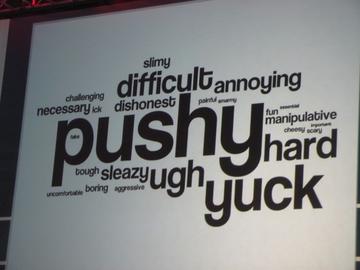
Pink cited research of more than 7,000 people that asked the question, “When you think of ‘sales’ or ‘selling,’ what’s the first word that comes to mind?” To illustrate the responses, he showed a word cloud with the most prominent answers in the largest point size. Among those responses were pushy, yuck, ugh, ick, difficult, annoying, dishonest, slimy, sleazy.
“This is pretty harsh,” acknowledged Pink, “But this is the view of sales that many people have in their heads on the other side of the table, even if you’re selling an idea or a concept. This idea is outdated and you need to scrub it out of your head.”
Pink said that he didn’t think the responses in the word cloud were actually about sales.
“I think this is a word cloud about information. Almost everything we know about sales has come from a world of information asymmetry where the seller had more information than the buyer,” he observed. “When the seller has more information than the buyer they can really rip you off. That’s what this word cloud is about; what it feels like to be a buyer in a world of information asymmetry. This is the principle of ‘buyer beware.’
“But here’s the thing: Do we live in a world of information asymmetry today?” he continued. “Less and less and less and less, and this is a big deal. And sometimes when a really big deal happens in the blink of an eye we don’t notice what a big deal it is.”
Seller Beware
Pink noted that when that same group of 7,000 people were asked to describe a picture of a salesman, the overwhelming choice was a pushy-looking car salesman. And yet auto sales demonstrate the point best, he said, of how the market has evolved from a place where the auto dealer controlled all the information to one in which the consumer does.
“That’s also true of consumer financial services,” he told credit unions. “So I did a search: ‘Where should I open a checking account in Washington, D.C.?’ I got a mere 109 million results. And that took Mr. Google a half-second. We’re now in a world where buyers have lots of information, and it’s a different world. It’s a Seller Beware world.
Pink then presented what he said were three thoughts from the 10,000-foot level. He noted that over the past 20 years there has been explosion of data research and social science and behavioral economics on how people make decisions and frame issues. For instance, is it best to make three, five or seven points when attempting to make a sale? “Please, please, stop with three. You see a big drop-off when you get to the fourth,” he said.
The old sales model was best summed up in the movie Glengary Glen Ross in which the character played by Alec Baldwin teaches other salesmen the ABC’s: “Always Be Closing.”
“And that’s not a bad idea in a world in which buyers don’t have much information and there is not much opportunity to talk back.”
The New ABC’s
But it’s a bad idea in a new world in which consumers have information and plenty of opportunity to talk back. Instead, the new ABC’s, according to Pink, are: Attunement, Buoyancy, and Clarity.
Attunement. “This is perspective taking. Can you get out of your own head and get into someone else’s head? It’s important, because not many of us have coercive power. You can’t force people to join a credit union or an employee to do something. When we lack that coercive power, the flip side is seeing their perspective and finding common ground.”
Buoyancy. “I would argue that 80% of your job is persuading. You’re going to get rejected all the time. Buoyancy is how do you stay afloat in that ocean of rejection. One of the best predictors of success in sales is how people explain their rejection, explain their failures. We tend to take it so personally.”
Clarity. “It used to be a competitive advantage to have access to information. Now everybody has access to information. What matters more is being able to curate information, being able to make sense of information and using your expertise to separate from the noise in information. When people need you is when they are wrong about a problem or confused. So it becomes a world of problem anticipation; it’s a different skill, a more perceptive skill.”
Five Treetop Level Views
Finally, Pink turned to five “treetops level” concepts he said CUs—and especially those in senior management—need to understand.
1. What Power Does. The more powerful a person feels, the more likely that person’s ability to see others’ perspectives fade. “What you see again and again is high-power people tend to be terrible perspective takers. This is one reason why some leaders aren’t persuasive. So you can increase your effectiveness by briefly reducing your feelings of power. Many people think of power as a dial that only goes in one direction. But you need to think of it as a dial that can be dialed back, especially with subordinates. What happens a lot when we’re in a position of power and we get resistance is our instinct is to want to assert our power. But I’m going to suggest that you should click, click, click down and improve the acuity of your decision making.”
2. How to “Persuade Up.” Pink noted that this point is especially relevant to credit unions that are in Washington seeking to be heard in Congress. He urged CUs to learn from research done in which three groups were sent out into the market to sell products, with the first team being given no instruction, the second being urged to imagine what the buyer might be thinking, and the third to imagine what the buyer might be feeling. Which performed best? The group that imagined what the other side was thinking. “Thinking is important, especially as you are persuading up. You want to get both channels; that’s the way to get a higher resolution picture, but that’s often very hard. Emotional intelligence is very important, but research shows in certain circumstances you want to focus on thoughts and interests and use your heads as much as your hearts.”
3. Personalities. In observations that surprised many, Pink said while extroverts are almost always considered “naturals” for sales positions and promotions, the research shows they only slightly out-perform introverts. A University of Pennsylvania study found that quiet people can be more effective at selling and persuading. The extraverts did a little better in sales. “But the big takeaway from the research is the ambiverts crushed the extroverts and introverts. Which raised the question: What the hell is an ambivert? It’s someone who isn’t strongly one way or the other. Ambiverts are ambidextrous, they can go left, they can go right. There is no evidence that strong extroverts make better persuaders; it’s an abject myth. But it also doesn’t mean strong introverts are best; they’re actually even worse. Don’t get seduced by myth of a strong extrovert. To be more persuasive, don’t be a glad-hander, be more like yourself.”
4. Questions Vs. Statements. Pink pointed to the 1980 presidential debate between between President Jimmy Carter and Ronald Reagan when the latter simply asked, “Are you better off than you were four years ago?” It was a powerful turning point in the campaign for Reagan. But why? “Research shows questions by their very nature elicit an active response. This is the key and please remember this—people come up with their own reasons for agreeing with you. They then believe those reasons more deeply. Questions often beat answers.”
But there’s a flip side, stressed Pink: “If people disagree with you they also believe that more deeply. When the facts are clearly on your side, use questions more than statements. But, when the facts are not clearly on your aide, don’t do this.”
5. Two Final Lessons. The meta-lesson: “When we as North Americans try to explain people’s behavior and predict people’s behavior, we almost always overweigh personality and underweigh context. Context drives our behavior more than people think.”
The micro-lesson: “Give people an off ramp. If you want people to do something, make it easier for them to do it. As humans, we don’t like to change our minds. Instead, make it easy for them to act, and when they begin acting a certain way, they often change their beliefs.”