

By Ray Birch
LAKE FOREST, Ill.— The coronavirus pandemic has also changed consumer behavior when it comes to using overdrafts, and credit union leaders must change their thinking in response, according to one expert.

That recommendation comes as a new analysis has found that even though a growing number of financial institutions have eliminated or reduced their overdraft fees and average OD pricing has fallen nationally, overall overdraft income is still expected to end 2021 higher than at the close of 2020, one new report is forecasting.
The study also reveals many more credit unions than banks have moved to eliminate or cut their overdraft charges, even though it was a bank that kick-started the trend.
“Reports of the death of overdrafts are greatly exaggerated,” said Michael Moebs, economist and CEO at Moebs $ervices, paraphrasing the famous quote by Mark Twain after a London newspaper erroneously published news of his death in 1897 (Twain actually died in 1910). “Overdrafts are going through the same ordeal as Mark Twain’s obituary. Reports of increasing OD prices, prices averaging $37, and OD revenue falling below $17 billion for all depositories are greatly exaggerated.
Significant Data Reviewed
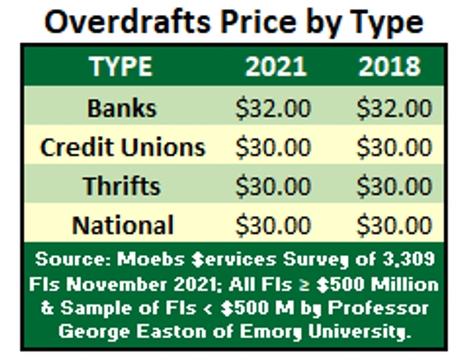
“We got the overdraft price from every bank, credit union, thrift and fintech firm greater than $500 million in assets,” continued Moebs, referring to the data the company has compiled. “We have this data back to 1992. Also, we found overall OD prices and the family of overdrafts—NSFs, stop payments, return of deposited items, transfers from other deposit accounts—and daily negative balance fees are starting to decline. We also did a review of actual OD revenue for all depositories and found that mid-November that net revenue was $32 billion annualized, or an increase of 2.2% from $31.3 billion at yearend 2020.”
Overdraft prices range from $0 to $48, but the median and average is $30 based data from 3,309 financial institutions, which also includes a large sampling of FI’s below $500 million in assets, Moebs explained.
As the number of financial institutions exiting the overdraft market rises, a trend on which CUToday.info has extensively reported, the Moebs survey shows 0.5% of financial institutions offering transaction accounts had no charge for overdrafts.
“Since 2018, which is pre-COVID, 3.6% of all FIs offering checking have gotten out of the overdraft business,” noted Moebs. “Of the FIs that have no charge for overdrafting, 11% are banks and 89% are CUs.”
What’s Happening Now?
What is happening to the overdraft price?
While overdraft pricing has remained fairly stable at $30 in recent years, there is significant pricing movement occurring in two asset-size categories, noted Moebs.
“I have never seen any category come down in a statistically significant way, until now,” Moebs explained. “They have always stayed about the same.”
The new Moebs report (see chart) shows financial institutions from $25 billion in assets to $50 billion have reduced their overdraft prices from $35.50 to $35. Those from $500 million to $1 billion have dropped their price $1 to $30.
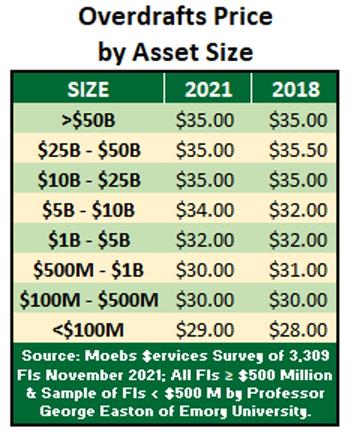
“Both of these movements are statistically significant,” asserted Moebs.
The ‘Ancient View’
Moebs emphasized the “ancient view” is overdrafts are inelastic, based on the wrong assumption that any price increase will not affect demand.
“But that thinking is long gone, and our latest study shows that,” stated Moebs. “Lowering the OD price will actually increase volume and revenue.”
The two asset categories in the report that decreased their pricing underscore how “less is more,” according to Moebs.
“Offering a lower price is not only a better deal for the consumer, but more revenue can be made for the bank or credit union, too,” he said. “This approach is far more consumer friendly and dilutes efforts in Congress to investigate unfair overdraft practices.”
Other Key Findings
- The coronavirus is changing consumer behavior making depositories rethink overdraft pricing and overall policy
- Depository management needs to rethink the limits imposed on ODs to accommodate the OD pricing changes.
“As Mark Twain said, ‘The secret of getting ahead is getting started.’ Does overdraft pricing need a kick start?” Moebs asked.