

LAKE FOREST, Ill.—With Wells Fargo’s aggressive sales culture in the spotlight for allegedly having driven more than 5,000 employees to create two-million sham accounts, how are CUs handling their incentive pay?
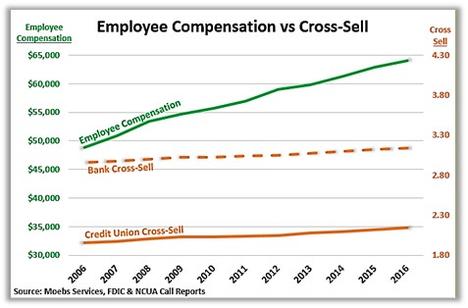
A new study shows that credit union cross-sell ratios are well below banks’ and suggests that CUs could benefit from increasing their efforts here.
Michael Moebs, economist and CEO at Moebs $ervices, which completed the report, says data show credit unions remain much more transaction-focused than relationship-focused, while at banks the inverse is the case. He said both banks and credit union cross-sell ratios are lagging behind their increases in staff compensation over the last 10 years.
Moebs emphasized that the way incentive programs are structured is critical, and that both banks and credit unions should make incentives “longer-term” in the way performance is measured and rewarded. Moebs said metrics should be used that are based as much on account holder satisfaction as they are sales numbers—a step he said should help avoid the unethical sales practices that occurred at Wells Fargo where employees were pressured to open eight account relationships per customer.
“The Wells Fargo Bank crisis is an opportunity for financial institutions to evaluate and adjust their own sales process,” said Moebs. “The key is compensation. However, unlike Wells Fargo Bank, you must compensate service effort over time, and not only for the initial sale of the service itself.”
Sales Comp Trailing Inflation
The Moebs $ervices study determined average employee compensation by dividing total compensation by the total number of employees per institution. The average employee compensation for all depositories grew from $50,929 in 2007 to $63,996 in the first half of 2016, a 25.7% increase over nearly a 10-year period. During the same time period, compensation resulting from cross-selling has been increasing at a slower pace of just 5.6%, Moebs said
Employee compensation and cross-selling rates of change can be compared to inflation, Moebs said, which grew 16.2% from 2007 to 2016. Compensation grew much faster than both the cross-sell rates and the inflation rate, data show.
“However, at 5.6%, the cross-sell rate did not match up to either the compensation or inflation rates,” said Moebs. “This indicates a positive or direct relationship between compensation and the consumer price index, while cross-sell is negative or indirect to (Consumer Price Index).”
Compensation does not align with cross-sell rates from 2007 to today, but reflects more of an inverse relationship, added Moebs.
“Something is amiss since well-executed incentive programs would indicate more compensation comes with more cross-selling,” said Moebs. “There may be many valid explanations for this, but cross-sell rates are typically higher in expansive economic times, but lower in difficult economic conditions, which certainly has been the case since the Great Recession.”
Credit unions typically apply a transaction-oriented marketing strategy when designing services such as a checking account, auto loan, home equity loan or mortgage, said Moebs.

Michael Moebs, Moebs $ervices
“The checking account is the credit union’s primary service. CUs’ cross-sell rate is lower than banks’ because credit unions emphasize volume with these transaction-related services, not expanding the relationship,” he said.
Banks are moving away from the checking account being the primary service and are focusing more on a relationship-oriented marketing strategy, explained Moebs.
“Other services banks offer include large deposits, loans, securities, insurance, retirement accounts, wealth management, and small business accounts. With many banks, checking is treated as a no-charge secondary account supplementing other services with higher margins,” said Moebs.
Evidenced by the large number of customers leaving mega-banks in recent years, banks’ moved to a relationship marketing strategy to gain profitability with fewer customers, said Moebs.
“In contrast, credit unions remained with the more basic strategy of transaction services to gain the maximum number of members,” Moebs said. “These different approaches to financial services allows banks to be more sales oriented and credit unions more order takers.”
Which Metric?
The question, said Moebs, is which marketing metric for compensation is most effective: transaction or relationship?
“It solely depends on the operating style of each institution; order-takers can be just as effective as sales people,” he said.
Another analyst agrees.
“It doesn’t matter if your methodology is transaction oriented or relationship oriented,” added noted sales expert Dan Kleinman. “The sales process has to fit your operating style. Compensation will only help improve it.”
Moebs said two “critical factors” apply to both approaches:
- Consumers must have their needs fulfilled with proper selling techniques, and
- Service/sales people must be compensated based on net measures over a period of time.
“A strong link in the financial service sales process exists between selling services and long-term employee compensation,” said Moebs. “Wells Fargo Bank failed at selling because it rewarded employees immediately instead of earning bonuses and incentivizing people over time, through the development of satisfied consumers.”