


Michael Moebs, Moebs $ervices
LAKE FOREST, Ill.—Credit unions lead banks in offering free checking, but they trail their counterparts—particularly community banks—in offering more account-friendly features such as daily overdraft limits and de minimis pricing, a new study shows.
That trend, said Michael Moebs, economist and CEO at Moebs $ervices, could impact credit union business long term, and possibly slow the record membership growth resulting from holding the line on free checking.
“The banks are focusing on checking account features and credit unions are selling Model Ts,” said Moebs, about findings from a report that surveyed more than 3,800 banks and credit unions.
Explaining the consumer benefits of features, such as de minimis pricing, Moebs, said, “We have all heard the story of the $34.81 latte. De minimis in its abbreviated form, means too minor to matter. So, with a de minimis policy a latte purchase of $4.81, which causes an account to overdraw with a very minimal negative balance, will not be charged an overdraft fee. Nationally, the de minimis amount is as high as $25 but is generally $10 or less.”
CUs Lagging Behind
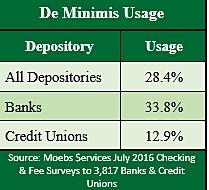
The Moebs study shows that 33.8% of banks have adopted de minimis pricing compared to 12.9% of credit unions. Overall, 28.4% of all financial Institutions have adopted this approach.
Daily overdraft caps, too, aid consumers by limiting the number of overdraft fees that will be charged in one day.
“Interestingly, daily caps can be as low as one overdraft per day and up to 10 per day,” said Moebs. “There is a problem many financial institutions have with daily caps. They want to avoid facing the initial loss of revenue due to the waiving of fees from the daily cap policy. However, they miss out of the long-term revenue gain from more consumers using overdrafts more frequently, and in the long run increasing volume and revenue.”
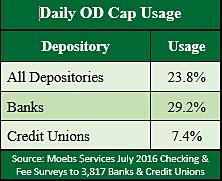
Moebs data shows that 29.2% of banks offer daily caps compared with 7.4% of CUs.
“These features bring a very high level of service to consumers, and they really help to keep the account holder with the institution and more satisfied, and as a result taking more services,” continued Moebs.
Friendly Features
Moebs said the report demonstrates there is a growing percentage of financial institutions that generate more fee income when they employ friendly overdraft features such as low price, de minimis and daily caps.
“Consumers use these friendly overdraft depositories more frequently driving up the financial institution’s overdraft volume and thus increasing overdraft revenue,” said Moebs. “The era of penalty pricing for financial services is dying as a more user friendly environment takes hold.”
Moebs said the FDIC, unlike the NCUA, has issued overdraft guidance to the banks.
“The overdraft guidance suggests more consumer friendly approaches. However, the banks are not required to follow this guidance. As a result, we see only about one out of three banks that have adopted the de minimis and daily cap policies. Both policies are offered even less when looking at credit unions, where only about one in ten offer each policy. The FDIC guidance for the banks has led them to adopt this more often than the credit unions,” he said.
37.7% Mor3e Fee Income
The Moebs study shows that FIs that offer both de minimis and caps have 37.7% more fee income than those that do not offer both features.
“The banks have been able to successfully introduce both policies. The credit unions started introducing these policies only recently, and lag behind the banks considerably,” said Moebs. “It’s like the old Model T—Henry Ford said you can have any color as long as it is black. But that is what created General Motors, who came along and said we’ll give you more colors, more options . . . Henry Ford sold millions and millions of Model Ts, but by the mid-to-late 19030s that wasn’t happening anymore.”