


Michael Moebs, Moebs $ervices
LAKE FOREST, Ill.—Just as overdraft revenue has hit record levels at banks, thrifts and credit unions—so too has OD volume, a new study has found. That same study also reveals that more community banks and large CUs are cutting overdraft price to increase income.
The current total FI overdraft revenue of $31.9 billon is the highest first quarter figure since 2010, according to a new overdraft study by Moebs $ervices. Along with increasing revenue, the overdraft volume also increased 4.4% in the past year, reported Michael Moebs, economist and CEO at Moebs $ervices.
“With the national price remaining constant for the past three years at $30, what is causing the OD revenue to increase?” asked Moebs. “When looking at the increase of OD revenue at an institutional level, one factor plays a big role. When an institution offers a lower overdraft price, the volume increases, which in effect increases the revenue. This trend is also apparent when looking at the industry as a whole.”
The latest Moebs study included every financial institution of more than $500 million in assets and a statistical sampling of more than 2,000 FIs of less than $500 million in assets.
“When comparing overdraft prices between the three types of institutions, there is no significant difference. Banks and thrifts both have a price of $30, while credit unions charge a dollar less at $29 per item. The market views this small price difference as negligible,” said Moebs.
The Breakdown
Where the real story can be found, said Moebs, is in breaking down the OD price by bank and credit union asset size.
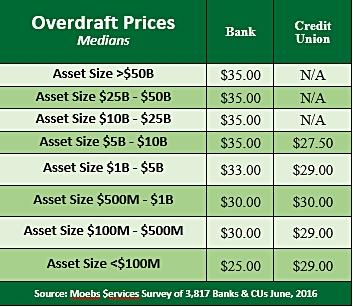
“Community banks, those under $100 million, have not changed their price in seven years. When comparing OD prices of the large Wall Street banks to the small community banks, there is a $10 difference,” said Moebs. “However, despite the large price difference they are collecting nearly the same in OD revenue, when measured as a percent to assets. These smaller banks are able to collect a good amount of OD revenue because of the volume created by their low price.”
Among credit unions, the larger CUs over $5 billion have the lowest price at $27.50. In each size category, the OD revenue is comparable, despite the price differences.
For the large CUs and the community banks, low price leads to higher volumes causing more revenue, said Moebs.
“The price of an overdraft continues to have an effect on revenue and volume. However, the business of overdrafts is no longer driven by the individual price alone,” explained Moebs. “Other friendly features such as de minimis or daily caps will also drive volume, which creates more revenue. We have been guiding financial institutions for years with the irrefutable concept: price drives volume. The large credit unions and the community banks are proving that volume is king.”