

LAKE FOREST, Ill.—Small business lending among all FIs has yet to climb back to pre-recession levels, and the issue is bigger among smaller banks and CUs.
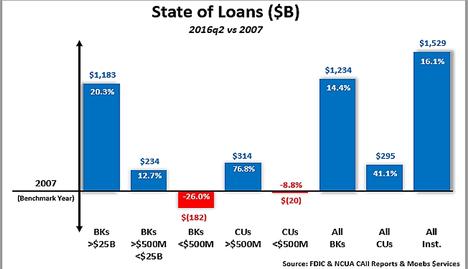
According to a new report from Moebs $ervices, the growing compliance burden and increased capital demands resulting from Dodd-Frank are key reasons why those FIs under $500 million in assets are having a harder time returning to business lending levels of 2007.
“Community banks and credit unions have been forced to adjust priorities,” observed Michael Moebs, economist and CEO at Moebs $ervices. “The average community FI has nearly quadrupled compliance personnel, and the required capital to assets has gone from 8% to 10% in the same time period. This has caused main street FIs to shift focus from lending to shrinking balance sheets to address the increase in regulatory costs and higher capital requirements.”
Pointing to the fact that small businesses employ over half of working Americans and create more than 60% of all new jobs, Moebs said, “Until community banks and credit unions under $500 million in assets can be unleashed from compliance and capital demands, employment will not increase in U.S.”
CUs $20 Billion Short
Addressing how small businesses typically have gone to community banks and credit unions for their lending needs, Moebs said the loan study shows community banks are $182 billion, or 26%, short of total loan balances from their all-time high of $700 billion in 2007. Community credit unions are $20 billion, or 8.8% short.
Moebs emphasized that growth in lending and access to credit, measured by loan balances and number of loans, is a key indicator of the overall strength of the economy.
“This access to credit is critical to the creation and growth of small businesses. Moebs information shows that all financial institutions have increased their overall loans by 18.3% since 2007,” Moebs said.
Banks have increased loans by $1.2 trillion (or 14.4%) in eight years, and credit unions have increased loans $295 billion or 41.1%, in the same time period, the study shows.
“However, as we delve deeper into the data and look at small business lending among FI’s with assets $500 million or less, we can see that all is not rosy,” said Moebs.
Moebs questioned why the Federal Reserve has not used its own studies to identify and address this major cause for the soft economy the past eight years.

Michael Moebs, Moebs $ervices
“The Fed has not made the connection that small FIs, the main source of credit to small businesses, are significantly lagging behind pre-recession business loan performance,” stated Moebs.
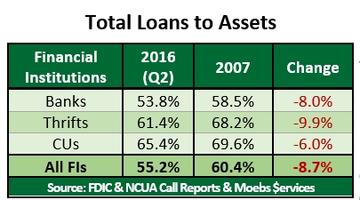
The Moebs study also points out loans to assets has shrunk for all depositories by 8.7% since 2007.
“Since 2008, the Fed has been forced to use monetary policy with no fiscal policy from the White House and Congress. Fiscal policy could have reformed taxes and entitlement programs, and introduced new stimulus programs,” continued Moebs. “The Fed failed to help community banks and credit unions with monetary policy alone.”
Steps For CUs To Take
Until the new administration can get the “Dodd-Frank Act corrected,” credit unions need to cut costs to cover increases in compliance, said Moebs.
“More importantly credit unions can provide better financing for small business,” he said. “CUs must go beyond commercial RE loans and get into loans for commercial equipment and even unsecured short-term financing. The shadow banking companies like Quicken Loans and others are providing more short-term unsecured financing than CUs and community banks. All depositories, especially the Main Street community credit unions and community banks, must beat the shadow banking outfits at their own game by providing better financing terms.”