

By Ray Birch
WASHINGTON—What will President-Elect Donald Trump’s announcement that during his first 100 days in office he wants to see two federal regulations eliminated for every new regulation enacted mean to credit unions?
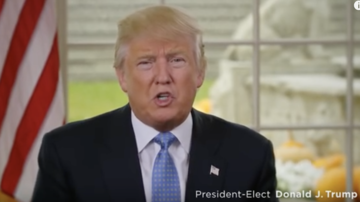
Trump made the announcement in a YouTube video outlining the executive actions he plans to take during those first 100 days. The video can be viewed here.
While CUNA and NAFCU do not believe Trump will issue a specific executive order requiring the elimination of two regulations for every new rule, they believe Trump’s statement delivers a strong message that development of new rules needs to be checked. They also believe that for the first time in many years, 2017 may be a year in which CUs begin to see some real regulatory relief.
Carrie Hunt, NAFCU SVP-government affairs and general counsel, does not think what Trump has outlined will be signed into law.
“Because of so many statutory requirements, it would be difficult to implement a rule like this, as Trump has stated,” said Hunt. “But this certainly sets the right tone and is something to aim for.”
Aggressive Goal
CUNA’s Chief Advocacy Officer, Ryan Donovan, concurred, said the aggressive goal announced by Trump really serves more as a guideline for how the new administration will address regulatory relief.

Carrie Hunt
“It establishes a broad perspective on how the new administration will approach rulemaking,” said Donovan. “The idea is that as you promulgate new rules you look at what’s on the books to see what can be removed—that is a positive step. It also sends a message to folks who will be leading executive branch agencies that the president wants to reduce the overall regulatory burden.”
Hunt thinks a reduction in regulations facing financial institutions is realistic.
“How that happens is somewhat of a complex process,” she said. “NAFCU has long had our list of the top 10 regulations to amend or eliminate, and we have seen some success with that list. But what we want is less regulations issued to begin with, especially from the CFPB. We have pushed the CFPB to not issue regulations where it is unnecessary to do so.”
Following Trump’s election, both NAFCU and CUNA asked the CFPB to put a moratorium on new rulemaking.
Regs Must Be Removed
Like Donovan, Hunt stressed that whether Trump is successful or not in creating a firm rule requiring the elimination of two new regulations for every one new rule enacted, outdated and unnecessary regulations must be taken off the books.
“We have pushed NCUA to do that, and we have seen some success,” Hunt said. “But what we need is for Congress to act and change some underlying statutes, because most regulations flow from a statutory requirement. Certainly, more teeth can be placed into these reviews of regulations that the agencies are doing.”
How will the new emphasis on reg relief affect NCUA—which declined to comment on Trump’s agenda—and its approach to rulemaking?
“This is where it gets complicated,” said Donovan. “NCUA, as an independent agency, is not always subject to executive orders—a little removed from the direct hand of the White House. It’s too early to tell how something like this might impact NCUA.”
But Donovan emphasized that NCUA over the last 10-12 months has been providing CUs with greater regulatory relief.
“They have finalized an FOM rule that is an overall reduction in regulatory burden for credit unions. They finalized a member business lending rule that is an overall reduction in regulatory burden,” said Donovan. “They are proceeding with modernization of their supervisory process, which we hope will ultimately reduce the regulatory burden on credit unions. While what NCUA is doing is not the same as the ‘two for one’ requirement Trump has outlined, what they are doing is moving forward in the same spirit.”

Ryan Donovan
Trump's Agenda
Donovan said that whatever the outcome of Trump’s agenda items for his first 100 days in office, it is certain that credit unions and their trade groups have a better chance of being heard in their efforts to lobby Congress to reduce the regulatory burden on CUs.
“This certainly changes the dynamic in Washington,” said Donovan, who emphasized that credit union regulatory relief will again be a top priority for CUNA in 2017. “Right now we have a situation where if Congress were to pass legislation like what Trump has outlined, it would almost certainly be vetoed. I think in the new administration that becomes significantly less likely.”
Trump’s proposal, while difficult to implement, at its heart is sound, said Donovan.
“The principle behind it a pretty solid one: The notion that over a period of time their ought to be a reduction in regulatory burden so financial institutions can effectively serve their customers and members,” said Donovan. “It would be interesting, too, to see what would transpire if Trump’s proposal were applied to the CFPB.”