ORLANDO–Is there really ROI to be found around empathy? Yes, according to one expert, who said the payoff involves much more than just internal cultures, and can be directly seen in how some financial institutions have made small language changes to improve payments and even in how they refer to their headquarters.
Belinda Parmar, CEO of the Empathy Business, told the League of Southeastern Credit Unions’ annual meeting here, she believes credit unions are in a unique position when it comes to empathy.
“Empathy is at the heart of what you do. It’s almost your currency. I’ve worked for large banks and there is a tendency to think of people as a credit score, not as people,” said Parmar, who described her work as being like a “company doctor,” in which she helps organizations with leadership, operations and communications.
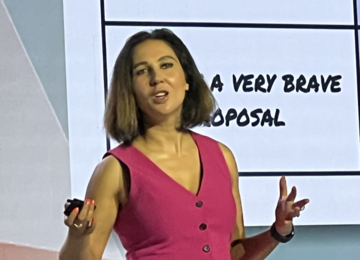
Belinda Parmar speaking to LSCU meeting.
Parmar framed her remarks around three themes: Context of Now; Myths Around Empathy, and Empathy in Action
“Empathy is the emotional impact an organization has on its colleagues and clients,” Parmar told the meeting.
Three Types of Empathy
According to Parmar, there are three types of empathy:
- Cognitive Empathy. “This is what the psychopaths have, when you understand someone to motivate them. CEOs are four times more likely to have psychopathic tendencies than the rest of us.”
- Affective Empathy. “It’s when you really feel another person’s position or pain.”
- Behavioral Empathy. “It’s empathy with boundaries and ultimately that allows a person to act.”
Context of Now
In employment engagement surveys, Parmar said people feel they are now being “done to,” an “element of feeling like a victim.”
The way many people now feel is the result of the rising cost of living and a feeling of having lost power, leading people to operate “from a place of fear.”
“The problem in operating from a place of fear is you become defensive,” Parmar said. “What we really need from leadership is where we give back to people a sense of purpose. During COVID people felt more empowered. In a crisis, leadership is somewhat easier. Now, employment engagement is the lowest it’s been in a decade.”
Three Important Questions to Ask
According to Parmar, the three most important questions leaders can ask are:
- Do you feel visible?
- Do you feel cared for?
- Do you feel valued?
Debunking Myths
Parmar told her audience that if they took no other message away from her remarks it would be to understand the difference between empathy and sympathy.
“Sympathy is when you feel sorry for someone. It’s a pity party. It doesn’t help them. Empathy is where you take ownership and there is honest and transparent communication.”
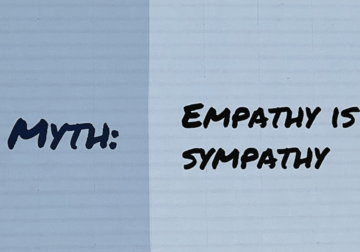
Parmar shared the observation from Brene Brown that “empathy feels connection, sympathy drives disconnection.”
Parmar also shared Brown’s observations that:
- “Empathy is feeling with people.”
- Rarely does an empathic response begin with “at least.”
- “The truth is rarely can a response make something better. What makes something better is connection.”
Myth: Empathy is a Commercial Trade-Off
Parmar said the data is clear that more empathic companies make more money, no matter how the numbers are cut. “Better companies are…50% more profitable.”
Myth: You can’t Measure Empathy
“If you really want to understand your progress you have to measure it,” said Parmar. “At the heart of an empathic company is a feeling of belonging. For example, we measure senior vs. junior people talking in meetings. You don’t want your senior people talking all the time. That’s a culture of deference and the opposite of empathy.”
Myth: Being Smart is Enough. “It’s not enough anymore. You need your EQ.”
Myth: You Are Either Born Empathetic or You are Not.
According to Parmar, research indicates approximately 10% of a person’s empathy levels are genetic. The rest is numerous other factors, but “essentially it’s a bit like a muscle, you have to practice to get it to grow.”
Myth: Change Starts With Big Gestures. “It doesn’t. It starts with these nudges. And language is one of the most powerful tools we have. I can’t overstate this.”
For example, Parmar noted the Disney company calls receptionists “director of first impressions.”
“People behave in a much different way with this title,” she said.
Another example of language that made a difference, according to Parmar, was when one company changed the name “head office” to “support hub.”
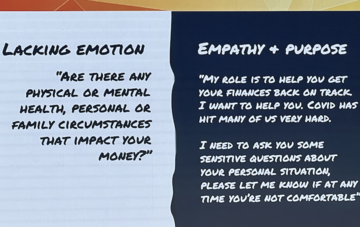
In financial services, shared this example:
- Unempathetic Language: “If your account is in debt….” Said Parmar, “Debt creates shame. Shame creates denial. We want to get people to act.”
- Empathetic Language. “If you accidentally missed a payment….” Said Parmar, “Much more empathetic way to say the same thing and this leads to more payments. Change will come through difficult conversations. We need to lean into those.”
A Different Question
With one bank with which Parmar worked, she said it changed the questions the front-line staff asked of customers to: “What would you do if it was a member of your family?”
“And that changed everything. It changed behavior,” said Parmar.
As an example, Parmar cited job recruitment company Indeed, which has an orange chair in every meeting room to represent the job applicant.
“It’s institutionalizing empathy,” Parmar said.
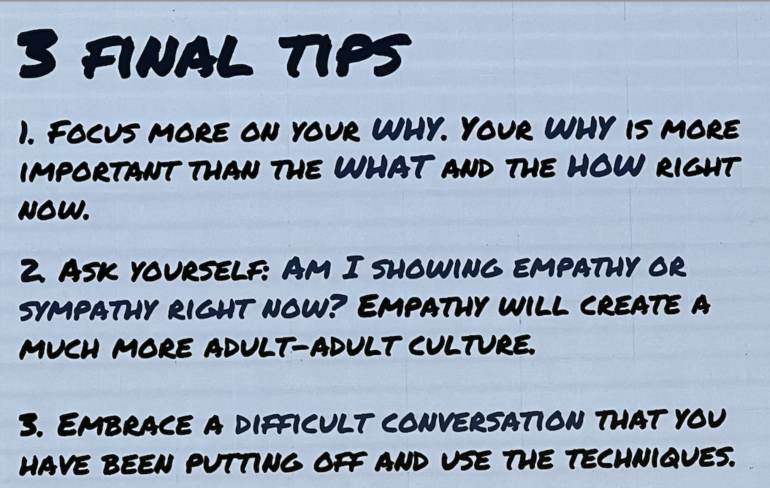
Finally, Parmar offered the three tips below as her final advice.