

LAKE FOREST, Ill.—Despite a likely move by the Federal Reserve this week to hike interest rates, financial institutions should not budget for significant interest expense changes for deposit services in 2018, according to a new report that also suggests net interest margin should improve.
But credit unions would be wise to move to “protect” their larger depositors now, according to the same analyst.
If the Fed increases the Fed funds rate at the conclusion of its meeting on Wednesday, and then also moves twice to bump up rates next year, overall paid interest on deposits will increase from a current average of 0.39% to 0.57%, but only if loan and investment rates increase proportionally by 50 BPs to about 3.75%, said Michael Moebs, economist and CEO at Moebs $ervices, and author of the report.
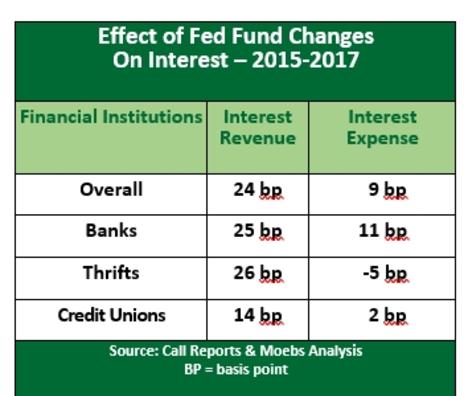
“Financial institutions are having trouble budgeting for interest expense on deposits in 2018,” said Moebs. “The Fed appears to tell what to expect in 2018. Three Fed fund rate increases since December 2015 moved the Fed funds rate from about 0.15% to 1.15%. In two years this moved interest revenue for all banks, thrifts, and credit unions about 24%.”
Powell Policies Similar
Interest paid on deposits moved less than 10%.
“And the change from Chair Yellen to Chair Powell appears to have more of the same slow Fed Funds changes in store,” observed Moebs.
Data from the 12,600 call reports of all financial institutions compiled by Moebs $ervices provides additional insights into what to expect in 2018, said Moebs.
“Jamie Dimon, CEO and chairman of JP Morgan Chase, said in an interview about six weeks ago that he expects a large increase in interest expense in 2018,” said Moebs. “However, the past numbers tell a different story. If interest expense doubles in 2018 from what it has done in the past two years, even with the potential of another rate hike in 2017 and two in 2018, interest expense would go from 0.39% of assets for all financial institutions to 0.48%. This is not much of an overall increase.”
Moebs noted that interest rates paid on deposits has been slow to move up despite Fed rate hikes.
“If you look at the asset side of the balance sheet for all financial institutions, investments and loans are substantially over one year in duration,” noted Moebs. “This means interest paid on deposits will be very sticky in rising as rates go up. The main reason is asset interest prices need to increase faster than rates on deposits to avoid a decrease in the net of revenue minus expense to prevent net interest margin from falling. Another reason is if a depository can slowly increase interest expense as rates rise the financial institution makes more net income.”
Interest Revenue Up 24%
Using the Fed funds change of 100 BPs as a base, interest revenue only increased 24%, while interest rates paid increased only 9% for all three of the Fed rate increases, explained Moebs.
“The net of the increases in rates for both revenue and expense is 14 BPs for banks and 12 BPs for credit unions,” he said. “Thrifts were twice this amount at 31 BPs. Thrifts even decreased their interest rates on deposits (by) five BPs.”
Moebs emphasized that it is important to understand the structure of interest rates paid on deposits can vary within a financial institution by the size of the deposit and type of deposit—for example, jumbo CDs vs. checking accounts.

Michael Moebs
“Some institutions can vary considerably by conditions, especially in checking, although this is dying. The number used is the average within each depository,” said Moebs.
What is the normal proportion of interest expense to interest revenue?
“What can be said about trying to find what level of interest paid on deposits is to interest revenue is that it will vary by the state of the economy, but for depositories it has never gone much above 50% in good times, nor much below 10% in hard times,” continued Moebs. “It is a good, concurrent measure of economic conditions.”
The average over the past 12 years, which have included both good and difficult economic conditions, is 23% for the proportion of interest paid to interest received, explained Moebs.
“The average interest expense was 1%. Interestingly, the asset size of a financial institution does not statistically vary from these averages,” he said. “The current interest expense for all financial institutions is 0.39%. The high point of economic activity was 2007 and interest expense was 2.84%.”
Fintech Pressure
Moebs recognizes there is pressure to increase rates on interest expense.
“This pressure is coming from fintech companies, as well as from the big online banks. Ally is paying 1.25% on savings and Discover is paying 1.30%. Selectively in some deposit types, banks, thrifts, and credit unions can match these other competitors. Yet, overall depositories need to stick to what will work supporting their asset structure to give them the net income to increase capital in order to grow,” he said.
As for credit unions, Moebs, said that with a new Federal Reserve Chair and the impact of tax reform, the consumer will start a long process over much of 2018 to “re-engage in the economy.”
“Credit unions need to protect their larger member deposits of $10,000 or more,” said Moebs, advising CUs to boost rates by 25 BPs on these funds in Q1. “Overall, regarding interest paid on deposits, credit unions should expect the overall deposit rate to rise from the current level of 0.39% to about 0.60% for the year.”