By Ray Birch
LAKE FOREST, Ill.—Ally Bank’s big announcement it will end overdraft charges is not as big as it seems—and the digital bank’s decision could have an impact on the overall OD market if a number of financial institutions react, two analysts are cautioning.
Should financial institutions respond, it could lead to changes in the general rules of overdrafts, the experts say.
As CUToday.info reported, last week Ally Bank, the largest digital bank in the U.S., eliminated overdraft fees on all accounts. Every Ally Bank customer is eligible and there are no requirements or restrictions, Ally stated.
"This is a significant advancement for consumers as we live out our mission and live up to our name—being a true ally,” said Ally Financial CEO Jeffrey Brown. “Overdraft fees are a pain point for many consumers but are particularly onerous for some. It is time to end them.”
U.S. financial insstitutions reported more than $31.billion in overdraft revenue during 2020.
Michael Moebs, economist and CEO at Moebs $ervices who has extensively analyzed overdraft offerings by financial institutions, terms Ally’s move a “mistake.”
“What do you think of something you get for nothing? This is what consumers are thinking in the latest overdraft blunder by Ally Bank,” stated Moebs, who argues the move will be injurious to the bank.
Period of Reexamination

Michael Moebs
Moebs said the COVID-19 era is producing a period of more rigorous reexamination of the pricing of goods and services as many Americans struggled with working at home, having no job, or even taking early retirement.
“Would you expect no fee for your auto mechanic fixing a flat tire?” asked Moebs. “The answer is no. And if there is no fee to fix the tire would you use the tire?”
Overdraft pricing is moving lower in price as financial service executives realize an overdraft is an error not a penalty, according to Moebs.
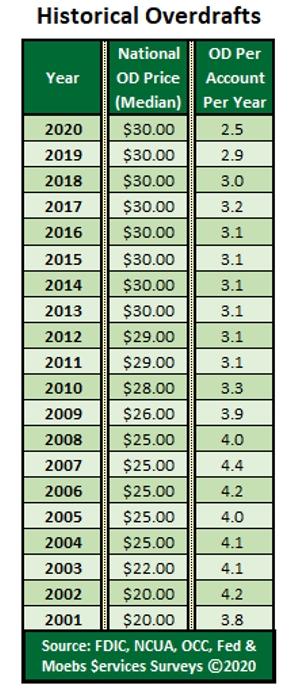
“The price for an overdraft is determined by eight factors, which are price, volume, cost, relationships, regulation, competition, value and risk. All of these pricing elements have changed, altering the price and tumbling OD revenue last year by $3.3 billion to $31.3 billion,” Moebs told CUToday.info.
The volume of overdrafts has continued to fall since peaking in 2007 at 4.4 overdrafts per consumer checking account, dropping to 2.5 overdrafts per consumer checking account today.
“This is over numerous ups and downs in GDP growth, from the 9/11 tragedy through the growth years until the Great Recession and ending up in the decline caused by the coronavirus,” said Moebs. “The conclusion is the OD price has gone too high.”
Lower price drives greater volume, but eliminating the fee is a big mistake, said Moebs, who pointed out the now defunct Washington Mutual tried the approach prior to the Great Recession. When Washington Mutual failed in 2008, at $183-billion in assets it became the largest failed bank in U.S. history for a number of reasons, including the collapse of the mortgage market. The bank was eventually absorbed by Chase.
Creating Some Risk
Moebs believes WaMu’s decision to do away with overdrafts also hurt its bottom line. Now, Moebs said Detroit-based Ally Bank is also creating some risk.
“By charging no fee for overdrafts, Ally bank throws its fees in disequilibrium producing uncertainty for the buyer of Ally Bank’s services now and in the future,” noted Moebs.

Ron Shevlin
Moebs $ervices’ recent survey of more than 3,100 banks, credit unions, savings banks and fintechs shows the median overdraft fee at $30. Moebs’ Functional Cost Analysis of the same 3,100 financial institutions shows the fully absorbed cost of an overdraft of all types at about $11.
“American checking account users do not know these prices nor costs but they sense an imbalance,” said Moebs. “Ally Bank has a strategic commitment to ‘Doing it Right.’ Well it’s back to the drawing board for them for doing it wrong.”
Not So Generous
Ron Shevlin, director of research at Cornerstone Advisors, told CUToday.info Ally’s move is not as generous as it appears.
“It’s not as magnanimous as it sounds as overdraft fees accounted for just 0.07% of Ally’s revenue in 2020, and the bank has never charged overdraft penalties on debit transactions,” Shevlin said. “I think other banks and credit unions will wait and see who else eliminates overdraft fees. If nobody blinks, the issue goes away. But if a few make the move, there will be a rush, because no one will want to be the last financial institution with overdraft fees.”
If changes do occur within the overdraft market, Shevlin think some institutions will adopt a program akin to what Chime does.
“Chime lets customers overdraw up to a certain dollar limit for a certain period of time,” he said. “Another alternative is a small-dollar loan program. It will put pressure on the financial institutions to develop or deploy analytical capabilities to better predict the propensity to overdraw.”