

ISLAMABAD, Pakistan–The man who led the World Council of Credit Unions’ project in Afghanistan and who later went into hiding before being captured and interrogated by the Taliban, is now in Pakistan with his family and hoping to restart his life with credit unions in Wisconsin.
The Wisconsin Credit Union League has agreed to cover the costs related to travel for Bashir Mohammad Khan and his family to come to the United States, with the only remaining issue being approval of visas for the seven family members. Khan told CUToday.info the U.S. embassy has the family’s passports and documents and each day he is hopeful approval will finally be received.
Sen. Tammy Baldwin’s (D-WI) office has also been involved in the effort to bring Khan to the United States.
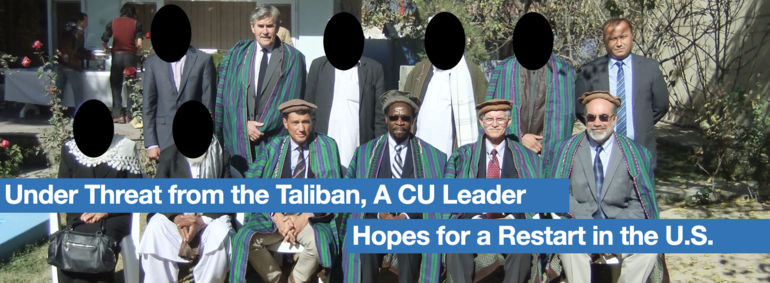
Participants in meeting of IIFCs/credit unions in Afghanistan. Note that some faces have been hidden to protect those individuals.
Khan served as the CEO of the credit union trade association in Afghanistan, the Islamic Investment & Finance Cooperatives Group, which during the time the United States had a major presence in the country was a direct member of the World Council of Credit Unions. Through its Rural Finance and Cooperative Development (RUFCOD) program, WOCCU worked on several finance and cooperative development programs from 2004-12 with local communities in the country as it sought to establish a national system of credit unions, known as Islamic Investment and Finance Cooperatives (IIFCs).
The trade association was a distribution point for funding provided by USAID, and it also provided technical support and oversaw operations and supervision for what were at point cooperatives that served more than 116,000 members.
No Chance of Returning
Speaking to CUToday.info from Islamabad, Pakistan, Khan made clear returning to Afghanistan is not an option.
He described his life as one of “two parts”: before and after the collapse of the Afghan government following the exit of the United States from the country and the subsequent takeover by the Taliban.
Khan helped to develop what is known as Islamic banking, or Shariah-compliant finance.
Under Islam, “you are not allowed to charge mark-up or interest. But you can sell it. For example, you buy a pen. You buy it for $1 but you sell it for $1.50. You ask that person to return the $1.50 in six months or a year,” Khan explained. “That 50 cents is your profit. That is how you cover your costs.”
Khan said he joined WOCCU on March 1, 2010 as part of a USAID project in the country on which he was engaged for three years and seven months. In the subsequent years he continued to lead the effort, but by 2020 he had concluded he had no choice but to leave the country.
As late as 2021, the World Council said it was in contact with the IIFCs in the country as conditions continued to worsen, as CUToday.info reported here.
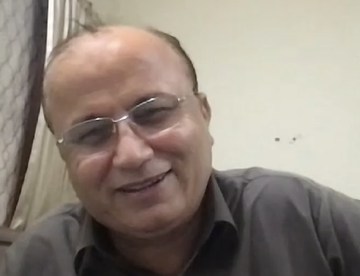
Bashir Mohammad Khan speaking to CUToday.info from Pakistan.
Still Leading Effort
Khan said he continues to lead the organization from Pakistan and that technically the IIFCs/CUs in the country still exist.
Technically, “we still have 27 credit unions in Afghanistan, but the situation is not right,” he said, noting that at one point there were 31 IIFCs operating in 17 Afghan provinces. “We had a huge portfolio. At the beginning the situation was good for me and my staff. We were frequently traveling to the credit unions and everything was going well. But after 2014…the security situation deteriorated and I limited my travel to the credit unions in the provinces.”
Threats Received
Khan said he also began receiving “threats off and on, different kinds of phone calls and messages,” and that on two occasions—once in Helmand Province and once in Jalalabad—attempts were made on his life.
“Luckily, I survived. I was told not to move a lot, to stay in Kabul and to control everything from Kabul,” Khan said. “I was frequently changing my route to the office, changing my phone number. At one time I was not going to the office or I was changing my times at the office.”
Khan said that at their peak Afghanistan’s IIFCs/CUs were financially sound and that when there were issues the association provided assistance, including through its training department. On occasion, he said credit union reps would come to Kabul for meetings, including board members.
“I was really close to them and together we worked very hard,” Khan said.
‘A Lot of Money for Us’
During the time World Council was still involved directly with the IIFCs and when the situation in the country was more stable, Khan said the organization received $18.6 million in funds to support its fledgling credit unions.
“That was a lot of money for us. We didn’t go anywhere else to apply for a loan for financial support,” Khan said. “Our situation compared to other institutions in Afghanistan was quite good and strong. We were moving forward. The end goal was to make them very, very strong. We were the second largest in Afghanistan in terms of portfolio and also outreach…
“We were supporting farmers and small businesses and later on we introduced another portfolio in consultation with the credit unions and that was to support government employees, because at that time they were not receiving their salaries,” he continued.
In northern Afghanistan, which is famous for its carpets, Khan said the IIFCs launched a separate product for carpet-weavers that included loans. “The goal was to support the people and to make them financially sound,” Khan explained.
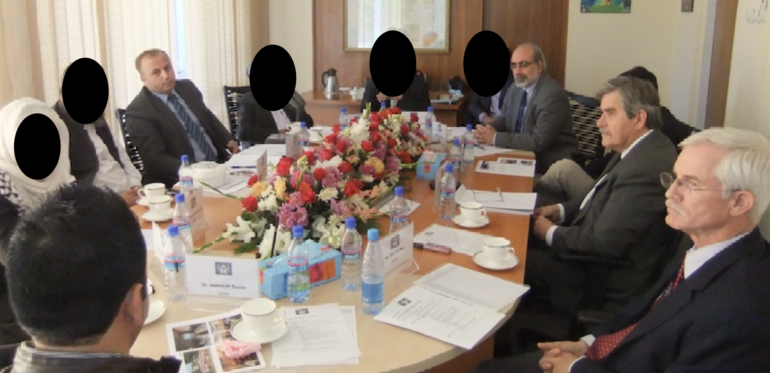
A meeting of Afghanistan's IFCC/CUs held in that country. Note that some faces have been hidden to protect identities.
More Challenges
But again, as he noted, the security situation in the country post-2014 created numerous challenges, with Khan saying the Islamic Investment & Finance Cooperatives Group began to consolidate its operations into cities as it sought safety.
And there were additional problems.
“We had government issues; government support was not there. We had regulation issues. And they were not allowing women to participate in these programs. We provided them with training,” Khan said. “We were still going forward and off and on. I was reporting to World Council about our activities.”
But after the U.S. pullout and the collapse of the government on March 15, 2021, an already difficult situation became almost impossible, according to Khan.
“The first few months actually went very well,” he said. “We (asked the Taliban), ‘What should we do now?’ They said ‘You are not allowed to operate until further notice.’ Then we waited and they did not say anything.”
But that bleak operating landscape took a turn for the worse when one man considered a terrorist by the United States was killed in a missile attack. From that point on suspicious fingers were pointed at anyone who had previously worked with the Americans, Khan said, with the Taliban demanding to know who was providing information on hideouts and certain people’s locations.
Held by the Taliban
“I don’t know how they found my address, but they came after me and they took me with them for two days. I don’t know what the location was,” Khan shared. “They were asking different questions about my relationship with the World Council, about the project we implemented and also about my relationships with Americans and what the motive was behind this project and why it was launched. In Helmand, we implemented this hearts and minds (program). We wanted to gain people’s support. We invested in Helmand. They were asking many questions about this.
“My response was the same: it was a normal project and we enhanced people’s financial capacity,” he continued. “My house was searched two times. A lot of documents were taken. Luckily, I knew this would happen to me, so I had reformatted my computer. I kept the most important documents somewhere else. After two and a half days they came to me and said, ‘OK, fine, we know that you still have connections with (the Americans) and talk to them and that you do this and that. We also know that you will leave Afghanistan soon.’ I denied everything. I said I will not go anywhere. This is my country and I will stay here.
“They found many people who worked with Americans,” Khan continued in his interview via video link with CUToday.info. “I don’t know how many are still in their custody and what will be their situation. It is not clear. There were a lot of projects that received funds from USAID. The situation is not right for those who worked with Americans.
A Demand for Money
“Then they came to me and said, ‘You earned a lot of money working with them. You were running an American project and you have money.’ I said I don’t have money, the money is with credit unions, actually. They have the money. OK, on a monthly basis I received something to run my operations.’ Then they said, ‘If you don’t accept this we will arrest you and your managers and we will create problems for your staff.’ I said, ‘OK, what can I do for you? You tell me.’ They said, ‘OK, money.’ I said, ‘Tell me how much you want.’
“At the beginning they were asking for 500,000 U.S. dollars. I said we do not have that much money. Whatever we had was at the credit unions and for one and a half years we were not allowed to operate. We had to cover our costs. Money was not available,” Khan continued. “I told them many times we can’t do this, we don’t have it, this is hard for me. Then they agreed to one-hundred-twenty-thousand U.S. dollars and they gave me time to prepare this money. It was very hard. I disposed of some of the assets in the office. I borrowed money from my friends and relatives. I arranged that money for them and then I was allowed to leave the country. They said, ‘OK, you can go and you cannot come back.’ I said, ‘OK, I will not return.’ I crossed the border on 5th of January 2023 and I reached Islamabad.”
Khan, who had been in touch with Brian Branch, who was CEO of the World Council during the implementation of the project in Afghanistan after Branch had retired, said he did not provide Branch with updates, informing him later of what was going on.
Khan said he had been told clearly that he has “connections to Americans, I spy for Americans. My presence in Afghanistan would be too risky.”
This is Not Right
The claims made by the Taliban today are not truthful, according to Khan.
“One thing is very clear,” said Khan. “They say they are not taking bribes but this is not right. They take bribes. There are corrupt people, as well. They are after those who were running American projects. They are trying to find them and arrest them and receive money from them. I don’t know what will happen with them. A few months back a lot of drone attacks happened in Kabul. They believe (we) were the people providing the information.”
Khan said he will not be returning to Afghanistan.
“If I were there I could be killed. I am so sure. They found a lot of information on our project. It was a big project. It supported more than 100,000 members. We had 24,000 borrowers,” Khan said.
The Fate of Credit Unions
So, what has happened to the IIFCs/credit unions?
“They exist. I oversee them from Islamabad. But they are not allowed to operate. They all have financial issues. They don’t have money,” he said. “If they are to start their operations again they will be needing financial support. Without the Taliban’s permission they cannot do anything. They have used up their portfolios to cover their operational costs. We had more than 300 staff. We were giving them monthly salaries. We were covering other costs. Rent. Taxes. Whatever credit unions had they used up that money.”
The Fate of Member Savings
And what has become of the members’ savings in the IIFCs/credit unions? According to Khan, in most cases members had their savings returned to them. But it’s also been a very fluid situation.
“(Many) people have left the country, and if not the country they have migrated from one province to another province. Financial conditions are very tough. Jobs are not there. Salaries are not there. The situation is very bad. The people are broke.”
As for the credit unions themselves, Khan said in the latter years it was an increasingly difficult to find financial institutions in which the IIFCs themselves could place their funds.
“All of them had bank accounts, but banks in Afghanistan also have a lot of issues,” Khan explained. “The banking sector is in a crisis. They don’t have money.”
Few Options Available
For the average Afghan, there are few if any financial services options available now, not that there is much demand.
“Unemployment is very high. Jobs are not there. They don’t even pay salaries to the teachers,” Khan said. “Conditions are very, very bad for all Afghans. Projects are not there. Everything is stopped. In Islamabad, you see a lot of Afghans. Many are trying to do their best to leave the country. Schools are not there. Colleges are not there. Banks are not there. Money is not there to support them.”
Where does the average Afghan keep whatever money they may have?
“They keep the money at home,” Khan responded. “Banks cannot be trusted. It would be hard to get the money back. If they learn you have money they come after you.”
Security Concerns
Khan said some Afghan credit unions while still operating kept money inside their own operations, despite the security risks, as they did not trust banks to return the funds. Those CUs were instructed to have a security guard in place.
Other credit unions found little alternative but to keep money with hawala dealers, a money transfer method that takes place outside the traditional banking system and requires a minimum of two Hawala dealers (or hawaladars) that take care of the “transaction.’” The hawala system in Afghanistan is often the only financial services available.
“But even hawala dealers are not trustworthy. But there is no other option. If you keep money in the bank it can be hard to get it back,” Khan stressed again..
Taliban Still Asking Questions
According to Khan, the Taliban continue to visit with those associated with credit unions—even though they are not operating—and to ask questions.
“The people running these credit unions are also at risk. I have been in touch with them. I have told them to remain as low profile as possible; don’t talk a lot with these guys,” he said.
In some instances IFCC/CU reps have gone and met with those who are delinquent on loans, but Khan said he has urged that that practice stop. “I tell them not to complain, because when you go there they will start asking questions. Who are you? Do you have a license? Where did you get the money from?”
Now Awaiting Word
Today, Khan said he is anxiously awaiting the visas for himself and his family to relocate 7,000 miles away to Wisconsin. He selected the Badger State based on his relationship with Branch, whom he said was “not just my supervisor but my friend.”
He especially dreams of a better life for his five children.
“I have three daughters who were not allowed to go to school. The priority is to get them educated,” said Khan, whose children are 20, 16, 14, 11, and six. “Women’s rights, there is nothing. They don’t respect women. They don’t allow them to work. They don’t allow them to go to school. I really want my daughters to get educated, my sons as well.”
Khan is hopeful of finding work at one of Wisconsin’s credit unions.
“I will try my best to work in Wisconsin. If I can find a job in … credit unions, that would be good. Hopefully, I will find a job there,” he said.
Two Different Futures
Will credit unions ever return to Afghanistan? Khan is pessimistic.
“The future of credit unions in Afghanistan is not really bright,” he said. “We don’t know what will happen.”
But there is one thing he is optimistic about.
“Now, I am waiting my turn to go to America,” he said.
Wisconsin’s CUs Provide Assistance
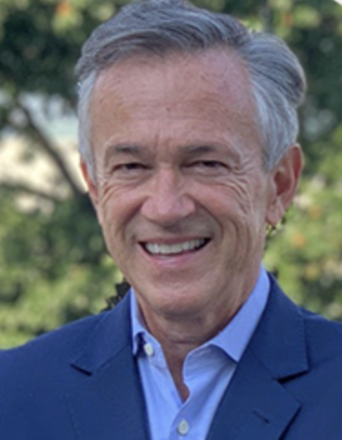
Brett Thompson, WCUL
Brett Thompson, president and CEO of the Wisconsin league, said the league is happy to be able to help cover the cost of airline tickets for Khan to come to the United States, an expense likely to be in the $20,000 range.
In addition to Wisconsin being the long-time home of the World Council of Credit Unions, Thompson noted some Wisconsin credit unions also had worked with the IIFCs/CUs in Afghanistan, and that the state’s military bases were also a temporary home to Afghans who were evacuated to the United States when the Taliban seized power. Some credit unions worked with those displaced individuals as they transitioned to life in this country.
Thompson said he learned of Khan and his family through Branch.
“We're really pleased to have an opportunity to potentially help this family,” said Thompson. “Bashir has an interest in establishing his home here in Wisconsin and so it seemed to be appropriate for us to step forward.”
Thompson said he is hopeful Khan will be able to find a position with a credit union in Wisconsin.
For now, Thompson said he empathizes with the plight of Khan and his family.
“I can imagine that in being on the other end of this, time must really hang for them.”
A Lifetime Investment
Similarly, Branch said he looks forward to Khan’s arrival in the U.S.
“Bashir invested his life’s work in the provision of service to his community through credit unions,” said Branch. “It is a relief to see him and his family escape persecution and come to the U.S. and again embrace the credit union ideal of service to our community.”
Those interested in potentially providing assistance to Khan and his family can reach Brian Branch at Bbranch007@gmail.com.