ST. PETERSBURG, Fla.—Credit card spending continued to rebound and the use of contactless plastic surged, according to the latest data from PSCU.
PSCU’s Advisors Plus and Data & Analytics teams have released payments data comparing the 38th week of the year (the week ending Sept. 20, 2020 to the week ending Sept. 22, 2019).
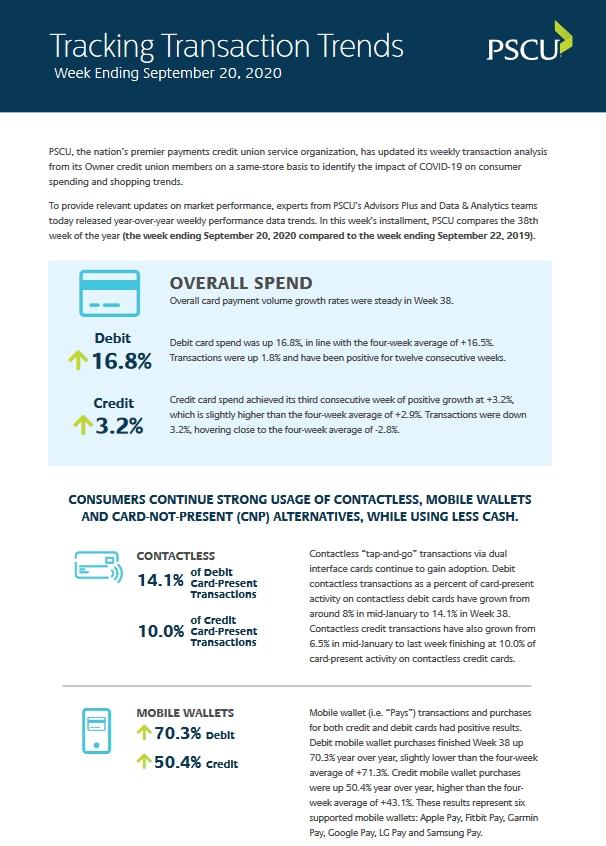
Card Payment Volume
Overall card payment volume growth rates were steady in week 38, PSCU said.
- Debit card spend was up 16.8%, in line with the four-week average of +16.5%. Transactions were up 1.8% and have been positive for 12 consecutive weeks.
- Credit card spend achieved its third consecutive week of positive growth at +3.2%, which is slightly higher than the four-week average of +2.9%. Transactions were down 3.2%, hovering close to the four-week average of -2.8%.
Contactless Cards
Consumers continue strong usage of contactless, mobile wallets and card-not-present (CNP) alternatives, while using less cash, PSCU said.
Among the findings:
- Contactless “tap-and-go” transactions via dual interface cards continue to gain adoption. Debit contactless transactions as a percent of card-present activity on contactless debit cards have grown from around 8% in mid-January to 14.1% in week 38. Contactless credit transactions have also grown from 6.5% in mid-January to last week finishing at 10% of card-present activity on contactless credit cards, PSCU said.
- Mobile wallet transactions and purchases for both credit and debit cards had positive results. Debit mobile wallet purchases finished week 38 up 70.3% year over year, slightly lower than the four-week average of +71.3%. Credit mobile wallet purchases were up 50.4% year over year, higher than the four-week average of +43.1%. These results represent six supported mobile wallets: Apple Pay, Fitbit Pay, Garmin Pay, Google Pay, LG Pay and Samsung Pay.
More CNP Volume
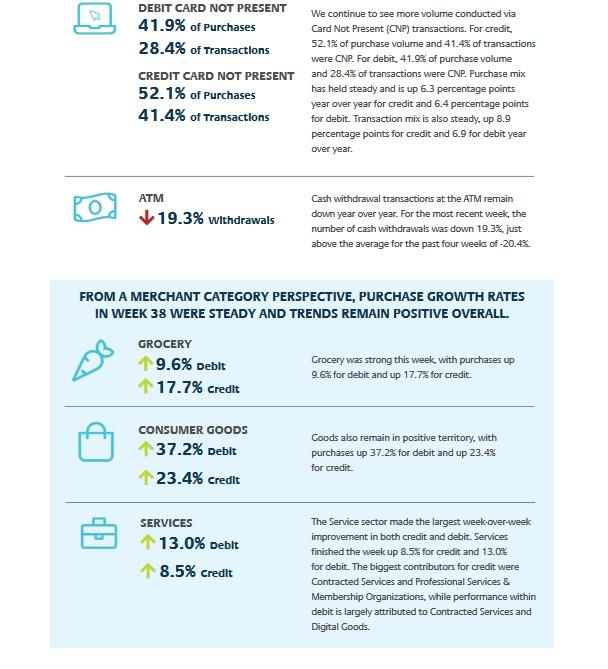
“We continue to see more volume conducted via Card Not Present (CNP) transactions. For credit, 52.1% of purchase volume and 41.4% of transactions were CNP. For debit, 41.9% of purchase volume and 28.4% of transactions were CNP. Purchase mix has held steady and is up 6.3 percentage points year over year for credit and 6.4 percentage points for debit. Transaction mix is also steady, up 8.9 percentage points for credit and 6.9 for debit year over year,” PSCU said.
The company noted cash withdrawal transactions at the ATM remain down year over year. For the most recent week, the number of cash withdrawals was down 19.3%, just above the average for the past four weeks of -20.4%.
Merchant Spend
According to PSCU, from a merchant category perspective, purchase growth rates in week 38 were steady and trends remain positive overall.
Among the trendlines:
- Grocery was strong this week, with purchases up 9.6% for debit and up 17.7% for credit.
- Goods also remain in positive territory, with purchases up 37.2% for debit and up 23.4% for credit.
- The services sector made the largest week-over-week improvement in both credit and debit. Services finished the week up 8.5% for credit and 13% for debit. The biggest contributors for credit were Contracted Services and Professional Services & Membership Organizations, while performance within debit is largely attributed to Contracted Services and Digital Goods.
Regional Spend
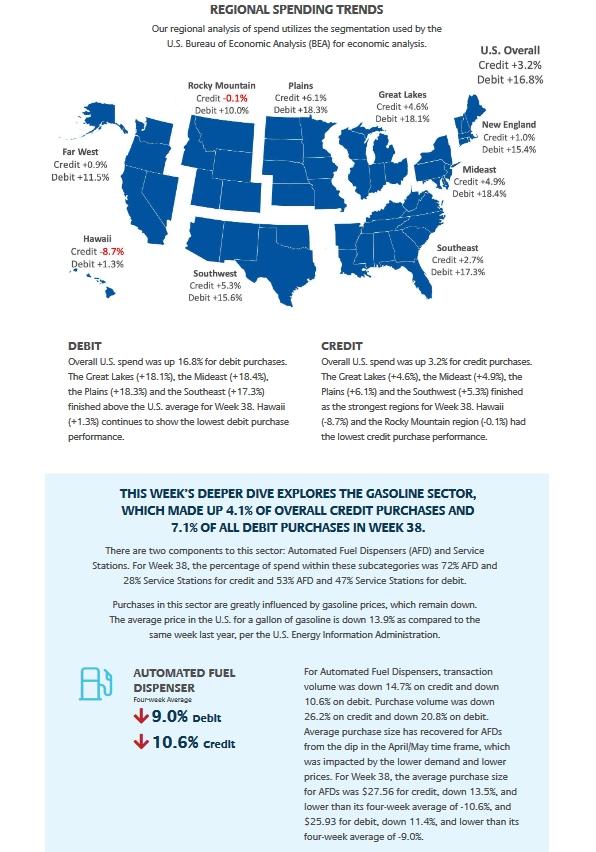
Regional analysis of spend utilizes the segmentation used by the U.S. Bureau of Economic Analysis (BEA) for economic analysis, PSCU said.
The company noted:
- Overall U.S. spend was up 3.2% for credit purchases. The Great Lakes (+4.6%), the Mideast (+4.9%), the Plains (+6.1%) and the Southwest (+5.3%) finished as the strongest regions for week 38. Hawaii (-8.7%) and the Rocky Mountain region (-0.1%) had the lowest credit purchase performance.
- Overall U.S. spend was up 16.8% for debit purchases. The Great Lakes (+18.1%), the Mideast (+18.4%), the Plains (+18.3%) and the Southeast (+17.3%) finished above the U.S. average for Week 38. Hawaii (+1.3%) continues to show the lowest debit purchase performance.
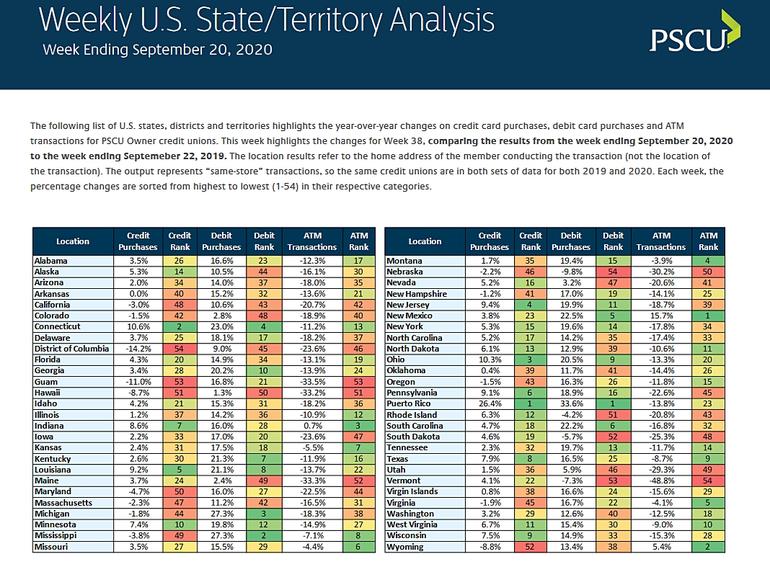
- PSCU’s Weekly U.S. State/Territory Analysis is available at www.PSCU.com/COVID19, ranking U.S. states and territories by year-over-year performance for debit purchases, credit purchases and ATM transactions.
Gasoline Spend
PSCU’s “deeper dive” for the week looked at the asoline sector, which made up 4.1% of overall credit purchases and 7.1% of all debit purchases in week 38.
“There are two components to this sector: Automated Fuel Dispensers (AFD) and Service Stations. For week 38, the percentage of spend within these subcategories was 72% AFD and 28% Service Stations for credit and 53% AFD and 47% Service Stations for debit,” PSCU said.
According to the company:
- Purchases in this sector are greatly influenced by gasoline prices, which remain down. The average price in the U.S. for a gallon of gasoline is down 13.9% as compared to the same week last year, per the U.S. Energy Information Administration,” PSCU said.
- For AFDs, transaction volume was down 14.7% on credit and down 10.6% on debit. Purchase volume was down 26.2% on credit and down 20.8% on debit. Average purchase size has recovered for AFDs from the dip in the April/May time frame, which was impacted by the lower demand and lower prices. For week 38, the average purchase size for AFDs was $27.56 for credit, down 13.5%, and lower than its four-week average of -10.6%, and $25.93 for debit, down 11.4%, and lower than its four-week average of -9%.
- For Service Stations, transaction volume was down 2.6% on credit and down 1.3% on debit. Purchase volume was down 0.3% on credit and up 5% on debit. Average purchase size in Service Stations has remained remarkably consistent throughout 2020. For week 38, Service Station average purchase size was $18.93 for credit, up 2.4% and higher than its four-week average of +0.5%, and $14.31 for debit, up 6.4% and higher than its four-week average of +5.8%.
- “Ultimately, while members are buying the same quantity of gas when they visit the gas station as they did earlier in the year (especially given the impact of the drop in fuel prices), the frequency of purchases has changed. Over the last four weeks, gasoline transactions on average are down 8.9% for credit and down 2.7% for debit,” PSCU said.
- For 2020, credit cardholders appear to pay more often at the AFDs (65%) versus inside the Service Station (35%) and debit cardholders appear to favor in-store Service Stations (62%) versus AFDs (38%).
Continued Rebound
“We saw solid performance overall in week 38, with notable continued strength in contactless debit,” said Glynn Frechette, SVP, Advisors Plus at PSCU. “Credit card spend continued to rebound, achieving its third straight week of positive growth – 10 straight weeks of growth if removing travel. We’ll continue to monitor this trend closely, as the extent to which consumers start using credit for living expenses could serve as an economic indicator. Meanwhile, the Gasoline sector, which we explore in this week’s deeper dive, remains notably down as consumers are traveling and commuting to work less frequently. ”