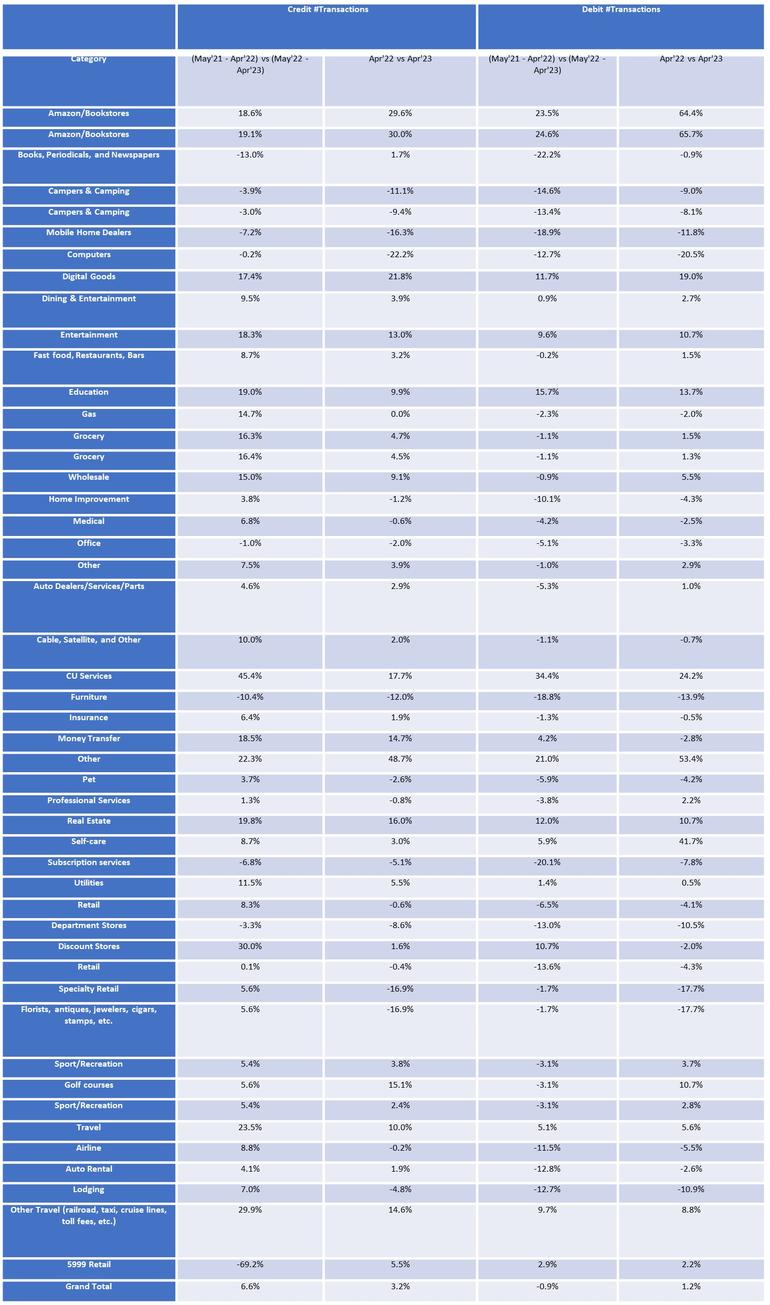
RANCHO CUCAMONGA, Calif.—After strong card spending by credit union members during March, there was more “muted” spending activity during April, according to new data released by Co-op Financial Solutions that show a pivot to debit on certain purchases and the ongoing shift in delivery and subscription models.
While nonfarm payrolls again grew in April, continuing the pattern of job growth,the consumer confidence index fell in April to its lowest level since July 2022, noted Co-op, citing “deep uncertainty” related to several bank failures and rising interest rates, the company said.
“Overall, Co-op spending data reports that April year over year transaction volume was up slightly across both the debit and credit portfolios.
Co-op said its SmartGrowth consultants are closely watching the following key spending trends:
Consumers Seeking Discounts on Everyday Goods
After more than a year of rising inflation, consumers are pulling back on their everyday grocery and retail spending, seeking out deals wherever they can, Co-op said.
“Even though grocery prices were down 0.3% in March and 0.2% in April, they remain more than 7% higher than a year ago,” Co-op said.
It pointed to PYMTS data that indicate the trend has led to four out of five shoppers taking at least one cost-cutting measure such as reducing the quantity or quality of the goods they purchase.
“Consumers are reserving their hard-earned dollar to spend on staples in lieu of luxury goods,” said John Patton, Co-op senior payments advisor. “We expect discount stores, along with generic grocery and household brands, to continue to do well as long as this economic uncertainty lingers.”
A Pivot to Debit On Amazon Purchases
Amazon spending grew year over year across both Co-op’s client credit and debit portfolios, according to the company, which said the growth was much sharper in debit with an increase of 65.7% from April 2022 to April 2023, compared with just 30.0% in credit.
“We’re seeing a mindset shift in how shoppers are using debit online,” said Beth Phillips, director, Co-op Solutions. “As Co-op’s latest research with Mastercard shows, consumers that fit a ‘budgeter’ profile tend to use credit more than debit. But this recent trend in Amazon spending highlights that recent economic trends – coupled with a growing comfort level in using debit online – is beginning to infiltrate across multiple member personas, including those with budgeter and non-budgeter behavior tendencies.”
Credit Balances Continue to Rise
“More broadly, cash-strapped shoppers are increasingly allowing their credit card balances to carry over from month to month,” noted Co-op in releasing the data.
It cited data from the Federal Reserve, showing annualized revolving debt grew by 17% in March 2023, a big jump from February’s 5.7% gain.
“Co-op’s proprietary data aligns with this trend. Following small declines in total credit card balances at the start of the year, Co-op customer credit balances restarted their upward ascent in March and April, rising by 1.13% and 2.38%, respectively,” Co-op said.
Year over year, credit balances were 15.13% higher in April 2023 than April 2022, it reported.
Subscription & Delivery Models Begin to Shift
Co-op noted that more than three years after the beginning of the pandemic, online delivery services have become part of the “fabric of modern consumerism,” with DoorDash reporting 40% revenue growth in the latest quarter, spurred by increases in both total orders and order value.
“Meanwhile, despite recent reports of subscribers dropping off of Netflix and other major streaming services, this segment of the subscription universe continues to out-perform,” the company said.
It further cited data from Warner Bros.’ direct-to-consumer unit, which includes the popular Discover+ and HBO Max services, as reporting the addition of 1.6 million subscribers in the first quarter of 2023.
“Services like subscriptions and food delivery that really took off during COVID-19 are continuing to do well,” said Patton. “Consumers have gotten used to the convenience of ordering online from the comfort of home, and are willing to pay a little more for these services.”
What Credit Unions Should Do Now
According to Co-op, credit union members are faced with multiple economic headwinds, including high prices for groceries, gas and rent, rising interest rates and an uncertain job market.
“Many credit union members are struggling to meet their loan obligations alongside their monthly household needs,” the company said. “Credit unions are in a unique position of trust to support their members through these turbulent times ahead. Credit unions should begin by offering members low-rate incentives to transfer their high credit balances to the institution’s card. With lower average rates than most bank-issued cards, credit unions have a strong value position and positive story to tell.”
In addition, Co-op said a robust rewards program is also important.
“So, now is a good time for credit unions to conduct a review of their current loyalty program to see if it is meeting members’ needs,” according to Co-op. “Determine, for instance, if cash back is a more compelling offer than travel rewards in the current climate. In addition, consider developing a relationship rewards program as a way to entice members to move their deposit accounts, mortgages, installment loans and other key products to their credit union.”
Additional Advice
Finally, Co-op advised credit unions to “dig into” member data to analyze which relationships are struggling, looking at key warning signs like late credit card or loan payments, high revolving balances, or an increased incidence of overdrafts on checking.
“Identify these members and proactively reach out to them to offer advice and recommendations to help them achieve their financial wellness goals,” Co-op said.