

By Ray Birch
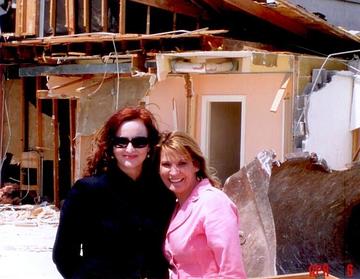
L-R: Gulf Coast Community CEO Lisa Graham and former CFO Tammy Barrett in front of the CU’s Pass Road office after Katrina struck.
GULFPORT, Miss.—No matter the years that pass following the devastating punch delivered by Hurricane Katrina to the Gulf Coast on Aug. 29, 2005, Debbie Pidek says she won’t forget what she witnessed and experienced 10 years ago.
“It was unbelievable, like a war zone,” said Pidek, EVP of communications and CCO at the $87-million Gulf Coast Community FCU here, the same positon she held when Katrina struck. “It was a very difficult time for months following the storm. You would drive to work and see things like a washing machine in the middle of a highway. It seemed unreal. If you were not here you cannot imagine the depth of the destruction and how it impacted everything—all aspects of your life—for a long time.”
With Katrina a decade in the rear view mirror, Pidek and others within the credit union community who experienced Katrina’s wrath say they are trying to forget an event that changed the Gulf area and, to some extent, credit unions there.
“The cities affected, despite the terrible times, have come back to be even better than before,” said Pidek, talking about the rebuilding and palpable sense of community that was created following the storm. “Credit unions, too, are stronger.”
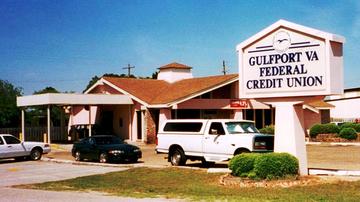
Gulf Coast Community's Pass Road office before Katrina.
Pidek and others told CUToday.info that shared branching now plays larger role in their operations, thanks to Katrina. And the solid image of credit unions was lifted higher in how they served their members and communities with not personal assistance, with special loans and loan deferrals to help members struggling to keep their lives together, by opening just days after the storm, and by finding creative ways to get money and services to members—often when banks were not even open. They say CUs came away from the disaster looking good to consumers.
CUs Build Image
With credit unions’ image not damaged by the storm, neither was membership, to any large extent, sources stated—not even during 2005 when many people had to leave the New Orleans and affected areas, some never returning.
Looking back, Pidek recalled how Katrina devastated the Gulf Coast with 174-mile-per-hour winds plus the highest storm surge ever recorded on the U.S. coast, claiming 1,833 lives in its path.
“As an example, the surge was recorded at 27.8 feet in Pass Christian, Mississippi, which is in Harrison County. Because the surge traveled so far inland, areas that had never before flooded did so,” said Pidek. “In the coastal Mississippi area, it’s been reported that all our towns flooded over 90% within a matter of hours, so you can imagine the kind of havoc that type of flooding could wreak.”
At that time Gulf Coast Community had three branches, two in Gulfport in Harrison County and one in Bay St. Louis in Hancock County. The Bay St. Louis Branch received heavy water damage from the storm surge that flooded the office.
“Our Pass Road branch in Gulfport, which was located less than two miles from the beach, was completely destroyed by wind damage,” said Pidek. “Since Pass Road is one of the area’s main east-west arteries, this was a very busy branch and in fact, had served as our main office until the December before Katrina when we moved our administrative staff to our Orange Grove branch where we are now.”
Heavy Wind Damage
The Orange Grove office is in the northernmost area of Gulfport, a little over nine miles from the beach. That branch sustained heavy wind damage, especially to its roof, which let rain water in.
“But we were able to open and serve members within two days of the storm, despite the lack of power and communication channels,” said Pidek. “Both land lines and cell towers were down so communicating with our staff was extremely difficult – we actually posted handwritten signs on the building telling any employees who were able to report to work. Because our data center is located in another state, we were able to provide real-time balances for members as soon as the power company restored our electricity.”
Lacey Hyer, VP of communications and public relations at the Louisiana CU League, said that despite damage by Katrina to 16 credit union offices, credit unions in the affected areas opened as best as they could and pulled together to help each other. Credit unions loaned each other mobile branches, while CUs in nearby cities opened doors to Gulf Coast CUs to work in offices that had remained out of harm’s way.
“When we evacuated there was this uncertainty and fear,” said Hyer, who in 2005 worked for the state’s shared branching network, joining the league a year later. “You were uncertain about your home, would it still be there and in what condition, and you were uncertain about your finances. Credit unions were there to help so many members get past these fears.”
The league evacuated, leaving its Harahan, La. headquarters for Baton Rouge, where many people relocated. The league worked out of an office at a credit union for just under two months and returned to find its main location untouched by the storm.
Unsure Of What's Left
Hyer was not sure what she would return to after she left her New Orleans-area home.
“The media made it seem like our city had been washed away completely with no chance of returning. They made it seem like our beloved city was simply a memory, that it would never recover. But we did,” said Hyer about a storm that led to an estimated at $108 billion in damage. “We’ve seen some changes since 2005, but the tradition, the culture, and the energy of New Orleans remains intact. Fortunately, my home was not damaged. We were displaced for about two months, but came home to just a few downed tree limbs in our front yard and no electricity. Other family members had lost everything, so they were staying with us and we helped them rebuild. We were one of the fortunate ones in that aspect.”
Back in Mississippi, Pidek recalled how so many members lost their homes, with a significant number underinsured or not insured for the flood damage. She said that led to a number of older members, who before the storm no longer had a mortgage, eventually having to take out a home loan for the first time in years.

Katrina floodwaters destroyed New Orleans Firemen’s FCU's Downman Road branch.
Mick Haupt, IT manager at the $158-million New Orleans Firemen’s FCU, recalled that only one of the five locations the credit union operated in 2005 was damaged significantly by Katrina.
“The Downman Road office in New Orleans East was devastated and never reopened,” said Haupt. “Our main office in Metairie got some water damage. It’s our main center, but it stayed open.”
Members Never Left
Gulf Coast Community said that it has never noticed any significant membership decrease related to Katrina, sentiments echoed by the league and Firemen’s FCU.
“Our membership remained fairly steady in the years immediately following Katrina but in the past five years we’ve had very positive membership growth,” said Pidek. “We believe our area has recovered for the most part, although many of our members are still affected financially. Those who lost homes who did not have insurance have loans for the repairs or new mortgages and everyone in South Mississippi has much higher wind insurance as well as flood insurance. I know a lot of people left, but population statistics show most have come back.”
Firemen’s FCU said its asset size grew following the storm, with deposits coming in from insurance payments.
“I don’t recall a drop in membership at all,” said Haupt, attributing some of that to the fact that the CU had enough locations to serve members as they left New Orleans. “And not long after Katrina we picked up our sixth branch at the time, and it was situated in an area where a lot of New Orleans residents moved to.”
Keeping members in the fold, too, said Hyer, had a lot to do with the reach of the shared branching system in the area—which added 21 new shared branch locations within 48 hours of the storm.
“CU membership totals in the state are 1.23 million today, up from 1.1 million in 2005,” Hyer said. “Average loan balances have jumped from $7,300 in 2005 to $10,500 today. As a movement here we may have taken a hit in the first few months after Katrina, but we picked things up.”
In its wake, Katrina did bring some good to the Gulf and its credit unions. Hyer believes the importance of shared branching was emphasized by the storm, playing a big role in Louisiana bringing its shared branch total to 150 today, well over double the number in 2005.
“Shared branching has become an important component of credit union disaster preparedness planning here,” said Hyer.
Hyer, Pidek and Haupt all said CU disaster recovery planning improved since 2005. Pidek said Gulf Coast Community runs mock disaster recovery drills annually and managers all have satellite phones in case land lines and cell towers go down.
Haupt said a personal benefit was being able to spend more time with his brother, who died unexpectedly four years ago.

Lacey Hyer, LCUL
“So I look back on Katrina with somewhat mixed emotions,” said Haupt. “After Katrina hit I had to go live with my brother in Baton Rouge for eight months. Today I am glad I was able to spend that time with him, something I would not have done if Katrina did not happen.”
Putting Bad Times Behind
Pidek said Gulf Coast Community’s business is better than ever.
“We are more than 100% recovered,” said Pidek. “We’ve done beautifully since the storm. The lending program is great, business is strong, and we have a new downtown branch and expanded call center.”
Pidek dug through a small collection of post-Katrina images that are left. She said there are more somewhere around the credit union, but no one is really spending much time these days keeping track of them.
“We probably do have more photos of the destruction stuck away somewhere, but honestly, it was such a traumatic time that we weren’t thinking much about photographing things,” Pidek told CUToday.info. “And we are very, very happy that Katrina is now ten years behind us.”