

By Frank J. Diekmann

By now even the cooperative Luddites among us have witnessed, and many more of you have invested in, the evolution of the credit union branch and workplace.
With many transactions moving online, those expensive fixed assets—that, ironically, Millennials prize above all others--have morphed into “consultative” environments with greeters and branch “concierges” aimed more at helping members, especially with lending and problem resolution.
It isn’t just happening in credit unions, obviously. Jeff Pochepan, president of Strong Project, recently offered Inc. Magazine five office design trends to watch in 2017, including:
- The Fate of the Filing Room
Unless you work in an intensely regulated industry such as finance or healthcare, you may have noticed more companies and departments are transferring physical files to the cloud. “As paper filing and storage give way to digital, you may find yourself with a large, empty area. Consider creatively repurposing that space into another small conference room or huddle workspace for projects,” said Pochepan.
- Rethinking the Office Desk
As more employees reconfigure their work days to include telecommuting, remote-based work, and collaborative meetings, the number of dedicated office desks may decrease, said Pochepan. It urges companies to “perform an audit to make sure employees are not only using their desks, but that their personal work space meets their productivity and comfort levels.”
- Your New Co-Worker: Mother Nature
In 2016 companies saw a rise in the number of offices that are strategically and deeply integrating natural elements in their workplace design such as salvaged wood, water features, living walls, outdoor office extensions, Inc. reported. The new standard is now biophilic design principles, which include design elements that have demonstrably real, measurable benefits for human performance metrics, such as productivity, emotional well-being, stress reduction, learning, and healing, according to Terrapin Bright Green. For example, Kickstarter's headquarters in New York renovated an old pencil factory into a space that includes a natural courtyard and an edible rooftop garden.
- Time to Collaborate Better and Faster
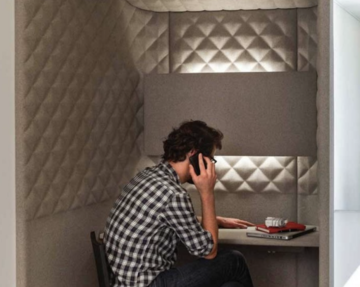
When it comes to collaboration and team meetings, diversity is key, according to Pochepan, and not just among the company, but among the collaborative furniture options available. If you have small meetings of two to six people, you can easily implement an acoustic furniture pod in the middle of your open office, for instance, he noted, adding that commercial workspaces are finding a way to blend acoustic seating and collaborative furniture while simulating the relaxed atmosphere of an employee lounge.
- Shape Up With New Seating Options
“Imagine how different the conversations would go in a company meeting if you had one area of round, low seating which created an equal playing ground for all involved,” Pochepan said. For example, Google's London headquarters did, using a giant semi-circle white sofa. “More than ever, offices must inspire and invite employees to do their best by offering furniture that meets different work modes,” Pochepan wrote. “You can take a cue from the search engine giant and use a large sofa, or try smaller "hobbit hole" spaces such as enclaves with padded benches, acoustic couches, a long communal table for lunch or telecommuters, the modern version of old-school desk attachments to rolling chairs, and general seating that helps employees feel comfier.”
The whole story can be found here.
A Certain Somebody Is Watching

As CUToday.info reported here, in Hong Kong a startup has rolled out the Neat app, in which users are asked to enter their biographical details as well as upload a proof of address and their passport photograph, which the app scans to verify authenticity. The app then prompts users to take a selfie to verify that the applicant is actually the same individual whose picture appears in the passport,” Biometric Update explained. If the images match, the app immediately issues a virtual prepaid credit card.” Anyone who thinks that under an authoritarian government this app is about payments needs to take their new prepaid card and buy a copy of 1984.
We Find the Bank Guilty
Innovation is all the buzz in financial services, and you really must give credit to the banks for repeatedly beating credit unions when it comes to innovating new fees. Case in point: JPMorgan Chase, which has added another inconvenience to jury duty—bank fees. Bloomberg reported that in a handful of jurisdictions JPMorgan Chase has taken over administration of the juror compensation system, issuing debit cards instead of traditional paper checks.
“In addition to the juror pay, the cards also come loaded with fees—for balance inquiries, for inactivity, for using non-Chase ATMs, for charges with insufficient funds and for cash or check issuance. The funds become impossible to withdraw from an ATM once the balance falls below $20, and in at least one jurisdiction—Washington, D.C.—there are no Chase branches or ATMs within 90 miles, ensuring the funds will eventually be frittered away to the bank,” Bloomberg said.
You’ll be pleased to learn that a lawyer who served on a Washington jury last year, William Mark Scott, has sued the bank, accusing it of unjust enrichment and violation of the Consumer Protection Act.
Frank J. Diekmann is Cooperator in Chief at CUToday.info and can be reached at Frank@CUToday.info or @FrankCUToday.